
Most high-growth executives lose 12 hours every week to administrative friction that should have been automated or delegated years ago. By Q1 2026, the competitive advantage belongs to leaders who successfully hire a virtual assistant to reclaim their strategic focus. You already know that low-level tasks are the primary bottleneck to your next $1M in revenue. You’ve likely experienced the burnout of managing unreliable freelancers or the anxiety of potential data breaches that come with remote staffing. It’s frustrating to pay for help that actually creates more work than it solves.
You deserve a partnership that scales without the management overhead. This guide delivers the exact framework for finding and vetting dedicated talent who integrate seamlessly into your business ecosystem. We’ll explore the 360-degree recruitment process that filters out 98% of applicants to find the elite professionals who offer predictable monthly costs and immediate ROI. Discover how to build a secure, high-performing team that unlocks your true leadership potential.
Key Takeaways
- Stop the exhausting hiring-firing cycle by transitioning from transactional gig marketplaces to a dedicated remote staffing model built for long-term growth.
- Discover the precise framework to hire virtual assistant talent that balances specialized technical skills with the rigorous data security standards of the modern economy.
- Eliminate the vetting burden by comparing hiring models and identifying why a managed agency approach delivers higher retention and lower management overhead.
- Apply our Task Audit tool to identify exactly which responsibilities to delegate first, ensuring your new hire provides immediate ROI and scalability.
- Master the first 48 hours of onboarding with a structured communication rhythm designed to transform remote staff into a seamless extension of your leadership team.
Why the Old Way to Hire a Virtual Assistant Fails in 2026
The 2026 economy demands more than just a pair of hands; it requires a brain plugged into your vision. The old “gig work” model, where you hire virtual assistant talent on a per-project basis, creates a revolving door of mediocrity. Research from early 2025 indicated that 42% of executives felt their productivity actually decreased after hiring unvetted freelancers. They spent more time correcting errors and clarifying instructions than leading their departments. To understand the baseline of this profession, you can read more about What is a Virtual Assistant and how the role has expanded from simple administrative tasks to high-level strategic support. A dedicated VA isn’t a task-based contractor; they’re a long-term strategic partner who integrates into your business ecosystem.
Marketplaces like Upwork often trap you in a “hiring-firing cycle” that drains your energy and capital. You spend 15 hours vetting candidates only to have them leave for a higher-paying gig three weeks later. This lack of continuity forces you to restart the training process from zero every few months. The hidden costs of managing unvetted freelancers are staggering, often exceeding the actual hourly rate by 300% when you factor in lost opportunity costs and project delays. Shifting to dedicated remote staffing ensures your hire virtual assistant search results in a professional who understands your culture, your clients, and your long-term goals.
The Management Overhead Trap
New hires should provide relief, not a second job. The “Time-to-Productivity” ratio measures how long it takes for a hire to generate more value than the cost of training them. Without a managed integration process, this ratio can stretch to 90 days or more. You end up working 60 hours a week instead of 40 because you’re micromanaging a task-based contractor who lacks context. Real growth happens when you eliminate this friction through a scientific vetting process that ensures immediate operational alignment. Choosing the wrong candidate leads to a cycle of constant oversight that kills your creative momentum.
Reliability and the Ghosting Phenomenon
High-quality talent avoids the race-to-the-bottom pricing of crowded, low-bid marketplaces. When you pay for a gig, you get a gig mindset. Ghosting rates in unvetted marketplaces rose by 22% between 2024 and 2026, leaving businesses stranded at critical moments. Dedicated staff members feel a psychological ownership of their roles because they see a clear career path. They aren’t looking for the next client; they’re looking to help you scale. This commitment is the difference between a temporary fix and a scalable solution that unlocks your leadership potential and keeps your operations running smoothly while you sleep.
The Anatomy of a Vetted Virtual Assistant: What to Look For
Identify the right talent by looking past the resume. In 2026, the gap between a standard freelancer and a high-performing partner is defined by technical precision and a proactive mindset. You aren’t just filling a seat; you’re integrating a growth catalyst into your business ecosystem. The most successful executives prioritize a 360-degree vetting process that balances hard skills with the emotional intelligence required for remote leadership. When you research how to hire a virtual assistant, you’ll quickly realize that technical ability is the baseline, but work ethic is the true ROI driver. A dedicated professional with a high “ownership” score can reduce your operational friction by 40% within the first 90 days.
Security and Compliance Protocols
Protect your intellectual property with rigorous 2026 data standards. Every candidate must pass a multi-layered verification process before accessing your systems. This includes:
- Compliance Verification: Confirming active knowledge of HIPAA for healthcare or GDPR for international data handling.
- Background Checks: Using global verification services to validate criminal records and past employment history.
- Access Management: Requiring the use of tools like LastPass or 1Password to ensure you never share raw passwords.
Ensuring your team follows these protocols prevents the 60% of data breaches that stem from human error in remote environments.
The Soft Skills That Drive ROI
Shift your focus from “order takers” to “problem solvers.” A top-tier assistant anticipates needs before you voice them. They don’t just manage your calendar; they protect your time by filtering low-value requests. Communication must be brisk and purposeful, maintaining a professional edge that reflects your brand’s standards. Cultural alignment is equally vital for client-facing roles. You need someone who understands the nuances of your market and speaks with the authority of a seasoned partner. This level of dedicated support allows you to step away from the minutiae and focus on high-level strategy.
Specialized Knowledge Requirements
Stop hiring generalists for technical roles. The 2026 market demands precision. For instance, a real estate virtual assistant must arrive with mastery of CRMs like Follow Up Boss or Chime to be effective on day one. There is a massive operational difference between a general admin and a specialized virtual assistant who holds industry-specific certifications. Look for candidates who have completed verified training in your specific niche. This specialized expertise ensures a seamless integration into your workflow, cutting training time by 75% and delivering immediate results. When you hire virtual assistant talent with these specific benchmarks, you secure a long-term asset rather than a temporary fix.
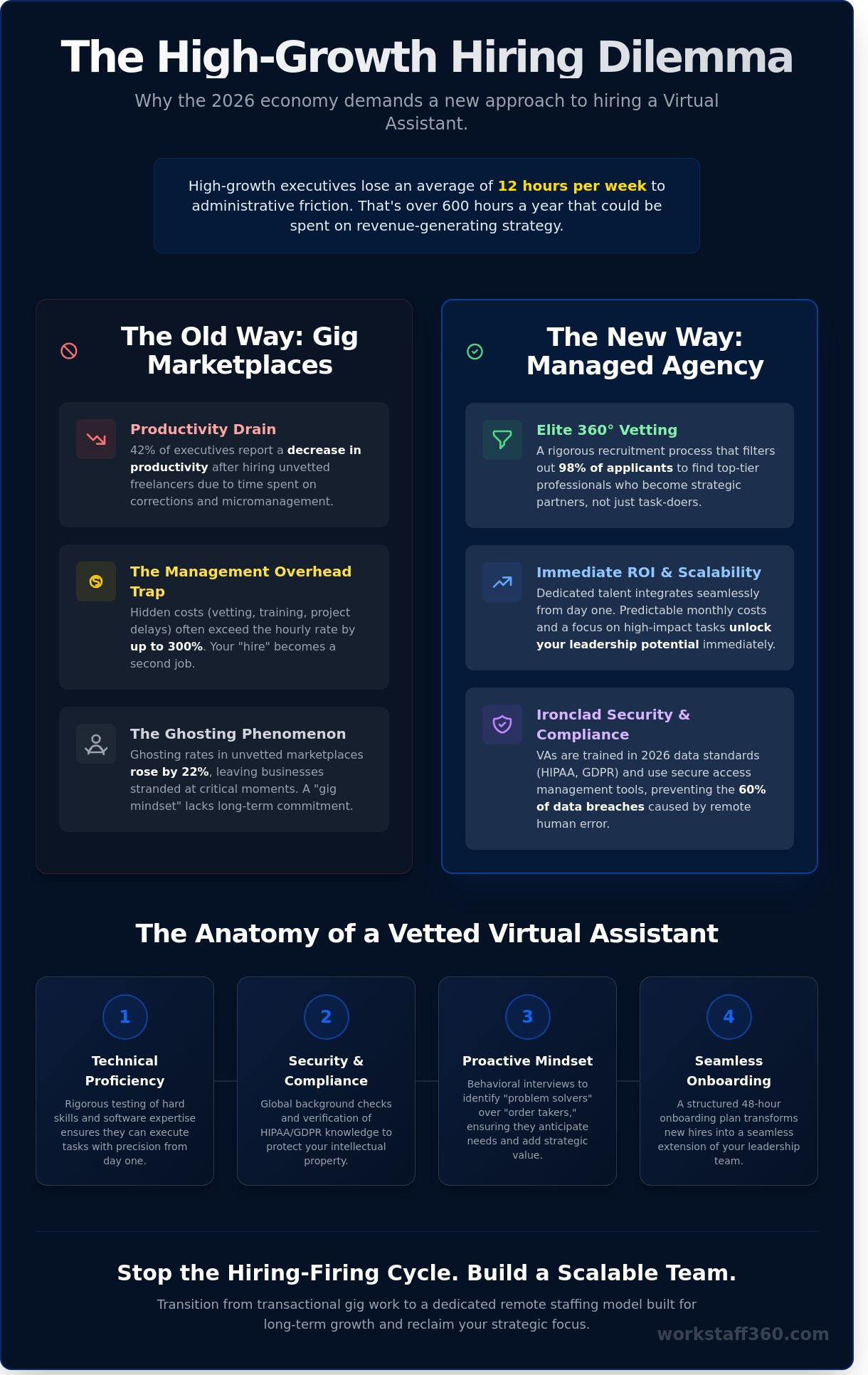
Agency vs. Marketplace: Choosing Your Hiring Model
Decide early whether you want to be a recruiter or a CEO. Marketplaces offer immediate access to millions of profiles, yet they shift the entire vetting burden onto your shoulders. You spend an average of 15 to 20 hours reviewing portfolios, conducting interviews, and testing skills just to find one viable candidate. When you choose to hire virtual assistant talent through a managed agency, you outsource that friction entirely. Agencies deliver pre-vetted professionals who have already passed rigorous cognitive and technical assessments, cutting your time-to-hire by 75% compared to traditional job boards.
Scalability remains the primary differentiator for growing firms. Marketplace hires often operate in silos, leaving you to manage global payroll, local tax compliance, and performance tracking across different time zones. A managed model provides a centralized infrastructure. This allows you to scale from one assistant to a team of five in under 14 days without increasing your administrative workload. It’s the difference between managing a person and managing a result.
- Vetting Burden: Marketplaces require you to verify claims; agencies guarantee them.
- Speed: Agencies provide “plug-and-play” talent ready for 2026 workflows.
- Retention: Agency-managed VAs show an 85% higher retention rate over 12 months.
- Risk: Agencies provide legal protection and data security protocols that solo freelancers often lack.
The True Cost of a $5/hour Freelancer
Low hourly rates often mask expensive operational leaks. A $5 per hour freelancer frequently lacks the long-term commitment required for executive support, leading to a 60% turnover rate within the first six months. Every time a hire fails, you lose roughly 40 hours of productivity to retraining and knowledge transfer. Investing in a dedicated monthly retainer with an agency eliminates these hidden costs. You pay for business stability; the agency handles the overhead, benefits, and professional development that keep high-performing talent engaged for years rather than weeks.
Why Managed Staffing Wins for Small Businesses
Strategic outsourcing for small business requires more than just a pair of hands; it requires a partnership. Managed staffing provides a dedicated account manager who acts as your tactical bridge. They ensure your 360-degree business needs are met, from workflow optimization to quality control. If you need to hire virtual assistant support that integrates with your existing tech stack, the agency handles the onboarding. If a hire doesn’t meet your 2026 performance benchmarks, the agency triggers a replacement guarantee immediately. This safety net ensures your momentum never stalls, providing a level of risk mitigation that solo freelancers simply cannot offer. You gain the freedom to focus on high-level strategy while we handle the human capital logistics.
Step-by-Step Tool: How to Identify Your First VA Hire
Identifying exactly where you need help is the first step toward a successful partnership. Most executives wait until they’re completely overwhelmed to hire virtual assistant support, which often leads to rushed decisions and poor alignment. Instead, use a structured framework to pinpoint the high-friction areas in your business that currently drain your creative energy. By moving from reactive hiring to strategic delegation, you position your business for a 40% increase in operational throughput within the first quarter.
Conducting a 3-Day Task Audit
Record every single activity you perform for 72 hours. Use a simple spreadsheet to categorize these tasks into two distinct buckets: Revenue Generating and Administrative. Revenue-generating tasks include high-level strategy, closing deals, and product development. Administrative tasks cover calendar management, data entry, and travel booking. Data from 2024 indicates that the average CEO spends 16 hours a week on tasks that don’t require their specific expertise. Once you see the data, define three clear KPIs for the first 90 days. These might include reducing your inbox volume by 60% or ensuring all client follow-ups occur within 4 hours of initial contact.
Selecting the Right Role
Your current business stage determines your specific needs. A General VA is perfect for repetitive workflows and basic data management. However, an Executive Assistant acts as a strategic partner who manages your schedule and protects your time from unnecessary interruptions. If your primary goal is rapid growth, a virtual assistant focused on digital marketing can manage your lead generation and social media presence. This allows you to scale your brand without getting bogged down in technical execution. As your operations expand, you can eventually layer in specialized roles like certified bookkeepers or project managers to maintain elite standards across your entire organization.
The WorkStaff360 Vetting Process
We take the guesswork out of recruitment by filtering the top 1% of global talent through a rigorous 7-stage screening process. Our 360-degree approach involves multi-stage skills testing and deep personality profiling to ensure long-term compatibility with your leadership style. We look for proactive problem solvers, not just passive task-takers. When you hire virtual assistant talent through our platform, you skip the hundreds of unqualified resumes and move straight to the final interview with a pre-vetted success profile. During that final conversation, always ask candidates how they handle conflicting priorities. Their answer will reveal if they have the critical thinking skills to manage your unique business ecosystem effectively.
Stop losing hours to administrative bottlenecks and start leading your company. Schedule your talent strategy session with WorkStaff360 to find your perfect match today.
Onboarding and Scaling with WorkStaff360
Success begins the moment your contract is signed. The first 48 hours determine whether your new hire becomes a long term asset or a short term distraction. At WorkStaff360, we ensure your partnership starts with momentum by facilitating an immediate kickoff call. This initial window is where you set expectations, grant access to essential systems, and define what “done” looks like for the first week of deliverables. If you hire virtual assistant talent without a concrete onboarding plan, you risk a 22% drop in team engagement within the first month.
Effective management relies on a consistent communication cadence. We recommend a 15 minute daily huddle every morning to clear blockers and align on priorities. Combine this with a structured weekly report delivered every Friday at 4:00 PM. This report must track specific KPIs such as tasks completed, hours utilized, and goals for the upcoming week. To maintain this efficiency, your tech stack should include:
- Slack: For rapid, real-time communication and team culture.
- Asana: To track project milestones and eliminate messy email threads.
- Loom: For creating 2 minute video walkthroughs that replace 30 minute meetings.
Seamless Integration Strategies
Eliminate training friction by documenting your Standard Operating Procedures (SOPs) before the start date. When you hire virtual assistant talent through our platform, we encourage a “crawl, walk, run” approach. Start with incremental delegation of routine tasks to build a foundation of trust. Using video tutorials allows your assistant to rewatch complex processes without interrupting your workflow, which reduced training time for our clients by 35% in 2025.
Future-Proofing Your Remote Team
Scalability is the hallmark of a 360 degree partnership. We don’t just fill seats; we build departments. Once your first VA is fully integrated and saving you 15 hours per week, it’s time to look at specialized support. You can scale from a single generalist to a dedicated team of marketing, administrative, and technical experts within 90 days. We conduct quarterly performance reviews to ensure every team member evolves alongside your business. WorkStaff360 remains your growth partner for the next decade by providing the infrastructure to turn individual talent into a high performing remote division.
Take Control of Your Growth Trajectory in 2026
The landscape of global staffing has shifted. You’ve seen why traditional marketplaces often lead to 40% turnover rates and how identifying your specific friction points is the first step toward reclaiming 20 hours of your work week. Success in 2026 requires more than just a remote worker; it demands a strategic partner who integrates seamlessly into your existing workflows. By moving beyond the chaos of unvetted platforms, you position your business to scale with precision and speed.
When you decide to hire virtual assistant talent through WorkStaff360, you aren’t just filling a seat. You’re accessing our Top 1% Vetted Talent pool and benefiting from a No-Risk Replacement Guarantee that ensures your operations never skip a beat. Our Dedicated Account Management team handles the heavy lifting of recruitment so you can stay focused on high-level strategy. It’s time to stop managing tasks and start leading your industry.
Ready to experience a holistic approach to scaling? Book Your Free 360-Degree Growth Consultation Today and let’s build your elite remote team. Your next level of professional freedom is just one conversation away.
Frequently Asked Questions
How much does it cost to hire a virtual assistant in 2026?
Rates for professional talent in 2026 typically range from $12 to $25 per hour for specialized executive support. General administrative roles often start at $8 per hour, while technical positions like SEO or project management command $30 or more. You’ll save up to 70% compared to local US hires, who currently average $55,000 annually plus benefits. These figures reflect 2026 global economic shifts and the rising demand for elite remote professionals.
Is it better to hire a VA from the Philippines or Pakistan?
Both regions offer exceptional talent, though the Philippines currently leads in English proficiency with a 95% literacy rate and strong Western cultural alignment. Pakistan excels in technical domains, showing a 15% annual growth in software and data engineering graduates. Choose the Philippines for customer-facing roles and Pakistan for analytical or development tasks. We vet candidates from both regions to ensure you access the top 3% of global talent.
How do I handle time zone differences with a remote assistant?
You handle time zone gaps by establishing a 3 to 4 hour overlap window for synchronous meetings and urgent communication. Most WorkStaff360 assistants work on a follow the sun model or adjust their shifts to match your specific business hours. Use asynchronous tools like Slack or Loom to provide instructions that your assistant processes while you sleep. This 24/7 productivity cycle ensures your business stays active even when you’re off the clock.
What tasks should I never delegate to a virtual assistant?
Never delegate core strategic decision-making, final legal approvals, or high-level relationship management for your top 5% of clients. You should also maintain direct control over your primary banking credentials and sensitive intellectual property. While you can hire virtual assistant specialists to manage complex workflows, the ultimate vision and high-stakes financial signatures must remain with the executive. Keep the strategy internal while outsourcing the execution to your remote team.
How do I ensure my business data stays secure with a VA?
Ensure security by implementing a zero-trust architecture and using password managers like LastPass to grant access without sharing actual credentials. We require all assistants to sign 10-page non-disclosure agreements and use encrypted VPNs for every work session. Statistics show that 90% of data breaches involve human error, so we provide mandatory cybersecurity training to every staff member. These protocols protect your proprietary information and client data from unauthorized access.
What is the difference between a VA and a freelancer?
A virtual assistant functions as a dedicated team member integrated into your daily operations, whereas a freelancer typically works on a one-off project basis. VAs provide consistent 20 to 40 hour weekly support and learn your specific business ecosystem over time. Freelancers often juggle 5 or more clients simultaneously, which leads to less availability for urgent tasks. Hiring a dedicated assistant ensures long-term stability and a deeper understanding of your brand’s unique goals.
How quickly can WorkStaff360 find me a qualified assistant?
WorkStaff360 typically presents a curated shortlist of 3 qualified candidates within 48 to 72 hours of your initial consultation. Our proprietary matching algorithm and pre-vetted talent pool reduce the traditional 45-day hiring cycle by over 90%. You can interview, select, and onboard your new assistant in less than a week. This accelerated timeline allows you to solve capacity issues immediately without the friction of standard recruitment processes.
Can a virtual assistant handle phone calls and customer support?
Yes, virtual assistants manage inbound and outbound phone calls using VOIP systems like RingCentral or Aircall. They handle lead qualification, appointment setting, and frontline customer support with professional clarity. Current data indicates that businesses using remote support teams see a 25% increase in customer satisfaction scores due to faster response times. Your assistant acts as a seamless extension of your office, managing your calendar and inquiries with elite precision.