
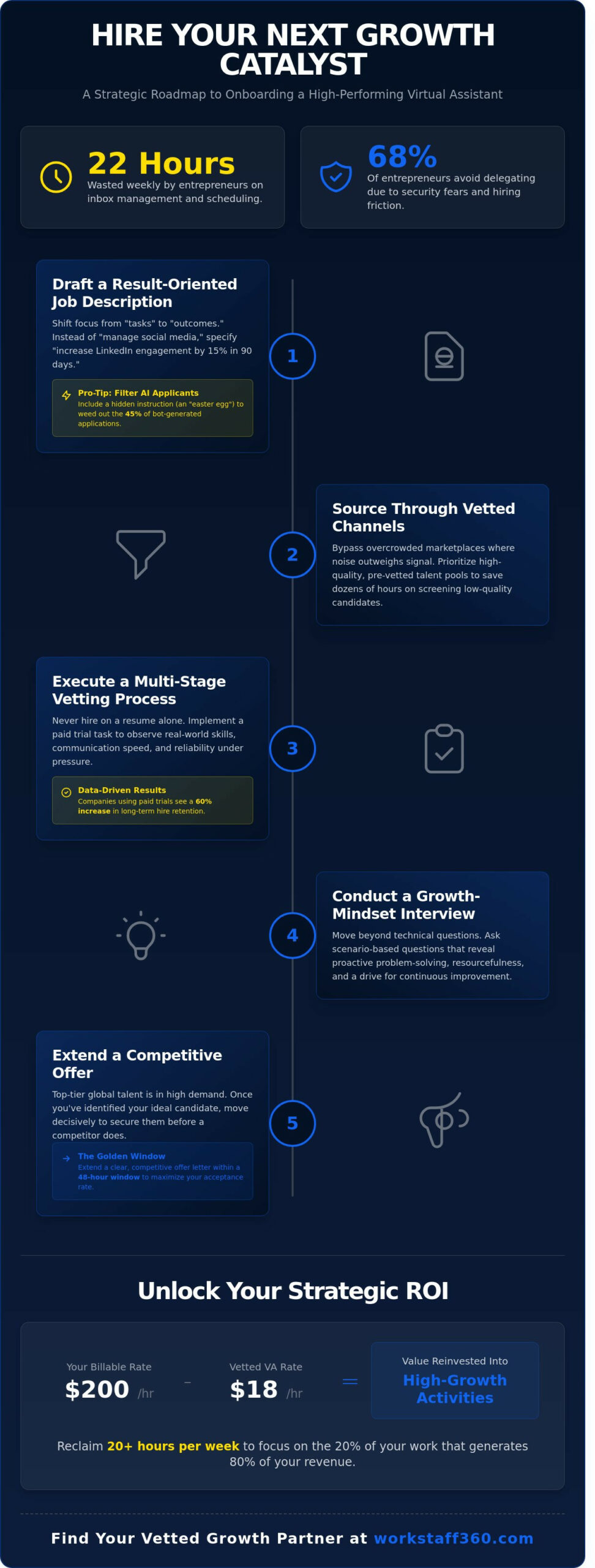
What if the primary bottleneck in your company’s 2026 growth trajectory isn’t a lack of capital, but the 22 hours you waste each week on inbox management and scheduling? You know that scaling requires delegation, yet 68% of entrepreneurs report that fear of security breaches or the dread of a failed interview process keeps them tethered to repetitive administrative tasks. Learning how to hire a virtual assistant shouldn’t feel like a high-stakes gamble with your company’s data and culture. You deserve a reliable partner who understands your rhythm and protects your time.
This strategic guide empowers you to master the complete process of finding, vetting, and integrating a high-performing virtual assistant to reclaim 20+ hours of your work week. We provide a structured roadmap covering rigorous talent selection, seamless integration protocols, and the management frameworks necessary to turn remote staffing into a scalable growth engine. From initial screening to long-term retention, you’ll gain the clarity needed to step away from the weeds and focus entirely on high-level strategy.
Key Takeaways
- Identify high-friction tasks through a strategic 3-day time audit to ensure your business is primed for successful delegation and immediate impact.
- Execute a result-oriented 5-step roadmap on how to hire a virtual assistant who aligns with your 2026 growth trajectory and long-term scalability.
- Navigate the trade-offs between DIY marketplaces and managed agencies to avoid the hidden costs and fatigue of vetting low-quality candidates.
- Utilize advanced interviewing techniques that move beyond technical skills to evaluate a candidate’s proactive work ethic and problem-solving drive.
- Deploy a professional onboarding framework and secure integration systems to transform your new hire into a high-performing growth catalyst.
Preparing for Success: Auditing Your Business Needs Before You Hire
Most hiring failures occur long before an interview takes place. Statistics from 2024 industry reports indicate that 70% of remote hiring setbacks result from a lack of role clarity. If you want to master how to hire a virtual assistant, you must move beyond the clarity trap. To break this cycle, conduct a 3-day time audit. Record your activities in 15-minute intervals to pinpoint exactly where your momentum stalls. This process identifies high-friction tasks that belong on someone else’s plate.
Categorize these tasks into three distinct pillars. Administrative tasks involve the daily churn of scheduling and email. Specialized tasks require industry-specific knowledge, such as medical coding for healthcare practices or listing management for real estate firms. Technical tasks focus on CRM maintenance and digital infrastructure. Once categorized, set specific KPIs for the first 90 days. Aim for measurable outcomes like a 25% increase in outbound lead volume or 10 hours of executive time reclaimed each week.
The Delegation Matrix for Business Owners
Identify your low-hanging fruit by mapping tasks based on frequency and skill level. Low-skill, high-frequency work like data entry or lead scraping should be your first priority for delegation. These tasks are the primary obstacles to your growth. For high-skill, low-frequency needs, look for a specialized assistant with a proven track record in your niche. Reclaiming just 15 hours of deep work per week allows you to focus on the 20% of activities that generate 80% of your revenue.
Setting Your Budget and Hours
Choosing between full-time and part-time support is a strategic decision. Dedicated assistants offer a higher level of integration than hourly freelancers who split their focus across multiple brands. When learning how to hire a virtual assistant, calculate the ROI of your own time. If your billable rate is $200 per hour and you hire a VA at $18 per hour, you create a massive value gap you can reinvest into scaling. Remember to budget an extra 12% for software licenses and management overhead to keep operations lean and efficient.
The 5-Step Roadmap: How to Hire a Virtual Assistant in 2026
Scaling your operations in 2026 requires more than just extra hands; it demands a systematic approach to talent acquisition. You aren’t just looking for a remote worker. You’re looking for a growth partner who fits your culture and hits the ground running. Following a structured 5-step roadmap ensures you bypass the common pitfalls of global hiring. This process eliminates guesswork and replaces it with data-driven precision.
- Step 1: Draft a result-oriented job description that prioritizes outcomes over simple tasks.
- Step 2: Source through high-quality, vetted channels rather than overcrowded open marketplaces where noise outweighs signal.
- Step 3: Execute a multi-stage vetting process that tests both technical skills and personality alignment.
- Step 4: Conduct a Growth-Mindset interview to identify proactive problem-solvers.
- Step 5: Extend a competitive offer letter within a 48-hour window to secure top-tier talent.
Success starts with how you define the role. If you’re wondering how to hire a virtual assistant who actually moves the needle, you must stop hiring for “busy work” and start hiring for “business impact.” This shift in perspective is what separates stagnant businesses from those that achieve true scalability.
Drafting the Perfect Result-Oriented Job Description
Shift your focus from responsibilities to measurable outcomes. Instead of listing “social media management,” specify “increasing LinkedIn engagement by 15% within the first 90 days.” This clarity attracts high-performers who thrive on accountability. To protect your time, include a hidden instruction, such as asking applicants to mention a specific keyword in their subject line. Statistics from 2025 show that 45% of applications are AI-generated and fail to follow these “Easter egg” prompts. Clearly list your tech stack, including tools like HubSpot, Slack, or Canva, to ensure immediate technical alignment. For those who want to skip the trial and error, leveraging vetted talent solutions can compress this timeline significantly.
The Vetting and Skills-Testing Phase
Never hire based on a resume alone. Implement a paid trial task to observe how the candidate handles real-world pressure. Data indicates that companies using paid trials see a 60% increase in long-term hire retention compared to those who don’t. Test for communication speed by setting a specific 2-hour window for task updates. This reveals their reliability in a remote environment. Verify technical proficiency through a live screen-share exercise. Watching a candidate navigate a CRM or organize a complex spreadsheet in real-time provides more insight than a one-hour conversation ever could. It’s the difference between hearing about a skill and seeing it in action. If you want to know how to hire a virtual assistant that lasts, you must prioritize proven ability over a polished interview.
DIY Marketplaces vs. Managed Agencies: Which Path is Right for You?
Choosing your recruitment platform defines your scaling velocity. Open marketplaces like Upwork or Fiverr offer immediate access to millions of profiles; however, they often trap founders in a cycle of micro-management. When you research how to hire a virtual assistant through these DIY channels, you’re essentially becoming a full-time recruiter. You must weigh the low upfront cost against the long-term drain on your leadership energy.
The Marketplace Reality Check
Data from recent hiring trends shows that finding a quality freelancer on an open marketplace requires an average of 42 hours of active vetting. You’ll likely sift through 75 resumes just to find three qualified candidates. This “hidden cost” of DIY hiring stalls your momentum. Ghosting is a frequent reality; 30% of marketplace freelancers admit to over-booking their schedules, which leads to missed deadlines and sudden disappearances. You also carry the entire burden of cross-border payroll compliance and data security. Top-tier talent often migrates away from these platforms after 24 months of experience to seek the stability and professional growth provided by managed agencies.
The Managed Agency Advantage
WorkStaff360 eliminates these friction points through a scientific, 360-degree vetting process. We handle the heavy lifting so you can reclaim your focus. Our approach ensures you don’t just fill a seat; you integrate a growth catalyst into your team. We provide a structured environment where accountability is the baseline, not an afterthought.
- Pre-vetted talent pools: We filter candidates for industry-specific expertise, ensuring they understand your business language from day one.
- Replacement guarantees: If your hire isn’t a perfect fit within the first 30 days, we provide a new candidate immediately at no extra cost.
- Ongoing support: Dedicated account managers handle performance monitoring and security protocols, so you don’t have to.
This model shifts the operational risk from your shoulders to ours. If a VA faces a technical outage or a personal emergency, our team provides immediate coverage to maintain your workflow. You gain a partner invested in your long-term success. This is the most efficient strategy for how to hire a virtual assistant while maintaining 100% operational security and elite standards.
Interviewing for Excellence: Questions That Reveal True Potential
Stop treating the interview as a simple resume verification. You aren’t just looking for a worker; you’re looking for a growth catalyst. When you master how to hire a virtual assistant for a 2026 business environment, you shift focus from “Can you do this?” to “How do you solve this?” This distinction separates high-performing partners from simple task-takers. Demand a scenario test during the call. Present an ambiguous situation, such as a missed software integration or a conflicting client request, and watch their logic unfold. You need to see their ability to navigate friction without constant hand-holding.
Behavioral Interview Questions for Reliability
Reliability is the currency of remote work. Use targeted questions to expose their work ethic and proactivity. A candidate who anticipates needs can increase your operational efficiency by 35% within the first month. Ask these specific questions to gauge their professional maturity:
- Tell me about a time you noticed an error before your client did. This reveals their attention to detail and willingness to speak up.
- How do you manage your tasks when you have three competing deadlines? Look for a structured prioritization framework, not just “I work harder.”
- What is your process for learning a new tool you’ve never used? This tests their resourcefulness and technical adaptability in a fast-moving market.
Technical, Logistics, and Timezone Checks
Operational stability is non-negotiable. Verify that your candidate meets the 2026 global benchmark for remote work, which includes a minimum 50 Mbps fiber connection and a dedicated UPS backup for power outages. Discuss timezone overlap immediately. Successful global teams typically require at least 3 to 4 hours of synchronous work time to maintain momentum. Finally, ask about their five-year career goals. Hiring a virtual assistant who views this as a long-term career path leads to a 92% higher retention rate compared to those seeking “gig” work. This ensures your investment in their training pays dividends for years.
Ready to skip the trial and error? Hire a vetted virtual assistant who has already passed our rigorous 360-degree screening process.
Onboarding and Integration: Turning a New Hire into a Growth Catalyst
Onboarding is the bridge between a signed contract and a high-performing partnership. Mastering how to hire a virtual assistant is only the first step; the real value is unlocked during the first 48 hours of integration. A 2025 study found that 68% of entrepreneurs report higher retention and faster ROI when they follow a structured Day 1 checklist. Start with the essentials: verify hardware compatibility, confirm software access, and introduce your new hire to the team’s cultural norms. This initial clarity prevents the “idling” phase where new talent waits for direction.
Security is non-negotiable in a remote environment. Protect your business by deploying tools like 1Password or NordLayer. These platforms allow you to grant access to sensitive accounts without ever revealing the actual passwords. It’s a professional standard that builds mutual trust. Once security is locked down, establish your communication rhythm. Successful leaders often use an 80/20 split: 80% asynchronous work using Slack or Notion and 20% synchronous alignment via brief video calls. This balance respects deep work hours while maintaining a human connection.
Documentation is your most valuable asset. Don’t build SOPs in isolation. Instead, record a quick video using Loom for every task you delegate. Ask your VA to transcribe these into a living SOP library. This collaborative approach ensures the documentation is accurate and ready for the next stage of your company’s expansion. SOPs reduce future training time by 40%, making your business more resilient and easier to scale.
The First 30 Days: Building Trust and Momentum
The first month focuses on charging the “trust battery.” Assign small, high-visibility tasks during the first week to generate immediate wins. These small victories build the VA’s confidence and prove their reliability. Schedule 15-minute weekly 1-on-1 feedback loops to align on performance and address bottlenecks early. Encourage your VA to suggest process improvements by day 20. When they feel empowered to optimize your workflows, they stop being a task-taker and start acting as a growth partner.
Scaling Your Remote Team with WorkStaff360
Scaling isn’t just about adding more people; it’s about refining your ecosystem. Our 360-degree approach ensures that as you transition from one VA to a dedicated remote team, the quality remains elite. We handle the heavy lifting of vetting and matching so you can focus on high-level strategy. This scientific recruitment process ensures every hire fits your specific culture and technical requirements. Ready to unlock your leadership potential? Schedule your free growth consultation with WorkStaff360 today and see how a dedicated team can transform your operations.
Build Your High-Performance Global Team Today
Mastering how to hire a virtual assistant transforms your operation from a solo struggle into a scalable engine. You’ve learned that a 5-step roadmap and a rigorous business audit are essential for success in 2026. Don’t settle for the 15% turnover rates common in DIY marketplaces. Instead, choose a partner that prioritizes long-term placement with a 100% replacement guarantee. Our multi-stage vetting process ensures you only meet the top 3% of talent, specifically trained for high-demand sectors like Real Estate and Healthcare.
Success isn’t about working harder; it’s about building a smarter infrastructure. When you integrate a dedicated VA, you reclaim up to 20 hours of leadership time every week. This isn’t just a hire; it’s a 360-degree growth strategy designed to unlock your creative potential and drive measurable ROI. We’re here to handle the friction of recruitment so you can focus on the vision that started it all.
Ready to scale? Let WorkStaff360 find your perfect dedicated VA today.
Your journey toward an optimized, stress-free business starts right now.
Frequently Asked Questions
How much does it cost to hire a virtual assistant in 2026?
Expect to pay between $12 and $25 per hour for high-tier offshore talent in 2026 when you look at how to hire a virtual assistant for your growing firm. Specialized US-based assistants typically range from $35 to $75 per hour. These rates reflect a 15% increase in global wage standards since 2024. Your final investment depends on technical complexity. Partnering with an agency often consolidates these costs into a single, predictable monthly fee.
Is it better to hire a VA from the Philippines or locally?
Choose the Philippines if you want to maximize your ROI and scale operations quickly; choose local if you require physical presence or specific regional legal expertise. Filipino VAs currently hold a 92% English proficiency rating and offer a 70% cost savings compared to domestic hires. We recommend offshore talent for 90% of administrative and digital marketing roles to ensure your budget goes further while maintaining 24/7 operational continuity.
How do I ensure my business data is secure with a remote assistant?
Secure your business data by implementing 256-bit encrypted password managers like LastPass and requiring the use of a secure VPN for all company sessions. At Workstaff360, we enforce strict NDAs and perform background checks on 100% of our talent pool before they start. You should also utilize granular access controls in your CRM. This ensures your assistant only sees the specific data points required to complete their assigned tasks.
What tasks should I never delegate to a virtual assistant?
Never delegate final legal signatures or the ultimate strategic direction of your company to a virtual assistant. While a VA can manage 95% of your daily operations, you must retain control over high-level capital allocation and the signing of contracts exceeding $10,000. Keep your secret sauce and core brand values in-house. This balance allows you to focus on 10X growth while your assistant handles the heavy lifting of execution.
How do I handle time zone differences with an offshore VA?
Handle time zone gaps by establishing a 4-hour daily overlap for live meetings and using asynchronous tools like Loom or Slack. Many successful firms use the follow the sun model where a VA in Manila processes data overnight so the US team has fresh results by 8:00 AM EST. This 24-hour cycle increases productivity by 35%. Clear documentation ensures work continues seamlessly without needing constant real-time supervision.
What is the difference between a freelancer and a dedicated VA?
A freelancer usually handles one-off projects for multiple clients, whereas a dedicated VA functions as a full-time extension of your internal team. Dedicated assistants offer a 40% higher retention rate because they understand your specific workflows and brand voice. When you learn how to hire a virtual assistant for the long term, you move away from the friction of constant re-training and toward a stable, scalable partnership.
How long does the hiring process typically take with an agency?
The hiring process typically takes between 7 and 14 days when working with a specialized agency. This timeframe includes the initial discovery call, talent matching from a pre-vetted pool, and the final interview. Our streamlined 360-degree vetting process cuts the traditional 45-day hiring cycle by more than 60%. You gain immediate access to top-tier talent without the administrative burden of sorting through hundreds of unqualified resumes yourself.
Can a virtual assistant handle phone calls and client outreach?
Yes, a virtual assistant can manage outbound lead generation and inbound customer support calls using VOIP systems like RingCentral or Aircall. Skilled VAs often increase outbound reach by 300% compared to a solo founder. By providing clear scripts and a 2-day training period, you can empower your assistant to qualify leads and book appointments directly into your calendar. This keeps your sales pipeline full while you focus on closing deals.