
What if your practice could reclaim the $31.50 lost on every single denied claim simply by shifting your operational strategy? According to industry data from 2023, nearly 11% of all medical claims are denied on the first submission, creating a massive revenue gap that most clinics struggle to close. You likely already feel the weight of rising administrative costs and the constant friction of billing staff turnover. Integrating a medical billing virtual assistant into your workflow solves these issues by meeting complex payer requirements with total precision.
This guide proves that a dedicated specialist is the strategic key to eliminating denials and accelerating your reimbursements. By leveraging vetted, professional talent, you can reduce your days in Accounts Receivable by 25% and slash overhead costs significantly. We’ll outline the exact roadmap to achieve revenue cycle excellence and build a scalable foundation that grows alongside your practice through 2026. Our 360-degree approach ensures your billing processes are precise, fast, and fully optimized for long-term growth, allowing you to return your focus to what matters most: your patients.
Key Takeaways
- Master the shift toward high-precision revenue cycle management by integrating a dedicated medical billing virtual assistant into your practice’s core operations.
- Implement “first-pass” accuracy standards that slash claim denials and ensure your reimbursements flow without unnecessary administrative friction.
- Perform a comprehensive cost-benefit analysis to see how remote staffing offers faster scalability and significantly lower overhead than traditional in-house hiring.
- Secure your practice with advanced HIPAA-compliant protocols and “Secure Remote Worker” frameworks designed for the digital-first landscape of 2026.
- Leverage the WorkStaff360 “360 concept” to access vetted talent that acts as a growth catalyst, freeing you to focus on elite patient care.
What is a Medical Billing Virtual Assistant and Why Does Your Practice Need One?
A medical billing virtual assistant is a specialized remote professional dedicated to mastering your revenue cycle management (RCM). By 2026, the healthcare industry has moved past the era of general administrative support. Modern practices now require high-precision virtual billing experts who understand the nuances of digital health records and evolving compliance standards. Unlike a general assistant who handles basic tasks, these specialists possess specific expertise in medical billing, including ICD-11 coding and CPT updates. Their primary objective is to maximize clean claim rates and eliminate the administrative weight that contributes to the 62% burnout rate currently reported among clinical staff.
You can’t afford to confuse a general VA with a specialized billing professional. A dedicated assistant brings a scientific approach to your back office, ensuring that every claim is scrubbed for errors before submission. This level of precision accelerates your cash flow and protects your practice from the financial volatility that defines the current healthcare market. By delegating these tasks to a vetted expert, you reclaim your time and focus on what matters most: delivering elite patient care.
The Growing Friction in Modern Revenue Cycles
Payer rules in 2026 have reached a level of complexity that manual, in-house systems can no longer sustain. Documentation requirements increased by 28% over the last twenty-four months, creating a bottleneck that drains clinic profitability. These hidden administrative costs often swallow up to 30% of a practice’s potential revenue. Most in-house teams reach a breaking point once they handle more than 200 claims per month, leading to a spike in denials and lost income. This friction isn’t just an inconvenience; it’s a direct threat to your scalability.
The Strategic Advantage of Virtual Staffing
Workstaff360 offers a 360-degree staffing solution that ensures seamless integration into your existing clinic workflows. By utilizing a medical billing virtual assistant, you access global talent without the overhead costs of traditional hiring. This strategic move allows your practitioners to focus 100% on patient outcomes. Our vetted talent serves as a high-performing growth catalyst, providing the dedicated support needed to turn your billing department into a profit center. You get the freedom to lead while we provide the specialized precision your revenue cycle demands.
- Precision Coding: Specialists trained in the latest 2026 coding requirements.
- Reduced Denials: Proactive claim scrubbing to ensure 95% or higher first-pass rates.
- Scalability: Add support instantly as your patient volume grows.
- Cost Efficiency: Eliminate the 40% markup typically associated with local full-time hires.
Core Responsibilities: How a Billing VA Streamlines Your Revenue
A medical billing virtual assistant acts as the high-performance engine of your revenue cycle, transforming a fragmented process into a high-velocity cash flow system. They manage the entire claim lifecycle from the moment a patient schedules an appointment to the final balance resolution. Achieving a first-pass clean claim rate of 95% or higher is the gold standard for modern practices, and a dedicated VA makes this a reality. This precision eliminates the 14-day payment lag typically caused by simple clerical errors. By prioritizing accuracy at the point of entry, your billing professional ensures that revenue isn’t just projected; it’s captured.
Front-End Billing and Insurance Verification
Successful billing begins long before the clinical encounter. Your medical billing virtual assistant performs real-time insurance verification to confirm coverage, deductibles, and co-pays. This proactive step prevents the 25% of denials that stem from eligibility issues. They also secure prior authorizations, ensuring complex procedures align with the seven fundamental elements of an effective compliance program as outlined by the U.S. Department of Health and Human Services. Meticulous data entry at this stage reduces administrative friction and significantly enhances the patient experience.
Claims Management and Denial Resolution
When a claim hits a roadblock, your virtual professional shifts into high gear to protect your bottom line. They review ICD-10 and CPT codes with surgical precision to ensure total compliance with updated 2026 coding standards. If a denial occurs, they don’t wait for a monthly report; they initiate aggressive follow-up within 48 hours. Managing the Accounts Receivable (A/R) aging report is a daily priority. By targeting claims older than 60 days, VAs often recover 15% to 20% of revenue that practices previously wrote off as uncollectible. Their role involves:
- Scrubbing Claims: Identifying missing modifiers or mismatched codes before submission.
- Payer Communication: Calling insurance adjusters to resolve “pending” statuses immediately.
- Appeal Drafting: Submitting clinical documentation to overturn wrongful denials.
Practice owners gain ultimate clarity through granular financial reporting and analytics. Instead of guessing your month-end totals, you receive customized dashboards highlighting net collection ratios and cost-per-claim metrics. This data-driven approach allows you to scale your practice with confidence while maintaining a lean overhead. This transparency ensures you remain the architect of your growth rather than a victim of administrative backlog.
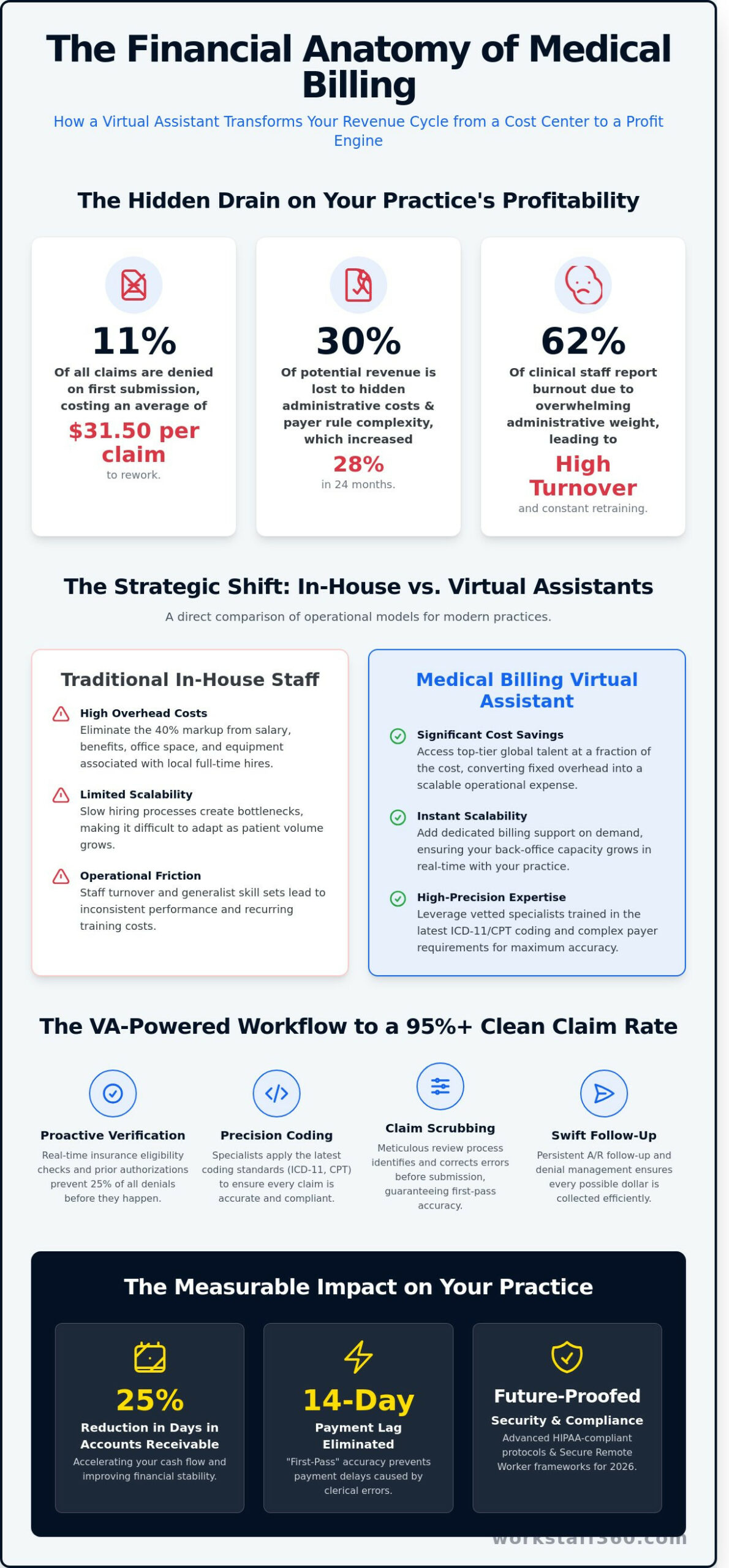
In-House Staff vs. Virtual Billing Assistants: A Cost-Benefit Analysis
Traditional hiring models are becoming obsolete as healthcare providers prioritize leaner, more agile operations. Recent data highlighting the medical billing outsourcing market growth, which is expected to expand at a compound annual growth rate of 12.3% through 2030, underscores a massive shift toward remote specialized labor. Hiring a medical billing virtual assistant allows you to bypass the financial weight of full-time local employees while maintaining high-tier accuracy and compliance.
Speed defines the modern revenue cycle. While filling an in-house position takes an average of 42 days according to industry benchmarks, WorkStaff360 can integrate a pre-vetted professional into your workflow in less than 72 hours. This rapid scalability prevents revenue leaks during staff transitions. You also gain a built-in buffer against local turnover. If a local staff member leaves, your remote team continues processing claims without interruption, ensuring your cash flow remains steady and predictable.
- Immediate Scalability: Add or reduce staff numbers based on patient volume within days, not months.
- Reduced Training Drag: Skip the basics of billing software; our VAs arrive with verified experience in major EHR platforms.
- Service Continuity: Eliminate the risk of “single point of failure” when a local employee takes sick leave or resigns.
Eliminating the Overhead of On-Site Employees
Stop paying for square footage you don’t need. An on-site biller requires a physical desk, a high-end computer, and expensive software licenses that can cost upwards of $3,000 in initial setup alone. By moving to a virtual model, you eliminate these hardware and utility costs instantly. You also shed the “soft costs” of HR management, payroll taxes, and health insurance premiums. For a deeper dive into these numbers, read our cost-benefit analysis guide to see how remote staffing protects your margins.
Accessing a Global Pool of Specialized Talent
Local hiring often limits you to a handful of candidates within a 20 mile radius, many of whom may lack specific ICD-10 or CPT coding expertise. We break those geographic barriers by sourcing elite talent from top markets like the Philippines and Pakistan, where medical billing is a core professional industry. This global approach enables a 24/7 processing cycle. Your medical billing virtual assistant can resolve denials and post payments while your local office is closed, effectively doubling your daily output without increasing your physical headcount.
Security and Compliance: Protecting Patient Data in 2026
Patient data security remains the primary barrier for practices considering a medical billing virtual assistant. With healthcare data breaches reaching record highs in 2025, security isn’t just a checkbox; it’s a survival requirement. Modern virtual staffing eliminates these risks through “Secure Remote Worker” protocols that exceed standard office protections. These protocols ensure every action taken by your remote team member aligns with 2026 HIPAA mandates and HITECH requirements.
Elite agencies formalize this protection using a Business Associate Agreement (BAA). This legal contract binds the staffing partner to the same rigorous privacy standards as your practice. It creates a clear chain of accountability. Beyond the legalities, security depends on technical barriers. Your medical billing virtual assistant works directly within your EHR via encrypted tunnels. They never store sensitive files locally. Audit trails track every click, providing 100% visibility into who accessed what data and when. This transparency allows practice managers to monitor activity in real-time, ensuring that 99.9% of data interactions remain fully compliant.
WorkStaff360’s Rigorous Vetting and Security Standards
WorkStaff360 employs a multi-phase verification process that filters out 97% of applicants before they even reach an interview. We conduct exhaustive criminal background checks and verify professional certifications with governing bodies. Every hire undergoes mandatory, ongoing HIPAA training to stay ahead of evolving 2026 regulations. You can verify our standards yourself by reviewing our evaluation checklist for medical practice VAs. This checklist ensures your practice maintains a 0% compromise rate during internal audits.
Technology and Encryption Protocols
We deploy high-level technical safeguards to lock down your revenue cycle. All VAs use enterprise-grade VPNs and mandatory two-factor authentication (2FA) for every login. By utilizing Virtual Desktop Infrastructure (VDI), we ensure that patient data stays on your servers, not on a remote laptop. Security is not a feature of virtual billing; it is the foundation upon which every claim is built. This approach prevents data leaks while maintaining high-speed processing. If you want to fortify your practice while scaling efficiency, schedule a security consultation with WorkStaff360 today.
Our infrastructure includes 256-bit AES encryption for all communication channels. We prohibit the use of personal devices, requiring VAs to operate within managed environments that block external storage and unauthorized screen captures. This level of control provides peace of mind that your practice remains shielded from the cybersecurity threats that targeted 35% of small medical clinics in the last year.
The WorkStaff360 Difference: Scaling Your Practice with a 360-Degree Partner
WorkStaff360 functions as a high-performing growth catalyst rather than a standard recruitment agency. We recognize that clinical success depends on more than just filling a desk; it requires a strategic alignment of talent and technology. Our 360-degree concept provides holistic support that encompasses every stage of the staffing lifecycle. We handle the rigorous sourcing, the technical onboarding, and the ongoing management of your medical billing virtual assistant. This comprehensive approach removes the administrative burden from your shoulders, allowing you to focus on patient outcomes.
We prioritize long-term placements because we value deep institutional knowledge. When a professional stays with your practice for years, they understand your specific payer mix and patient demographics better than any rotating agency staff could. This stability transforms your billing department from a source of friction into a streamlined engine of growth. You deserve the freedom to lead your practice without being tethered to daily claim disputes or clearinghouse errors.
Seamless Integration into Your Clinical Workflow
Successful delegation requires precision. We don’t provide generic workers; we match a medical billing virtual assistant to your specific medical specialty and software stack. Whether your clinic operates on Epic, Kareo, or Athenahealth, we ensure your new team member possesses the exact technical proficiency required. This eliminates the steep learning curve that often stalls new hires. Our dedicated support team works alongside you during the initial weeks to ensure the VA integrates into your culture and communication channels perfectly.
Our methodology focuses on making the VA a core team member rather than a distant contractor. To see how this fits into a broader operational plan, you can review our 2026 strategy for outsourcing medical billing. This guide provides the implementation steps necessary to align remote talent with modern clinical workflows, ensuring a 100% synchronization rate with your in-house staff.
Ready to Transform Your Revenue Cycle?
The ROI of a specialized billing assistant is immediate and measurable. Industry benchmarks from 2024 indicate that the average cost to rework a denied claim is roughly $25; reducing your denial rate by even 5% can save a medium-sized practice thousands of dollars every month. By delegating the complexities of coding and follow-ups, you reclaim your most valuable asset: time. This is your opportunity to unlock your leadership potential and move away from the “billing grind.”
Don’t let revenue leakage hold your clinic back from its 2026 expansion goals. We invite you to schedule a free practice consultation to identify the gaps in your current revenue cycle. Let us show you how a dedicated partner can stabilize your cash flow and provide the professional support you need to scale with confidence.
Secure Your Practice’s Financial Future for 2026
The landscape of healthcare administration is shifting toward specialized, remote solutions that prioritize both precision and security. Integrating a medical billing virtual assistant into your workflow eliminates the administrative bottlenecks that typically lead to a 5% to 10% loss in annual revenue due to coding errors or missed claim deadlines. By 2026, practices that leverage global talent will outperform traditional models by reducing overhead costs by up to 60% while maintaining rigorous HIPAA-compliant remote protocols. You don’t have to navigate these complexities alone.
WorkStaff360 provides the holistic support your business ecosystem needs to thrive. We connect you with vetted healthcare professionals who bring 5+ years of industry experience to your team from day one. Our dedicated long-term staffing model ensures your practice benefits from consistent, expert attention rather than high-turnover temp work. You gain the freedom to focus on patient care while we handle the technical precision of the revenue cycle. It’s time to unlock your practice’s full leadership potential through strategic, scalable staffing.
Book Your Free Revenue Cycle Consultation with WorkStaff360
Frequently Asked Questions
Is a medical billing virtual assistant HIPAA compliant?
Yes, every medical billing virtual assistant we place adheres to strict HIPAA regulations through encrypted VPNs and secure workstations. Our vetting process ensures they follow the 1996 Health Insurance Portability and Accountability Act standards for data privacy. They utilize multi-factor authentication and undergo annual security training to protect your Protected Health Information. This rigorous approach eliminates the risk of data breaches while maintaining 100 percent compliance with federal laws.
How much does a medical billing virtual assistant cost compared to in-house staff?
Hiring a remote professional reduces your total operational overhead by 60 to 70 percent compared to traditional in-house staffing. According to the Bureau of Labor Statistics, the median annual wage for medical records specialists was $47,180 in 2023, and that’s before adding benefits or office space. By shifting to a virtual model, you save on payroll taxes, health insurance, and 401k contributions. This allows you to reinvest those funds directly into practice growth and patient care.
What EMR/EHR systems can a virtual billing assistant work with?
Our assistants are proficient in all major platforms, including Epic, Cerner, Athenahealth, and eClinicalWorks. Since 96 percent of non-federal acute care hospitals use certified EHR technology as of 2023, our staff maintains up-to-date training on these specific interfaces. They navigate patient portals, update coding entries, and pull financial reports with high precision. You won’t need to change your existing software to integrate a medical billing virtual assistant into your current workflow.
Can a virtual assistant handle complex claim denials and appeals?
Yes, they manage the entire denial management lifecycle to recover lost revenue. Statistics from the Kaiser Family Foundation show that some insurers deny nearly 17 percent of in-network claims. Your assistant identifies the specific reason codes for these rejections, such as missing documentation or incorrect modifiers. They file formal appeals within the standard 60-day window to ensure your practice receives every dollar it’s earned through its services.
How do I monitor the performance of my remote billing assistant?
You track productivity through real-time KPI dashboards and weekly performance reports. We focus on critical metrics like the Clean Claim Rate, which should stay above 98 percent, and Days in Accounts Receivable. Most high-performing practices aim for an AR under 35 days to maintain healthy cash flow. By using integrated time-tracking software, you gain full visibility into daily tasks and output. This transparency ensures your revenue cycle remains efficient and predictable.
What is the typical onboarding time for a medical billing VA?
The standard onboarding process takes between 7 and 14 days from initial selection to full integration. During this period, we configure EMR access levels and establish communication protocols via Slack or Microsoft Teams. You’ll spend the first 48 hours reviewing your specific practice preferences and billing nuances with your new hire. This structured timeline ensures your new team member starts contributing to your cash flow within the first two weeks of the partnership.
Do virtual billing assistants handle patient inquiries regarding their bills?
Yes, they manage patient phone calls and emails to resolve balance questions and payment disputes. They use HIPAA-compliant VoIP systems to provide a professional, local experience for your patients. By handling these time-consuming interactions, they free up your front-desk staff for in-person patient care. This service improves your collection rate while maintaining a 90 percent or higher patient satisfaction score through clear, empathetic communication regarding financial obligations.
Can a VA help with credentialing and payer enrollment?
Yes, they oversee the complex credentialing process to keep your provider profiles current. Since payer enrollment can take 90 to 120 days to complete, your assistant starts applications early to avoid gaps in reimbursement. They maintain your CAQH ProView profile and track expiration dates for licenses and DEA certifications. This proactive management prevents the 5 to 10 percent revenue loss typically associated with expired credentials or enrollment errors.