
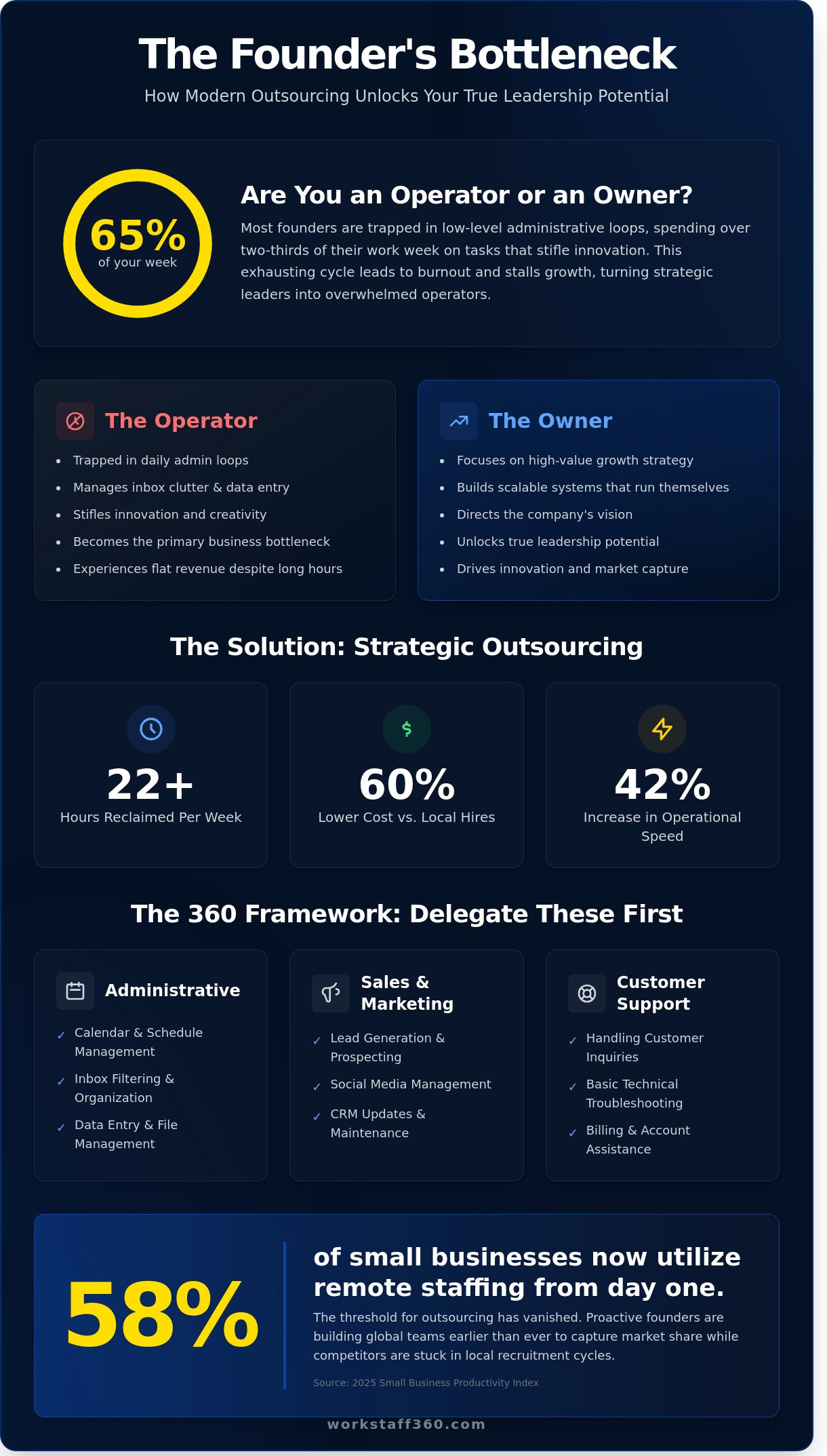
What if the biggest threat to your company’s growth is actually you? Most founders spend 65 percent of their work week trapped in low-level administrative loops that stifle innovation and lead to total burnout. You know the exhausting weight of being an overwhelmed operator rather than a strategic leader. It’s frustrating to watch your vision stall because you’re busy managing inbox clutter or basic data entry. Modern outsourcing for small business isn’t just about cutting costs anymore; it’s a critical survival strategy to maintain a competitive edge as we head into 2026.
This guide provides the exact blueprint to buy back 22 hours of your work week while building a scalable engine that runs without your constant supervision. You’ll learn how to bypass the fear of bad hires and access specialized talent that costs 60 percent less than local alternatives. We’re breaking down the modern frameworks you need to transition from a solo bottleneck to a high-performing owner. From choosing the right model to seamless integration, here is how you build your global team and unlock your true leadership potential.
Key Takeaways
- Learn how modern outsourcing for small business has shifted from a cost-cutting tactic to a strategic partnership that drives sustainable growth.
- Identify the high-impact administrative and technical functions you must delegate to transition from an overwhelmed operator to a strategic owner.
- Compare the risks of gig platforms against the agency advantage to ensure your scaling efforts aren’t derailed by high turnover or low quality.
- Implement a five-step roadmap to standardize your operations and delegate tasks with total confidence using proven SOP frameworks.
- Explore how a 360-degree vetting process achieves a 99% placement success rate, providing the dedicated support your business ecosystem requires.
What is Outsourcing for Small Business in 2026?
In 2026, the definition of success for emerging companies has shifted. Outsourcing for small business is no longer a desperate cost-cutting measure; it’s a primary lever for rapid scaling. Modern founders use it to leverage external talent for non-core functions so they can focus on high-value growth. This transition represents a move away from the “cheap labor” mentality of the past decade toward high-level strategic partnerships. In the current global economy, you aren’t just hiring a pair of hands. You are integrating specialized, vetted talent into your business ecosystem to gain a competitive edge.
Small businesses now outsource earlier in their lifecycle than ever before. In 2024, many startups waited until they hit $1 million in revenue to hire internationally. By 2026, that threshold has vanished. Data from the 2025 Small Business Productivity Index shows that 58% of companies with fewer than ten employees now utilize remote staffing from day one. This proactive approach allows them to capture market share while their competitors are still bogged down in local recruitment cycles. To understand the foundational principles of this shift, it’s helpful to review the history of What is Outsourcing and how it evolved into the sophisticated model we use today.
The efficiency gains are impossible to ignore. A 2026 industry report confirmed that small enterprises using dedicated remote teams saw a 42% increase in operational speed. These businesses don’t just save money on overhead; they reclaim the most valuable asset any founder possesses: time. By offloading repetitive processes, you create the mental space required for innovation and leadership.
The ‘Operator vs. Owner’ Mindset
The jack of all trades approach is the #1 killer of small business growth. When you try to be the accountant, the marketing manager, and the customer support lead, you become the primary obstacle to your own success. You’ve reached the Bottleneck Moment when your daily task list prevents you from looking at your quarterly goals. This stage is characterized by flat revenue despite working longer hours. Overcoming the psychological barrier of letting go is the hardest part of scaling. You must stop being the operator who does the work and start being the owner who builds the system. Trusting a vetted partner to handle the details is the only way to break through the ceiling of your own capacity.
Core vs. Non-Core Functions
Scaling requires you to identify your Zone of Genius. These are the tasks that only you can perform to drive the vision of the company forward. Everything else falls into the 360-degree view of business operations, including admin, sales, marketing, and support. We define non-core functions as any task that doesn’t directly require the founder’s unique creative signature. If a process can be documented, it can be outsourced. By delegating these responsibilities to a dedicated professional, you ensure that every part of your business receives elite-level attention. This allows you to stay focused on the high-impact decisions that actually move the needle.
- Administrative: Calendar management, inbox filtering, and data entry.
- Sales & Marketing: Lead generation, social media management, and CRM updates.
- Support: Customer inquiries, technical troubleshooting, and billing assistance.
The 360 Framework: What Small Businesses Should Outsource First
The 360 Framework focuses on creating a self-sustaining ecosystem where the founder directs the vision while a dedicated team handles the execution. High-impact outsourcing for small business starts by identifying the specific friction points that stall daily momentum. You cannot build a scalable company if you’re buried under a mountain of unread emails and unfiled receipts. Success requires a strategic shift from being the primary doer to becoming the primary architect of your business systems.
Project management acts as the central nervous system in this framework. While you’re busy building the “car” by securing new partnerships and developing products, a remote project manager keeps the “engine” running. They ensure that deadlines are met in tools like Asana or ClickUp, preventing the 30% drop in productivity that typically occurs when owners attempt to multitask between high-level strategy and low-level task tracking. This role bridges the gap between your ideas and your team’s output.
Administrative & Bookkeeping Efficiency
Administrative tasks are often the quietest killers of growth. The average small business owner spends roughly 20% of their working week on repetitive office tasks. A General Virtual Assistant (VA) eliminates this noise by managing your calendar, filtering your inbox, and organizing data entry. By delegating these duties, you reclaim approximately 10 hours every week to focus on revenue-generating activities. You can explore this list of 15 tasks to outsource to a General Virtual Assistant today to see where you can start saving time immediately.
Financial clarity is equally critical. According to a 2023 study, 82% of small businesses fail due to cash flow problems. Professional bookkeeping provides the visibility you need to make informed decisions before a crisis hits. The U.S. Small Business Administration provides a clear roadmap on what small businesses should outsource to maintain compliance and financial health. Outsourcing this function ensures your records are tax-ready and accurate, removing the panic of April 15th while providing a real-time snapshot of your profit margins.
Growth-Centric Roles: Sales & Marketing
Many entrepreneurs confuse a marketing firm with a dedicated marketing assistant. A firm often handles high-level strategy and expensive ad buys, but a dedicated assistant executes the daily grind. They manage your social media presence, draft email newsletters, and update your e-commerce product listings. This consistent activity keeps your brand visible without requiring your constant intervention. It is a more cost-effective way to maintain outsourcing for small business momentum without the high retainer fees of a large agency.
Industry-specific needs require specialized talent. Real Estate Virtual Assistants (REVAs) can manage lead coordination and transaction paperwork, which is vital for maintaining momentum in a fast-moving market. If you’re in the property sector, learning how a REVA can help you close more deals this year can be the difference between a stagnant portfolio and a record-breaking quarter. Similarly, Healthcare VAs handle patient scheduling and insurance verification while adhering to strict HIPAA compliance standards. These front-facing roles ensure that lead generation and customer support never skip a beat.
If you’re ready to stop managing tasks and start leading a team, it’s time to find a vetted professional who fits your specific business culture and operational needs.
Outsourcing Models: Freelancers vs. Agencies vs. Dedicated Staff
Stop treating hiring like a one-off transaction. Success in outsourcing for small business depends entirely on the model you select. While gig platforms host over 157 million freelancers globally, the “gig” approach often creates a revolving door of talent. Business owners lose an average of 42 days every time they have to replace a departed freelancer. This churn kills momentum and drains your energy.
The freelance trap is built on low hourly rates that mask high hidden costs. You might find a worker for $8 an hour, but you become their de facto project manager. If you spend 5 hours a week correcting their mistakes or chasing deadlines, your actual cost of labor doubles. High turnover is the standard on these platforms because gig workers are constantly hunting for the next project rather than focusing on your growth.
Agencies eliminate the friction of vetting by providing a structured layer of support. They handle the heavy lifting of background checks and skill assessments before you ever see a resume. Instead of gambling on an unverified profile, you gain access to a professional who has already cleared a rigorous 5-step screening process. This structure is particularly effective for the functions small businesses can outsource to reclaim their executive focus, such as bookkeeping or lead generation.
The dedicated professional model represents the gold standard for scalability. This isn’t just “help”; it’s a seamless integration into your team. Unlike project-based contractors who juggle 5 other clients, a dedicated staff member focuses 100% on your specific KPIs. This commitment leads to a 30% increase in output compared to fragmented freelance help.
Why Long-Term VAs Outperform Gig Workers
Institutional knowledge is a silent profit driver. A VA who has been with you for 12 months knows your top 50 customers by name and understands your brand voice without a prompt. Security risks also drop when you move away from solo freelancers. Agencies implement professional data protocols and monitoring software that individual gig workers cannot match. Protecting your sensitive data requires more than a handshake agreement. For a deeper dive into this topic, explore why long-term VAs outperform short-term freelancers.
Navigating Global Talent: Philippines vs. Pakistan
Choosing the right market is a strategic decision based on your specific needs. The Philippines maintains a 95% literacy rate and high cultural alignment with Western markets, making it the premier choice for customer-facing roles and administrative support. Pakistan offers a deep pool of technical talent, particularly in software development and complex data analytics. You can leverage the “follow the sun” model to ensure your business operates 24/7 while you sleep. To determine the best fit for your business, read our comparison on Philippines vs. Pakistan: Which VA market is for you.
Effective outsourcing for small business requires looking past the initial price tag to see the total cost of ownership. Replacing a staff member typically costs 33% of their annual salary in lost productivity and recruiting fees. By choosing a dedicated, agency-backed model, you bypass these expenses. You aren’t just filling a seat; you’re building a foundation for permanent expansion.
The Small Business Outsourcing Roadmap: 5 Steps to Success
Stop guessing where your time goes and start measuring it. Successful scaling begins with a rigorous audit of your daily operations. Track every single task for five consecutive business days to identify the high-friction activities that drain your energy. A 2023 study by Harvard Business Review found that executives spend roughly 24% of their workdays on tasks that could easily be delegated. Use this data to separate your “Genius Zone” from your “Admin Zone.” If a task doesn’t require your unique expertise, it’s a prime candidate for outsourcing for small business owners who want to reclaim their strategic focus.
Creating SOPs That Actually Work
Standardize your workflow before you hand it off. Use the “Record, Review, Refine” method to document your internal processes. Start by recording your screen while performing a task; this captures the nuances that written text often misses. Review the footage to identify logical gaps, then refine the steps into a clear, actionable checklist. Tools like Loom reduce training time by 40% compared to traditional manuals. Remember this: “An SOP is not a manual; it is a blueprint for consistent excellence in your absence.”
Once your processes are clear, you must vet for more than just technical skill. A 2024 LinkedIn Global Talent Trends report shows that 92% of hiring managers now prioritize cultural alignment and soft skills alongside technical proficiency. You aren’t just looking for a freelancer; you’re looking for a partner who communicates proactively and solves problems without constant oversight. Look for candidates who demonstrate a high degree of ownership during the interview process. This ensures they’ll integrate into your business ecosystem rather than remaining an isolated contractor.
Integration is the bridge between hiring and high performance. Treat your remote staff like core team members from day one. Set up dedicated communication channels and hold a 15-minute kick-off call to align on goals. Integration fails when communication is treated as an afterthought. Provide access to the right software and define what success looks like for the first 30 days. This creates a sense of belonging that drives long-term retention and loyalty.
The AI-Augmented Assistant
The landscape of outsourcing for small business is shifting toward high-tech efficiency. By 2026, top-tier virtual assistants will spend 60% of their time managing AI tools rather than performing manual data entry. Hiring a human who manages AI is the ultimate small business “cheat code.” These assistants use AI to accelerate content creation, research, and data analysis while you maintain the human touch in high-stakes client interactions. This hybrid approach allows you to scale from one assistant to a multi-functional team with 3x the output of traditional models.
Iterating your team structure is the final step toward total freedom. As your first hire masters their role, identify the next bottleneck in your growth. Move from a single assistant to a specialized remote team that handles marketing, customer support, and operations. This cascading growth model ensures your business remains agile and responsive. You’ll stop being the operator and finally become the visionary leader your company needs to reach the next level of revenue.
Ready to reclaim your time and accelerate your growth? Build your high-performance remote team today with a partner dedicated to your success.
Scaling with WorkStaff360: Your Dedicated Growth Partner
Stop treating hiring like a high-stakes gamble. Most platforms offer a database of names; we offer a curated growth solution. Our 360-degree vetting process is designed to filter out 97% of applicants before you ever see a resume. This rigorous screening ensures we maintain a 99% placement success rate across all industries. When you choose WorkStaff360, you aren’t just hiring a remote worker. You’re integrating a dedicated professional who has been tested for technical skill, cultural fit, and proactive problem-solving. Effective outsourcing for small business requires more than just a pulse; it requires a partner who understands your specific growth trajectory.
The Holistic Staffing Approach
Our model bridges the gap between global affordability and North American professional standards. By combining Canadian-based management with elite global talent, we eliminate the communication barriers and time-zone friction that plague traditional outsourcing. In 2023, a Florida-based real estate firm utilized our staffing services to handle their lead management and CRM updates. They doubled their annual revenue in just 14 months by freeing their core team to focus exclusively on closing deals. This isn’t about cutting corners; it’s about strategic expansion. Ready to scale? Book your free 360-degree growth consultation today.
We don’t leave you to figure out the logistics alone. Our team assists with seamless integration, helping you build workflows that actually stick. You might start with a General VA to handle your inbox, but our talent pool scales as you do. We’ve seen clients transition from a single assistant to a full department led by a dedicated Project Manager within 18 months. This evolution moves you from the “operator” role to the “owner” role, granting you the business freedom you’ve been working toward since day one.
Your First 90 Days
The first 30 days of your journey focus on alignment. You’ll establish communication cadences and define clear success metrics. By day 60, your new staff member typically operates with 85% autonomy. By the 90-day mark, they’re often identifying process efficiencies you hadn’t even considered. We provide ongoing support through monthly performance check-ins to ensure your outsourcing for small business strategy stays on track and continues to deliver a high return on investment.
Outsourcing isn’t an expense that drains your budget; it’s the strategic investment that buys your future back. By offloading repetitive tasks to a vetted professional, you reclaim the hours needed to focus on high-value tasks that move the needle. Whether you’re looking for administrative support or specialized technical skill, we provide the infrastructure to help you grow without the overhead of traditional hiring. Your time is your most valuable asset. It’s time to start spending it on the vision that started your business in the first place.
Future-Proof Your 2026 Growth Strategy
The business landscape in 2026 rewards agility and precision. You’ve learned how the 360 Framework identifies critical tasks for delegation and why a structured 5-step roadmap prevents the common pitfalls of rapid expansion. Success now depends on moving beyond temporary fixes to build a foundation of permanent, high-performing talent. Strategic outsourcing for small business serves as the engine that powers this transition, allowing you to reclaim up to 40 hours of leadership time every single month.
WorkStaff360 eliminates the hiring friction that stalls most entrepreneurs. We connect you with the vetted top 3% of global talent, ensuring every hire is a long-term asset rather than a short-term gig-hopper. With our Canadian-based support and oversight, you gain the security of local accountability combined with global expertise. Stop managing tasks and start leading your industry. Scale your business with a dedicated WorkStaff360 professional today and secure the dedicated support your vision deserves. The path to a leaner, more profitable organization starts with a single strategic hire.
Frequently Asked Questions
Is outsourcing safe for small businesses with sensitive data?
Yes, outsourcing for small business is safe when you partner with agencies that enforce ISO 27001 security standards and 256-bit encryption. WorkStaff360 implements rigorous background checks and multi-factor authentication protocols for all vetted talent. You’ll maintain control through Secure Shell access and limited data permissions. These layers of protection ensure your proprietary information stays confidential while your team scales effortlessly.
How much does it cost to outsource to a virtual assistant in 2026?
Expect to pay between $12 and $25 per hour for a high-level virtual assistant in 2026. Specialized roles like executive assistants or technical coordinators often command the higher end of that range due to increased demand for niche skills. This represents a 65% cost reduction compared to hiring a full-time in-house employee. You save on overhead, benefits, and office space immediately.
What is the difference between outsourcing and offshoring?
Outsourcing refers to the practice of hiring a third party to handle specific business functions; offshoring specifically means moving those functions to a distant country to leverage lower labor costs. You can outsource to a local firm five miles away or offshore the work to a team 8,000 miles across the globe. Both strategies aim to increase efficiency and maximize your budget through global price arbitrage.
How do I manage a remote team across different time zones?
Schedule a mandatory 4-hour overlap window where all team members are online simultaneously for real-time collaboration. This ensures your project momentum doesn’t stall during the 24-hour production cycle. Use centralized platforms like Slack for communication and Jira for task tracking to maintain a clear audit trail. Clear documentation prevents bottlenecks and keeps your global operations running smoothly while you sleep.
Can I outsource customer service without losing the ‘local’ feel?
You can maintain a local feel by selecting vetted talent who undergo 40 hours of brand-specific cultural immersion training. WorkStaff360 focuses on hiring professionals with high emotional intelligence and neutral accents to ensure a seamless customer experience. Data from 2024 shows that businesses using localized scripts achieve a 92% customer satisfaction rate. Your customers won’t notice a difference; they’ll only see faster response times.
What happens if the outsourced staff member isn’t a good fit?
We initiate a replacement process immediately and typically present a new qualified candidate within 14 business days. Our 360-degree vetting process minimizes this risk, but we offer a satisfaction guarantee to protect your investment. You won’t be stuck with a poor performer or lose time on a lengthy re-hiring cycle. This agility allows your business to stay on its growth trajectory without administrative friction.
Do I need to provide equipment for my remote staff?
You don’t need to provide hardware because our staff must meet strict technical requirements, including an i7 processor and 20Mbps minimum internet speed. This removes the $1,500 upfront cost per employee typically associated with new hires. We verify every workstation before the onboarding process begins to ensure peak performance from day one. Your capital stays in your business where it can fuel further expansion.
How do I track the productivity of an outsourced worker?
Track productivity through automated tools like Hubstaff or Time Doctor which provide 100% transparency into daily activities. We recommend setting three specific Key Performance Indicators for each role to measure output rather than just hours worked. This results-oriented approach often leads to a 15% increase in efficiency compared to unmonitored in-house staff. You’ll receive weekly reports that quantify exactly how your investment is driving growth.