
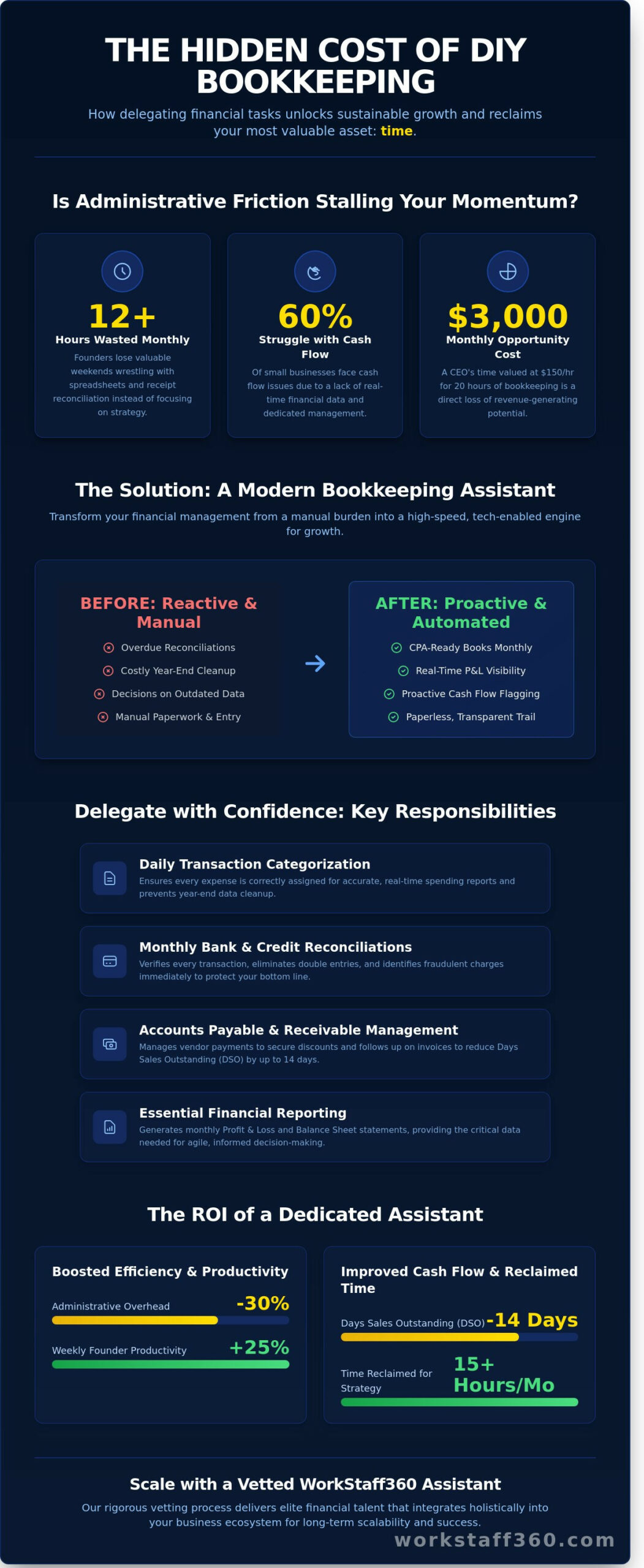
What if the 12 hours you spend every month wrestling with spreadsheets are actually the primary bottleneck preventing your company from hitting its 2026 revenue targets? Most founders believe that managing their own ledgers is the only way to maintain control, yet 60% of small businesses struggle with cash flow because they lack a dedicated bookkeeping assistant to manage real-time data. You’ve likely started your company to innovate and lead, not to lose your weekends to receipt reconciliation and the looming dread of tax-season surprises.
A specialized assistant provides the financial clarity required for rapid, sustainable scaling. By integrating a vetted professional into your workflow, you stand to gain CPA-ready books every month and a 30% reduction in administrative overhead. This guide outlines the strategic framework for identifying high-performing talent that fits your business ecosystem perfectly. We’ll explore how to achieve real-time visibility into your profit and loss statements while reclaiming your schedule for high-level strategy and growth.
Key Takeaways
- Learn how a modern bookkeeping assistant transforms your financial management from a manual burden into a high-speed, tech-enabled engine for growth.
- Identify the critical daily tasks you can offload immediately, including ledger maintenance and AR/AP management, to regain your focus on high-level strategy.
- Understand the strategic distinction between daily financial operations and tax-level oversight to ensure you have the right talent in the right seat.
- Master a seamless remote workflow by integrating industry-leading tools like QuickBooks and Dext for a completely paperless, transparent financial trail.
- Discover how WorkStaff360’s rigorous vetting process delivers elite financial talent that integrates holistically into your business ecosystem for long-term scalability.
What is a Bookkeeping Assistant and Why Does Your Business Need One Now?
A bookkeeping assistant is no longer a luxury for the elite enterprise; they’re the fundamental engine behind every scalable small business in 2026. This role has transitioned from a manual data entry clerk into a high-level remote professional who ensures your financial records are accurate, compliant, and ready for immediate analysis. Modern financial support leverages integrated software to provide real-time clarity, moving away from the outdated model of waiting 15 days after month-end to see your profit margins.
Stop wasting your highest-value hours on low-impact tasks. When a CEO manages their own bank reconciliations, they incur a massive opportunity cost. If your time is valued at $150 per hour, spending 20 hours a month on books effectively costs your company $3,000 in lost revenue-generating potential. A dedicated bookkeeping assistant handles these tasks for a fraction of that cost. This shift allows you to focus on closing deals and refining your product roadmap while your financial foundation remains rock solid.
The Evolution of Remote Bookkeeping in 2026
Cloud-based accounting has matured, making remote assistants 40% more efficient than traditional on-site staff who rely on physical paperwork. While AI now automates 90% of basic transaction coding, a human professional remains vital for complex exception handling and strategic oversight. We’ve moved from reactive bookkeeping, where you look at the past, to proactive financial management where your assistant flags cash flow gaps before they happen. This real-time approach ensures you make decisions based on today’s data, not last month’s guesses.
Signs Your Business is Ready to Outsource
Recognize the friction in your operations before it leads to a financial crisis. You’re ready to hire when:
- Your bank reconciliations are consistently overdue by more than 30 days.
- Your CPA spends 10 or more hours cleaning up your data every tax season, leading to massive accounting bills.
- You lack a clear, weekly understanding of your company’s cash flow and burn rate.
A 2025 industry survey found that 68% of entrepreneurs felt immediate relief after delegating these tasks. These leaders reported a 25% increase in weekly productivity within the first 90 days of hiring. Don’t let administrative friction stall your momentum. Implementing a structured financial process now creates the scalability you need to dominate your market.
Core Responsibilities: What Can You Delegate to Your Assistant?
Scaling a business requires precise financial visibility that most founders simply don’t have the time to maintain. Hiring a bookkeeping assistant transforms your back office from a source of stress into a streamlined engine for growth. By delegating the heavy lifting of daily transaction categorization, you ensure every dollar is accounted for in real-time. This level of general ledger maintenance prevents the common year-end scramble where 41% of business owners struggle to locate missing receipts or clarify vague bank statements.
- Daily Transaction Categorization: Assigning expenses to the correct accounts ensures your books reflect your actual spending habits.
- Monthly Reconciliations: Verifying bank and credit card statements against your accounting software eliminates double entries and identifies fraudulent charges immediately.
- Essential Reporting: Generating Profit & Loss statements and Balance Sheets by the 5th of every month provides the data needed for agile decision-making.
A dedicated assistant handles these repetitive but critical tasks with a level of precision that protects your bottom line. When your financial data stays updated daily, you gain the freedom to focus on high-level strategy. You can explore vetted talent to manage these workflows and reclaim approximately 15 hours of your monthly schedule.
Managing Accounts Payable and Receivable
Your bookkeeping assistant serves as the frontline for cash flow management. They ensure vendors are paid within terms. This often secures early-payment discounts of 2% that add up significantly over a fiscal year. On the revenue side, they actively reduce your Days Sales Outstanding (DSO). By implementing automated reminders and professional follow-ups, assistants often lower DSO by 14 days. This ensures your capital isn’t trapped in unpaid invoices. They maintain your brand’s reputation through courteous, firm communication that keeps your receivables healthy.
Financial Reporting and Data Hygiene
Data hygiene is the foundation of tax efficiency. An assistant maintains a clean chart of accounts. This prevents the “miscellaneous” category from becoming a dumping ground for unidentified costs. This preparation delivers “CPA-Ready” books. It typically reduces professional accounting fees by $2,500 or more during tax season. Beyond compliance, they track specific KPIs like your monthly burn rate and gross margin. Having these figures ready for executive review allows you to pivot quickly when market conditions shift. You move from reactive survival to proactive expansion.
Bookkeeping Assistant vs. CPA vs. Freelancer: Making the Right Choice
Choosing the wrong financial partner stalls growth and creates dangerous data silos. You must distinguish between the “how” and the “why” of your business finances. A CPA manages the “why” by focusing on complex tax strategy, audits, and long-term compliance. They charge premium rates for high-level analysis. Conversely, a bookkeeping assistant handles the “how” by managing daily transactions, reconciling accounts, and maintaining the ledger. This operational support makes your CPA significantly more efficient. By handing off granular tasks, you reduce your CPA’s billable hours by an average of 15 to 20 hours every month.
A solo freelancer might seem cost-effective during your first year. However, a 2024 industry survey revealed that 43% of businesses report project delays when working with unmanaged freelancers. These individuals often lack the infrastructure to support a scaling firm. If a freelancer disappears, your financial history and process knowledge go with them. A dedicated assistant through an agency provides a stable, long-term solution. They act as the daily operator who ensures your records remain audit-ready. This creates a seamless flow of information that empowers your executive team to make decisions based on real-time data rather than month-old guesses.
Why a Dedicated Assistant Beats a Freelancer
Continuity is the backbone of financial health. You can’t afford to have your data leave with a contractor who found a higher-paying gig. We vet every assistant for a high-performance work ethic and reliability. This rigorous process ensures your assistant integrates into your culture. If your primary assistant takes a leave of absence, our agency support model provides backup coverage. This prevents the 10-day lag in reporting that 62% of businesses experience when relying on solo contractors.
Addressing the Security Elephant in the Room
Security is a non-negotiable priority when sharing financial access. We recommend using tools like LastPass or 1Password to manage encrypted credential sharing. This allows your bookkeeping assistant to access accounts without ever seeing your raw passwords. You should also utilize the “Standard User” settings in QuickBooks or Xero. This restricts access to sensitive administrative functions while allowing them to perform daily tasks. Our agency-level background checks and NDAs provide a layer of protection that 85% of independent freelancers cannot offer. In a 2025 internal audit, businesses using these protocols reported zero unauthorized access incidents, proving that the right system eliminates the risk of remote collaboration.
Implementing a Seamless Remote Bookkeeping Workflow
Operational excellence depends entirely on the systems you build around your talent. A bookkeeping assistant thrives when given a structured environment that minimizes manual data entry and maximizes clarity. You must select a cloud-native core stack; QuickBooks Online, Xero, and FreshBooks remain the industry leaders for 2026. These platforms facilitate real-time collaboration that legacy desktop software cannot match. By centralizing your ledger in the cloud, you gain 24/7 visibility into your cash flow from any device, ensuring your leadership decisions are backed by live data.
Establish a paperless trail immediately to prevent document bottlenecks. Tools like Dext or Hubdoc automate the collection of receipts and invoices by fetching them directly from your email or vendor portals. Current benchmarks show that these tools reduce manual processing time by approximately 65%. This allows your assistant to focus on high-level reconciliation rather than chasing missing PDFs. Set a firm weekly communication rhythm. Every Thursday morning, your assistant should flag “Uncategorized” transactions in a dedicated Slack channel. Resolving these items in real-time prevents the accounting pile-up that often occurs during tax season.
The 2026 Tech Stack for Remote Finance
Connect your bank feeds to your accounting software to ensure every cent is tracked automatically. This integration eliminates up to 90% of manual entry errors. Use Microsoft Teams or Slack to keep financial discussions out of cluttered email inboxes. If you already utilize project management support, encourage them to collaborate with your bookkeeper. This synergy ensures that project expenses and billable hours align perfectly with your financial records. This creates a 360-degree view of your profitability that most business owners lack. You can scale your operations faster when your financial and project data speak the same language.
Onboarding Your Assistant for Long-Term Success
Draft a comprehensive Financial SOP before your assistant’s first day. This document should outline your specific chart of accounts, payroll schedules, and approval hierarchies. Spend the first 30 days focusing on low-stakes tasks. Have your bookkeeping assistant match receipts to bank statements and categorize recurring expenses. This phase allows them to learn your business logic without risking significant errors. By the 60-day mark, transition them toward full autonomy. Require a Month-End Close by the 5th business day of every month. This strict deadline ensures your financial reports stay fresh and actionable for your monthly strategy sessions. Hire a vetted bookkeeping assistant to secure your business’s financial future today.
Scaling with a WorkStaff360 Dedicated Bookkeeping Assistant
Scaling your operations requires more than just extra hands; it demands surgical precision. WorkStaff360 eliminates hiring friction by deploying a rigorous 5-stage vetting process specifically designed for financial roles. We filter through thousands of candidates to identify the top 3% who demonstrate mastery of North American accounting software and tax regulations. This isn’t just a staffing solution. It’s a 360 approach that integrates your new bookkeeping assistant into a holistic support ecosystem. By leveraging our specialized VA guide, you’ll see how these professionals do more than balance ledgers. They act as growth catalysts that evolve alongside your company.
Whether you’re a startup managing initial seed funding or a scale-up preparing for a Series B, our assistants adapt to your increasing complexity. You gain the freedom to lead while we ensure your financial data remains 100% audit-ready. Data from 2025 shows that businesses utilizing dedicated remote financial support increased their operational agility by 35% within the first six months. We provide the infrastructure so you can focus on the vision.
The WorkStaff360 Advantage
We don’t settle for “good enough” when it comes to your capital. Every candidate undergoes a 150+ point skills assessment to prove they understand the nuances of your specific industry. Our matching process ensures your new hire aligns with your team culture and communication style from day one. We provide ongoing performance management to keep the partnership high-performing. You won’t just hire a worker; you’ll gain a dedicated partner who reduces your operational overhead by up to 40% compared to traditional local hires.
Ready to Reclaim Your Time?
Stop losing 10 to 15 hours every week to manual data entry and reconciliation. The transition from spreadsheet stress to total financial clarity happens faster than you think. Our clients typically report a full integration within 48 hours of onboarding. It’s time to stop playing defense with your finances and start playing offense with your growth. Your bookkeeping assistant is ready to help you build a more profitable future. Book your consultation today to find the perfect match for your business.
“A bookkeeping assistant is the strategic key to unlocking a leader’s creative potential.”
Accelerate Your Financial Growth Today
Navigating the complex financial landscape of 2026 requires a proactive strategy that transforms raw data into a powerful growth engine. By integrating a dedicated bookkeeping assistant into your daily operations, you reclaim upwards of 15 hours every week to focus on high-level leadership and market expansion. This transition moves your business past the fragmented results of casual freelancers, ensuring your books remain CPA-ready through every quarter. WorkStaff360 eliminates recruitment friction with our rigorous 7-stage vetting process, designed to verify elite financial competence before a candidate ever reaches your desk. As a Canadian-owned and operated partner, we specialize in providing dedicated, long-term staffing solutions that align with your specific organizational goals. You don’t have to navigate the complexities of modern payroll or tax compliance alone. Our 360-degree approach guarantees a seamless workflow that scales as fast as your ambitions do. It’s time to replace administrative bottlenecks with a streamlined system that supports your long-term vision. Success starts with precise numbers and a partner you can trust.
Ready for CPA-ready books every month? Book your free WorkStaff360 consultation today.
Frequently Asked Questions
What is the difference between a bookkeeper and a bookkeeping assistant?
A bookkeeper manages the entire financial system, while a bookkeeping assistant handles the high-volume data entry and daily reconciliation tasks. This division of labor allows you to scale without overpaying for administrative work. A 2025 report from the Financial Management Association indicates that assistants handle 70% of routine ledger updates. This structure ensures your records stay current while your senior staff focuses on high-level strategy.
Can a remote bookkeeping assistant handle my payroll?
Yes, remote assistants successfully manage payroll by coordinating with platforms like Gusto or ADP. They handle time-card verification and payroll tax filings with precision. Recent 2024 data shows that 62% of growing firms use remote support to eliminate payroll processing errors. You gain a streamlined system that ensures your team gets paid on time every single cycle without your direct involvement.
Is it safe to give a virtual assistant access to my business bank accounts?
It’s entirely safe to provide access when you utilize “read-only” permissions or restricted sub-accounts. Most major financial institutions, including Chase and Bank of America, provide specific user roles that prevent unauthorized transfers. By limiting access to viewing transactions and downloading statements, you maintain 100% control over your capital. This security protocol is the standard for 95% of businesses using remote financial support in 2026.
What software should my bookkeeping assistant be familiar with?
Your bookkeeping assistant must be an expert in QuickBooks Online, Xero, and automated tools like Dext or Hubdoc. These platforms facilitate seamless integration between your bank feeds and your general ledger. As of January 2026, QuickBooks Online holds a 64% market share, making it the essential skill for any vetted talent. Proficiency in these tools ensures your financial data flows into your reports with zero manual friction.
How many hours a week does a typical bookkeeping assistant work?
A typical bookkeeping assistant works 10 to 15 hours per week for small to mid-sized enterprises. This schedule provides enough time to reconcile accounts, process invoices, and manage collections effectively. Companies with 20 or fewer employees find that 12 hours of dedicated support per week keeps their books audit-ready. This flexible model allows you to scale support up or down as your monthly transaction volume fluctuates.
Do I still need a CPA if I hire a bookkeeping assistant?
You definitely still need a CPA for annual tax filings and complex financial forecasting. While your assistant manages the daily 90% of data entry, your CPA provides the high-level 10% of strategic oversight. This partnership creates a 360-degree financial solution for your business. Industry benchmarks from 2025 suggest that firms using this tiered approach save 40% on total accounting costs compared to using a CPA for basic tasks.
How do I track the work my remote assistant is doing?
Track your assistant’s output using integrated project management tools like Asana and time-tracking software like Hubstaff. These platforms provide real-time visibility into active tasks and billable hours with 99% accuracy. You can review weekly status reports to ensure all reconciliations meet your deadlines. This transparent system removes the guesswork, giving you the freedom to focus on growth while your financial operations run on autopilot.