
How much is your time actually worth if you’re spending 70% of your workday on $15 per hour administrative tasks? It’s a frustrating reality for high-performing agents who find their growth stalled by a ceiling of their own making. You know that every hour spent formatting a spreadsheet or chasing a missing signature is an hour you aren’t closing a deal. Hiring a dedicated real estate virtual assistant isn’t just about delegating chores; it’s a strategic move to reclaim 20 or more hours every single week.
We believe your business shouldn’t stop just because you want to take a vacation. This guide shows you how to integrate vetted talent to automate your lead flow and double your conversion rates through relentless, consistent follow-up. You’ll discover the exact framework to transform your daily hustle into a scalable, high-GCI engine that runs smoothly even when you’re off the clock. We’re going to break down how to build a business that finally supports your life instead of consuming it.
Key Takeaways
- Identify the “30-deal wall” and learn how to eliminate the administrative friction that prevents top producers from scaling their revenue.
- Discover how to leverage a dedicated real estate virtual assistant to manage high-impact tasks across administrative, sales, and marketing pillars.
- Explore advanced workflows that integrate AI and modern CRM ecosystems to automate your lead flow and market reporting.
- Apply a proven three-stage hiring blueprint to vet for “Real Estate IQ” and ensure your next hire is a seamless cultural fit.
- Understand the critical shift from hiring task-based freelancers to securing dedicated professionals who drive long-term business transformation.
The Real Estate Growth Ceiling: Why Top Producers Need a Virtual Assistant
Every high-performing agent eventually hits a structural limit known as the 30-deal wall. This is the exact point where administrative friction outweighs your ability to generate new business. A real estate virtual assistant acts as a dedicated remote professional who specializes in property-specific operations; they manage the complex workflows that keep your business running while you focus on the closing table.
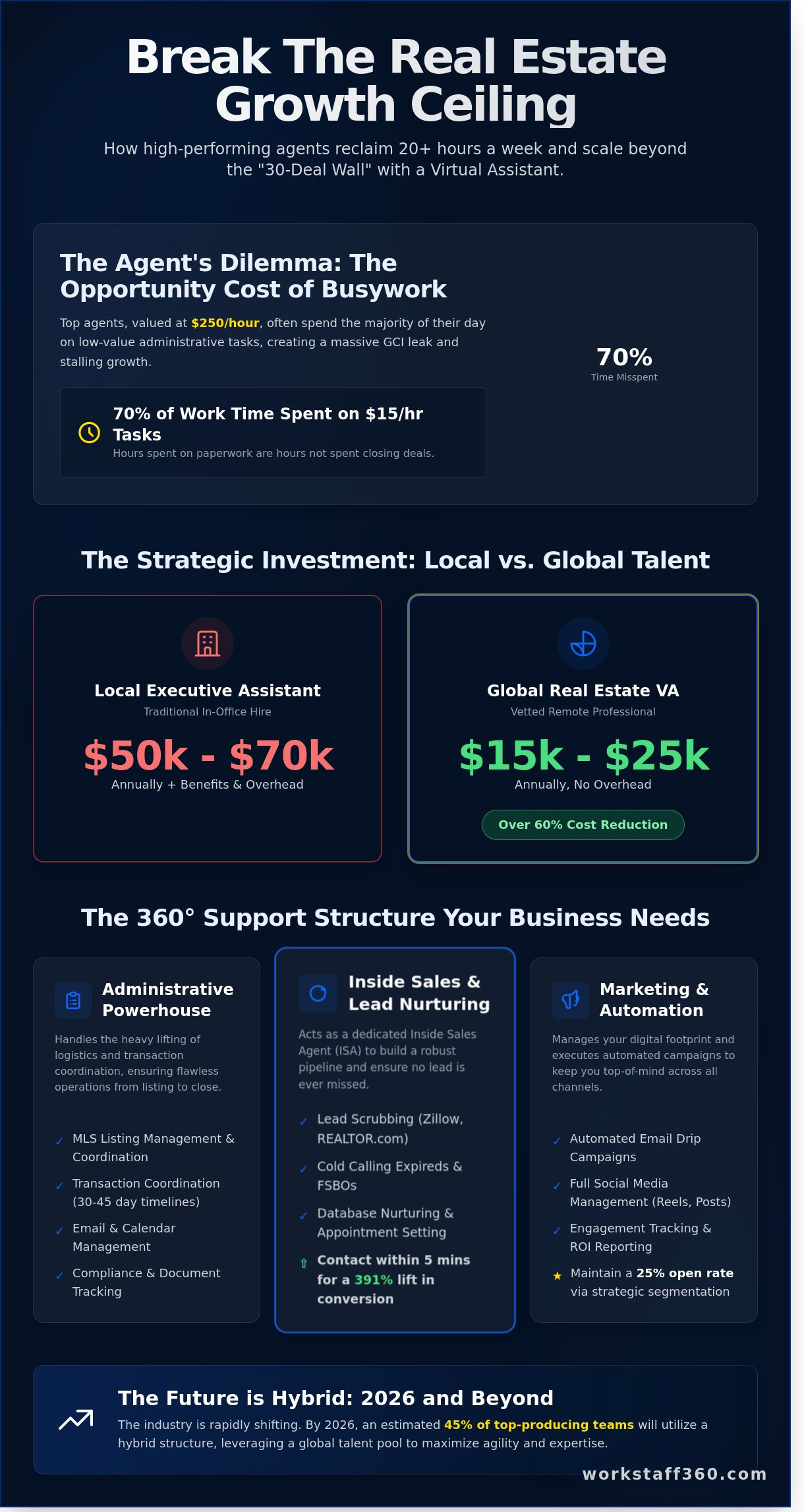
Most solo agents plateau at 30 transactions per year because they’re buried in listing coordination and transaction management. Scaling beyond this ceiling requires a shift in how you view human capital. Hiring a local executive assistant in 2024 demands a salary between $50,000 and $70,000 plus benefits. A global REVA provides the same high-level operational support for $15,000 to $25,000. This 60% reduction in overhead costs allows you to reinvest capital into lead generation rather than just maintaining the status quo.
Strategic growth depends on the concept of Highest and Best Use. Your time is a finite resource. If you aren’t spending 90% of your day on listing presentations, buyer consultations, or high-stakes negotiations, you’re effectively paying yourself an assistant’s wage to do administrative work. A 360-degree support structure ensures that your specialized skills are applied where they generate the most revenue.
The Opportunity Cost of Paperwork
Top agents earning $500,000 in annual Gross Commission Income (GCI) value their time at approximately $250 per hour. Spending five hours every week on CRM data entry or file auditing costs you $1,250 in lost productivity. These “GCI leaks” often go unnoticed, yet data from industry performance reports shows that poor lead follow-up results in a 20% loss of potential revenue annually. Delegation eliminates these leaks and creates the mental space required for high-level strategy and client relationship building.
Why 2026 is the Year of the Hybrid Team
The industry is rapidly shifting toward remote-first brokerage models that prioritize agility over physical office space. By 2026, an estimated 45% of top-producing teams will utilize a hybrid structure to leverage the global talent pool. This model allows you to source vetted professionals who are experts in modern prop-tech and digital marketing. The modern real estate virtual assistant is a tech-enabled growth catalyst who automates the mundane to amplify your human potential.
Decoding the Role: What Does a Real Estate Virtual Assistant Actually Do?
A real estate virtual assistant functions as the operational engine of a high-growth agency. They transform a chaotic solo practice into a 360-degree business ecosystem by managing three critical pillars: administration, sales, and marketing. Instead of reacting to daily crises, agents who leverage these specialists regain 15 to 20 hours of their work week to focus on high-dollar closing activities.
The Administrative Powerhouse
Administrative REVAs handle the heavy lifting of listing management and office logistics. They manage the MLS by coordinating professional photography, writing compelling property descriptions, and ensuring every listing goes live within 24 hours of contract signing. They act as a digital gatekeeper, filtering an average of 100+ daily emails so the agent only sees “money” communications. These assistants also function as Transaction Coordinators. They track 30 to 45 day closing timelines, ensuring every inspection report and escrow document meets strict compliance standards before the deadline. This precision prevents deal fallouts and keeps the GCI pipeline moving.
Inside Sales and Lead Nurturing
The Inside Sales Agent (ISA) role is a high-impact function dedicated to revenue generation. These professionals scrub leads from platforms like Zillow or REALTOR.com, making initial contact within the critical 5-minute window that increases conversion rates by 391 percent. They consistently cold call expired listings and FSBOs to build a robust pipeline. By nurturing the existing database through personalized outreach, they identify “warm” prospects and book listing appointments directly onto your calendar. This proactive approach ensures your sales funnel never runs dry. To see how these roles fit into your specific business model, you can explore vetted talent options that match your current volume.
Marketing and Automation
Marketing assistants manage the digital footprint that keeps an agent top-of-mind. They execute automated email drip campaigns that maintain a 25 percent open rate through strategic segmentation and personalized messaging. Beyond simple posting, they handle full social media management, from creating Reels to responding to comments in real-time. This 360-degree support ensures your brand remains active across all platforms without requiring a single minute of your personal time. They track engagement metrics and report on ROI, allowing you to double down on the channels that actually generate contracts.
Beyond Data Entry: Advanced Workflows and 2026 Tech Integration
Stop viewing the real estate virtual assistant as a mere data entry clerk. By 2026, the industry will shift toward total digital integration, where the “360-Degree Support” model replaces traditional task-based hiring. This model focuses on high-level outcomes like lead conversion rates and speed-to-lead metrics rather than just hours logged. Top-tier REVAs now function as technical operations managers who architect your business growth from the inside out.
Efficiency thrives on automation. Your VA configures Zapier triggers to create a seamless flow between your lead sources and your CRM. For example, setting up an automated workflow that pushes Zillow leads into Follow Up Boss and triggers an immediate SMS can improve contact rates by 391% when handled within the first five minutes. This level of technical proficiency transforms your business into a self-sustaining ecosystem that generates revenue while you sleep.
Mastering the Real Estate Tech Stack
Modern REVAs act as the “CRM Shepherd” for your database. They audit platforms like Chime or KVCore daily to ensure no prospect falls through the cracks. They also take the lead on high-impact marketing tasks that drive visibility. They edit raw footage into polished property tours for YouTube and TikTok, capturing the 73% of homeowners who are more likely to list with an agent using video. Additionally, they coordinate digital signatures through DocuSign or Dotloop, ensuring every initial and date is captured to prevent closing delays that cost you commissions.
The Human-AI Synergy
Artificial Intelligence is a powerful tool, but it lacks the nuance of a local expert. REVAs use AI to analyze complex market trends and generate detailed neighborhood guides in minutes. They provide the necessary human oversight to ensure automated client communications don’t feel robotic or impersonal. A real estate virtual assistant serves as the essential bridge between raw AI data and the high-trust relationships required to close seven-figure deals. This synergy allows you to scale your content output by 500% without sacrificing the personal touch that defines your brand. By delegating the prompting and refining process, you maintain the authority of a market leader while the VA handles the heavy lifting of content production.
The Hiring Blueprint: Selecting and Onboarding a Dedicated Professional
Scaling your brokerage requires more than just an extra pair of hands; it demands a strategic partner with a high “Real Estate IQ.” Hiring a generalist often leads to a 40% increase in training time compared to industry-specific talent. A dedicated real estate virtual assistant should already understand the difference between a pending sale and a contingent offer. They must arrive ready to integrate into your workflow without a three-month learning curve on basic terminology.
Vetting for Excellence
Test for more than just technical skills during the evaluation. Conduct a 15-minute mock screening to evaluate local market nuance and English proficiency. Focus on identifying a “proactive” personality type. A proactive assistant identifies a missing signature on a disclosure before you even open the file. If you’re unsure where to start the process, learn how to hire your first virtual assistant to avoid common pitfalls. Use a 3-stage interview process to guarantee a match:
- Skills Test: Assign a 30-minute task like drafting a listing description or organizing a CRM export to verify technical claims.
- Personality Fit: Use the DISC profile to ensure their communication style aligns with your team’s energy.
- Cultural Alignment: Verify their long-term career goals match your firm’s growth trajectory to ensure retention.
Security and Data Protection
Protecting your client’s 100% confidential data is non-negotiable. Implement a zero-trust architecture from day one. Use LastPass for encrypted password sharing so your real estate virtual assistant never sees raw credentials. Require a VPN for all MLS and CRM activities to prevent unauthorized access. Treat every financial document with a HIPAA-level mindset. Establish clear Standard Operating Procedures (SOPs) that dictate exactly how to handle sensitive information and what to do if a breach is suspected.
The first 90 days determine the ROI of your new hire. Set three specific KPIs by day 30. This might include a 15% increase in lead follow-up speed or 100% accuracy in transaction data entry. Establish a daily 10-minute huddle to maintain a brisk communication rhythm. This structure transforms a remote worker into a core pillar of your business ecosystem. It’s about building a foundation of trust through transparency and measurable output.
Scaling Your Legacy: How WorkStaff360 Transforms Your Real Estate Ecosystem
Scaling a brokerage requires a fundamental shift from hiring “gig” workers to investing in dedicated professionals. A standard real estate virtual assistant found on common freelance platforms often juggles five different clients, leading to fragmented attention and missed deadlines. WorkStaff360 eliminates this conflict by providing a dedicated partner who lives and breathes your brand. Our 360-degree vetting process filters through thousands of applicants to identify the top 1% of global talent. This rigorous 15-step evaluation ensures your hire possesses the technical skills and the emotional intelligence required for high-stakes real estate transactions.
Long-term placements create tribal knowledge that a freelancer simply cannot match. When your assistant understands your specific market nuances and client preferences, they stop being a cost and start being an asset. This continuity allows you to stop training and start leading. By securing a permanent team member, you protect your business continuity and ensure that your next 50 deals are handled with the same precision as your first.
The WorkStaff360 Advantage
We don’t just fill seats. We integrate talent into your unique company culture to ensure seamless collaboration from day one. Managing HR, global compliance, and payroll consumes roughly 20% of a typical business owner’s week. We take that burden off your plate entirely. Agents who transition from solo operations to a supported WorkStaff360 model typically see a 40% increase in lead conversion within the first six months. This holistic approach allows you to focus on high-dollar activities while we handle the operational heavy lifting.
Your Next Steps to Freedom
Stop letting administrative friction cap your commissions. Your journey starts with a discovery call where we pinpoint the exact bottlenecks stifling your growth. We don’t just send resumes; we use data-driven matching to find a real estate virtual assistant whose personality complements your leadership style. This precision reduces turnover and accelerates your ROI. Ready to reclaim your time and scale your legacy? Schedule your 360-degree growth consultation today and build the ecosystem your business deserves.
Own Your Time and Dominate Your Market
Stop trading your limited hours for repetitive tasks that stall your momentum. Scaling beyond your current limits requires a strategic shift from solo operator to visionary leader. By integrating a dedicated real estate virtual assistant into your 2026 business model, you bridge the gap between daily busywork and high-stakes closing. You’ve seen how advanced workflows and specialized talent turn a chaotic inbox into a streamlined lead conversion engine.
WorkStaff360 eliminates the friction of traditional hiring by providing direct access to our top 1% vetted global talent pool. We don’t believe in revolving doors; we provide dedicated, long-term placements who arrive with specialized Real Estate IQ training already complete. This precision-focused approach typically saves top producers 20 or more hours every week, allowing you to focus entirely on revenue-generating activities. It’s time to stop managing spreadsheets and start building your legacy.
Ready to scale? Book your free Real Estate VA Strategy Call with WorkStaff360
Your next level of growth is just one strategic hire away. Let’s build something exceptional together.
Frequently Asked Questions
What is the difference between a general VA and a real estate virtual assistant?
Real estate virtual assistants possess industry-specific expertise in transaction coordination, lead scrubbing, and listing management. While a general assistant handles basic admin, a specialized real estate virtual assistant understands the nuances of a purchase contract versus a listing agreement. Hiring specialized talent saves you 15 hours of basic training and ensures your hire hits the ground running with 100% focus on property workflows.
How much does a real estate virtual assistant cost in 2026?
Expect to invest between $12 and $18 per hour for a high-quality real estate virtual assistant in 2026. This price range reflects the increased demand for technical skills like CRM automation and AI-driven lead nurturing. Standard administrative support typically starts at $10 per hour. Investing in vetted, premium talent ensures a 4x return on your time within the first 90 days of your partnership.
Can a real estate VA legally talk to my clients and set appointments?
Virtual assistants can legally set appointments and conduct follow-up calls provided they don’t perform licensed activities like negotiating prices or explaining legal disclosures. Regulations vary by state, but 48 out of 50 US states allow unlicensed assistants to schedule showings and gather lead data. Always verify your specific state real estate commission guidelines to ensure 100% compliance with your local brokerage laws.
How do I train a virtual assistant if I am too busy to even eat lunch?
Utilize screen recording tools like Loom to capture your daily processes without stopping your workflow. Recording a 5 minute task as you perform it creates an instant training library for your assistant. We recommend building a 10 video Standard Operating Procedure library during your first week. This strategy cuts your active training time by 75% while ensuring your assistant follows your exact methodology.
What happens if my real estate VA quits or loses internet access?
Managed staffing agencies provide a 24 hour replacement guarantee and redundant internet systems to prevent service gaps. Professional VAs in established hubs often maintain 2 backup internet connections to ensure 99.9% uptime. If a resignation occurs, our 360 degree support model ensures a new, vetted professional steps in immediately. This prevents any disruption to your active listings or vital client communications.
Is it safe to give a virtual assistant access to my MLS and CRM?
It’s safe when you utilize secure password managers like LastPass and set specific user permissions within your CRM. 92% of top-producing teams grant limited MLS access to their assistants for listing input and market research. Implementing two-factor authentication adds a critical layer of security. This approach protects your sensitive data while giving your assistant the tools needed for seamless integration into your business.
How many hours a week should I hire a real estate VA for initially?
Start with 20 hours per week to establish a consistent rhythm and clear communication channels. This part-time commitment allows you to delegate 80 hours of monthly administrative tasks without the overhead of a full-time salary. As your lead volume increases by 25% or more, you can scale to a 40 hour schedule. This phased approach ensures a high ROI while you refine your delegation skills.
Can a real estate virtual assistant help with property management tasks?
Real estate VAs effectively manage maintenance requests, tenant screening, and lease renewals. They coordinate with 100% of your vendors to ensure repairs happen on schedule. By handling the 35 monthly inquiries typical for a mid-sized portfolio, your assistant frees you to focus on new acquisitions. This specialized support transforms your property management arm from a time-sink into a scalable, hands-off revenue stream for your business.