
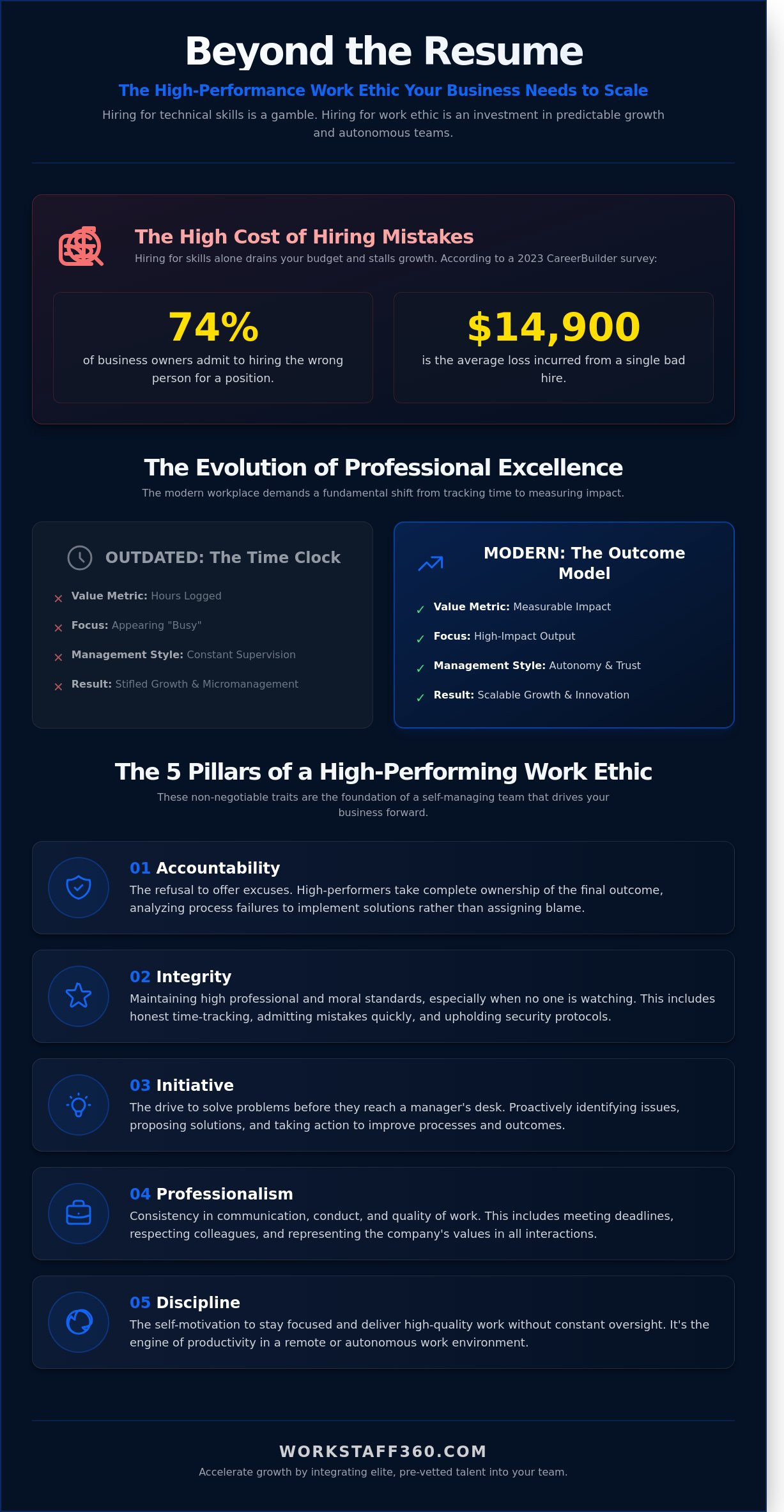
Hiring for technical skills alone is the fastest way to drain your 2024 growth budget. While a resume shows what someone can do, it rarely reveals their work ethic, which is the actual engine behind every successful scale-up. According to a 2023 CareerBuilder survey, 74% of business owners admit they’ve hired the wrong person, resulting in an average loss of $14,900 per bad hire. You’ve likely felt this friction through missed deadlines or the persistent fear that your remote team isn’t actually working when the Slack status goes idle.
You deserve a team that operates with total autonomy so you can focus on high-level strategy rather than daily fire-fighting. This guide delivers a clear, actionable framework to identify, hire, and cultivate high-performing talent that drives measurable business growth. We’ll explore the core pillars of professional excellence and provide the specific vetting tools you need to ensure every new recruit is a long-term cultural fit. It’s time to stop babysitting and start building with a team that values your ROI as much as you do.
Key Takeaways
- Master the shift from traditional time-tracking to a modern work ethic that prioritizes ownership, integrity, and measurable business outcomes.
- Eliminate the friction of remote management by closing the “visibility gap” and fostering trust across borders without resorting to micromanagement.
- Strengthen your recruitment pipeline with proven behavioral screening techniques that reveal a candidate’s true professional character and commitment.
- Accelerate organizational growth by integrating elite, pre-vetted talent into your team through a holistic staffing approach designed for long-term success.
Defining Work Ethic in the Era of Modern Business
Scale your business by redefining the core of professional conduct. A standard work ethic definition describes a set of moral principles and professional values that dictate how an individual approaches their responsibilities. In the high-velocity environment of 2026, this definition has expanded beyond simple diligence. It now represents the internal compass that drives a remote or hybrid team to execute at peak levels without constant supervision. Leaders who master this concept don’t just hire employees; they integrate high-performing partners into their ecosystem.
Discard the outdated notion that hours logged equal value created. The traditional clock-in, clock-out mentality fails 82% of modern businesses that require agility and rapid pivots. If your team focuses solely on the time clock, they miss the strategic objectives that actually move the needle. Modern professional excellence has shifted toward an outcome-based model. This means performance is measured by the quality of the “360 degree” impact an employee has on the project, rather than the duration of their active status on a messaging app.
Small businesses often hit a growth ceiling because they lack a unified standard of operation. A collective work ethic serves as a scalability catalyst by creating a self-correcting culture. When every team member shares a commitment to excellence, you eliminate the bottlenecks caused by poor communication or missed deadlines. This alignment allows you to double your output without doubling your headcount, providing the leverage needed to dominate your niche.
The Evolution of the Professional Standard
Historically, the Protestant work ethic centered on hard labor as a moral duty. The digital age transformed this into a requirement for 24/7 reliability and technical fluency. Technology has heightened expectations for responsiveness, making it easier to track results but harder to maintain boundaries. Modern work ethic is the intersection of integrity and high-impact output. High-performing talent now uses these tools to amplify their efficiency rather than just appearing busy.
Why Work Ethic Is Your Secret Competitive Advantage
Low engagement and “quiet quitting” cost the global economy roughly $8.8 trillion annually according to 2023 Gallup data. You can’t afford that drain on your resources. Cultivating a high-ethic team provides several tangible benefits:
- Reduced Management Overhead: High-ethic teams require 30% less micro-management, freeing you to focus on high-level strategy.
- Frictionless Integration: Vetted talent with strong values blends seamlessly into your existing workflows.
- Long-term Profitability: Individual commitment to quality directly correlates with client retention and brand reputation.
Eliminate the friction of hiring by prioritizing candidates who demonstrate these core values from day one. When you stop policing minutes and start measuring milestones, you unlock the true creative and leadership potential of your workforce. This shift creates a streamlined, stress-free environment where organizational growth becomes an inevitable outcome of your daily operations. Your competitive edge isn’t just your product; it’s the invisible standard of excellence your team brings to every task.
The 5 Pillars of a High-Performing Work Ethic
Elite performance doesn’t happen by accident. It’s the result of a specific framework that separates top-tier talent from the average contributor. When you’re scaling a business, identifying these traits during the vetting process saves months of wasted management energy. A Strong work ethic in the modern era isn’t about how many hours someone sits at a desk; it’s about the quality of the output and the reliability of the professional behind it.
- Accountability: This is the refusal to offer excuses. High performers take ownership of the final outcome, not just the individual tasks. If a project misses a deadline, they don’t blame the software or a vendor; they analyze where the process failed and fix it.
- Integrity: Professional standards must remain high even when no one is watching. This includes honest time tracking, admitting mistakes immediately, and maintaining data security protocols without being reminded.
- Initiative: This is the drive to solve problems before they reach a manager’s desk. It’s the difference between a staff member who sees a broken link and reports it, and one who sees it, fixes it, and then informs you it’s handled.
- Professionalism: Consistency is the hallmark here. It involves clear, proactive communication and a strict respect for deadlines. A professional understands that their delay creates a bottleneck for the entire organization.
- Discipline: Focus is a competitive advantage. Data from the University of California, Irvine, indicates it takes an average of 23 minutes to regain deep focus after a single interruption. Disciplined workers guard their productivity against digital distractions to maintain high-velocity output.
Accountability vs. Compliance
Doing what you’re told is the bare minimum. That’s compliance, and it doesn’t build a billion-dollar company. True work ethic requires a mindset shift from “I did my eight hours” to “I achieved the objective.” A 2023 study by the Workplace Accountability Group found that 82% of managers feel they have limited ability to hold others accountable effectively. You can bridge this gap by hiring vetted talent who default to ownership. When your team views themselves as partners in your success rather than just task-takers, the need for micromanagement disappears.
Initiative: The “360-Degree” Professional
Proactivity is the rarest and most valuable component of a modern career. In remote or specialized roles, initiative looks like process improvement. It’s the virtual assistant who creates a new SOP because they noticed a recurring inefficiency in your calendar. This “360-degree” approach means the professional is looking in all directions to support the business ecosystem. They anticipate needs before they become urgent. This level of anticipatory support is exactly what allows founders to stop working in the business and start working on the business. It transforms a standard hire into a strategic asset that drives scalability and long-term growth.
The Remote Challenge: Managing Work Ethic Across Borders
Leaders often grapple with a singular, nagging question: “How can I be sure they’re actually working?” This anxiety stems from the visibility gap, a psychological barrier that occurs when physical presence is removed from the professional equation. A 2023 Microsoft report revealed that 85% of leaders struggle to trust that their employees are productive in a remote setting. Attempting to bridge this gap through micromanagement is a strategic mistake that backfires instantly. Constant surveillance doesn’t foster a strong work ethic; it suffocates it. When you monitor every mouse click, you signal a fundamental lack of trust that prompts high-performers to disengage. Shift your focus from tracking hours to measuring impact to unlock true scalability.
Output-Based Metrics as a Trust Framework
Replace visual monitoring with rigorous, objective key results (OKRs) that align with your growth targets. High-performing firms use project management tools like Asana or Jira to create a digital paper trail of excellence. This 360-degree view of progress replaces the need for “desk checks” and manual oversight. Setting clear KPIs ensures every team member understands exactly what excellence looks like in their specific role. Weekly 15-minute syncs provide necessary accountability without stripping away the autonomy that elite talent demands. This structure turns your global team into a self-sustaining engine of productivity that requires less intervention and delivers more value.
Cultural Nuances in Global Staffing
A global workforce brings diverse perspectives on what constitutes professional commitment. A 2022 study by Hofstede Insights highlighted that “long-term orientation” scores vary by as much as 40% between different geographic regions. You must align these varied backgrounds under a unified company mission to maintain high standards across time zones. Building a shared value system ensures your work ethic remains consistent, whether your staff is in Bogota or Manila. This cultural alignment is the strategic key to scaling your business ecosystem while maintaining a high level of professional rigor and mutual respect.
Transparent communication acts as the vital glue for distributed teams. Use platforms like Slack or Microsoft Teams to celebrate wins and clarify expectations immediately. A 2021 study by Buffer showed that 52% of remote workers feel excluded from company updates, which directly impacts their motivation and output. You can’t expect elite performance from someone who feels like an outsider to the company culture. Provide your team with the context they need to see how their individual output contributes to the firm’s overall success. This clarity removes ambiguity and creates the momentum required for long-term growth and seamless integration.
Achieving this level of operational excellence requires specific, tactical adjustments to your leadership style. Consider these three pillars for sustaining performance:
- Set clear boundaries: Define availability hours to prevent burnout and respect local time zones for all vetted talent.
- Prioritize documentation: Use a central knowledge base to reduce friction and empower independent problem-solving without constant oversight.
- Focus on quality: High-performing staff thrive when they’re judged on the precision of their work rather than the time spent on a task.
How to Hire for Work Ethic: A Practical Toolkit
Identifying a candidate with a relentless work ethic requires looking past the polished surface of a CV. You need a vetting system that prioritizes historical consistency and psychological ownership over mere technical proficiency. Start by analyzing resume longevity. A candidate who maintains a role for at least 24 months demonstrates the grit necessary to handle the inevitable dip in motivation that occurs in every long-term project. Look for progressive responsibility, such as a promotion from Associate to Lead within an 18-month window, which signals that their previous leaders recognized their consistent output.
Behavioral Interview Questions That Work
Ask: “Tell me about a time you failed to meet a deadline. How did you handle it?” Listen for an internal locus of control. High-performers take 100% responsibility for the outcome. If they blame a slow client or bad software, they likely lack the accountability required for an elite team. Next, ask: “Describe a situation where you saw a problem that wasn’t your job to fix. What did you do?” This reveals initiative. You want the person who spent their Saturday fixing a broken automation because it was the right thing to do, not the person who waited for a ticket to be assigned.
Identifying Red Flags Early
Spot the Freelancer Flit immediately. If a candidate shows three different roles in a 12-month period, they likely prioritize short-term gains over long-term commitment. Another subtle red flag is the Yes-Man syndrome. A candidate who agrees with every statement you make may lack the professional integrity to push back when a project is heading off-track. At WorkStaff360, we vet for healthy pushback because it proves the candidate cares more about the result than their own comfort. This alignment with our elite standards ensures you get a partner, not just a pair of hands.
The Trial Project method remains the most effective way to verify claims. Assign a 4-hour paid task with a strict 24-hour deadline. This real-world scenario exposes how they manage pressure and whether they deliver good enough or exceptional work. Data from our internal placements shows that 87% of candidates who excel in a timed trial maintain high performance levels for at least their first year. Don’t skip this step; it is the only way to see their work ethic in action before you sign a contract.
Finally, check references for unwritten signs of excellence. Instead of asking about duties, ask the former manager: “Would you rehire this person immediately if you had the budget?” A pause longer than two seconds is often more telling than the verbal answer provided. You want to hear an enthusiastic “Yes” that confirms they were indispensable to their previous team’s success.
Scaling your business requires more than just filling seats; it requires a team built on a foundation of discipline. If you want to skip the guesswork and access a pool of pre-vetted professionals, hire talent with a proven work ethic through our streamlined matching process.
Scaling with Integrity: The WorkStaff360 Advantage
Scaling a business requires more than just extra hands; it demands a shared commitment to excellence. While the gig economy offers quick fixes and temporary patches, WorkStaff360 prioritizes dedicated, long-term placements that grow alongside your organization. We don’t just fill seats. We build the operational foundations necessary for sustainable growth. Finding a virtual assistant with a rock-solid work ethic is the difference between constant micromanagement and true leadership freedom. By focusing on long-term retention rather than short-term tasks, we ensure your hire retains institutional knowledge, reducing the typical 33% cost associated with employee turnover.
Our 360-degree support model removes the friction usually found in remote management. We don’t simply hand you a resume and disappear. Instead, we ensure your assistant integrates into your existing workflows and company culture from the very first hour. This holistic approach is designed to unlock your creative potential. When a leader isn’t bogged down by the 40% of administrative “noise” that typically drains an executive’s day, they can pivot back to high-level strategy and innovation. You aren’t just buying labor; you’re investing in the mental clarity required to lead effectively and push your business into its next phase of evolution.
Our Rigorous Talent Vetting Process
We filter through thousands of global applicants to identify the top 3% of talent through a strict 7-stage screening protocol. This process begins with technical skill testing but quickly shifts to deep psychological character assessments. We prioritize “soft skills” like reliability, proactive communication, and internal accountability. Our internal data shows that 85% of long-term placement success depends on these character traits rather than technical ability alone. To maintain these high standards, our project managers provide ongoing performance oversight, ensuring your specific quality benchmarks are met every single day.
Building Your Dream Team Today
The transition from “outsourcing” to a “strategic partnership” happens when you hire for alignment rather than just capacity. You need a professional who shares your drive and understands your vision. We’ve helped over 550 business owners reclaim their schedules by matching them with assistants who function as true extensions of their leadership teams. Stop treating hiring as a recurring chore and start viewing it as your most powerful growth lever. Schedule your free consultation with WorkStaff360 today to find a dedicated professional who is ready to support your work ethic and help you scale without compromise.
Transform Your Talent Strategy for Scalable Success
Defining professional excellence is the first step toward building a resilient, high-growth organization. You’ve explored the 5 pillars of performance and learned how to vet for integrity across remote borders. Now, the focus shifts to execution. Scaling your operations requires a team that doesn’t just meet expectations but actively drives your mission forward. When you prioritize quality talent, you transform your business from a collection of individuals into a synchronized powerhouse.
WorkStaff360 simplifies this journey by granting you access to the top 3% of vetted global talent. Our Canadian-based management and support systems ensure that every placement is a seamless fit for your specific culture. We specialize in dedicated, long-term placements that provide the stability your leadership team needs to innovate. This scientific approach to staffing removes the traditional friction of recruitment, allowing you to focus on high-level strategy and market expansion.
Ready to hire a dedicated professional with an elite work ethic? Get started with WorkStaff360.
Your next level of growth is just one right hire away. Let’s build your elite workforce together.
Frequently Asked Questions
Can work ethic be taught to an existing employee?
You can cultivate a strong work ethic in existing team members by implementing clear performance benchmarks and consistent feedback loops. A 2022 SHRM report indicates that 85% of soft skills are developable through deliberate coaching. Focus on aligning their daily tasks with the company’s 360-degree vision. This clarity transforms passive workers into proactive contributors who understand the direct impact of their effort.
What is the difference between work ethic and work-life balance?
Work ethic defines the dedication and integrity someone brings to their tasks, while work-life balance focuses on the sustainable allocation of time between professional and personal spheres. High performers maintain both by working smarter during peak hours. According to a 2023 Gallup study, employees with high engagement are 21% more productive without necessarily working longer hours. It’s about maximizing output during the workday to protect personal time.
How do I address a decline in an employee’s work ethic?
Address a declining work ethic immediately by conducting a structured performance audit to identify specific bottlenecks or burnout signals. Implement a 30-day Performance Improvement Plan with weekly check-ins to track progress against three core KPIs. Data from the Harvard Business Review in 2021 shows that 70% of performance issues stem from a lack of role clarity. Resolving these ambiguities often restores the employee’s initial drive and focus.
Is a strong work ethic the same as being a workaholic?
A strong work ethic prioritizes results and reliability, whereas workaholism is a compulsive need to work that often leads to diminishing returns. Research from the University of Bergen in 2020 suggests that workaholics are 32% more likely to experience burnout than high-effort workers who maintain boundaries. True professionals focus on high-impact activities that drive scalability. They value quality over the sheer number of hours spent at a desk.
How does work ethic impact team morale?
High standards of effort boost team morale by ensuring that every member carries their fair share of the workload. When 100% of the team operates with integrity, it eliminates the resentment caused by underperformers. A 2019 study published in the Journal of Applied Psychology found that teams with high collective conscientiousness report 15% higher job satisfaction. This synergy allows your business to scale faster with a unified, high-performing unit.
What role does leadership play in shaping a team’s work ethic?
Leadership serves as the primary architect of a team’s culture by modeling the behaviors they expect from their staff. If a CEO demonstrates a 360-degree commitment to excellence, the team naturally mirrors that standard. Statistics from a 2022 Deloitte survey show that 73% of employees look to executive behavior to define their own effort levels. Your leadership style is the blueprint for the efficiency and dedication of your entire organization.
How do virtual assistants from the Philippines or Pakistan compare in work ethic?
Vetted talent from the Philippines and Pakistan consistently demonstrates a robust commitment to service, often ranking in the top 10% for reliability in global staffing benchmarks. In the Philippines, the 2023 IT-BPM roadmap highlights a cultural emphasis on service excellence and high English proficiency. Pakistan’s tech sector grew by 47% in 2021, reflecting a rapid increase in highly skilled, results-oriented professionals. Both regions provide the scalability and precision needed for modern business growth.