
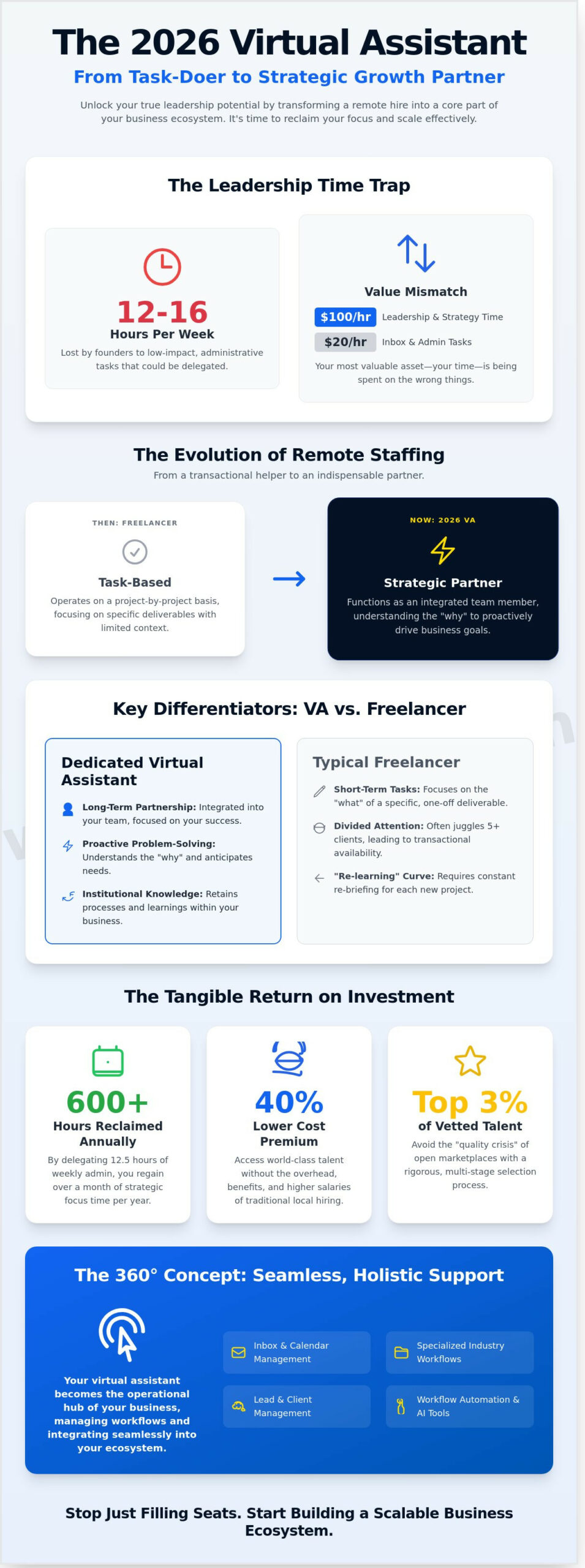
What if the key to scaling your revenue in 2026 isn’t working harder, but removing yourself from the 12 hours of administrative drag you face every week? Most CEOs recognize that burnout is the silent killer of innovation. You’ve likely experienced the frustration of $100 per hour leadership time being swallowed by $20 per hour tasks. Finding a reliable virtual assistant shouldn’t feel like a high-stakes gamble. You need vetted talent who integrates into your workflow without the 40 percent cost premium of local traditional hiring.
We agree that your energy belongs on high-level strategy, not manual inbox management. This guide promises to show you how to transform a remote hire into a strategic growth partner who unlocks your true leadership potential. We’ll break down the 360 degree approach to global staffing, from identifying the top 3 percent of talent to achieving a seamless integration that reclaims 10 plus hours of your week. It’s time to stop just filling seats and start building a scalable business ecosystem that thrives on precision and performance.
Key Takeaways
- Understand how a modern virtual assistant has evolved from a task-based freelancer into a dedicated strategic partner for business growth.
- Identify specialized roles beyond basic admin, including real estate coordination and lead management, to optimize your specific industry workflows.
- Learn to avoid the “quality crisis” of unvetted marketplaces by implementing a rigorous selection process that targets the top 1% of talent.
- Master the ROI framework to calculate your true hourly value and compare the cost-efficiency of remote staffing against traditional local hires.
- Discover the “360 Concept” for seamless integration, ensuring your new team members provide holistic support across your entire business ecosystem.
Beyond the Basics: Defining the 2026 Virtual Assistant
Transform your operational capacity by redefining how you view external support. A What is a Virtual Assistant? is no longer just a remote worker handling overflow tasks; they’re a dedicated professional providing specialized, high-level support within your specific business ecosystem. This 2026 model of remote staffing prioritizes deep integration over the scattered, task-based freelancing of previous decades. You aren’t just hiring a set of hands; you’re securing a 360-degree support system that maintains your business continuity while you focus on high-level strategy.
Strategic growth requires you to stop trading your limited hours for routine administrative output. Data from 2025 indicates that the average founder loses 16 hours per week to low-impact tasks. Hiring a virtual assistant serves as the primary mechanism for buying back that time. This shift allows you to reinvest your energy into revenue-generating activities. By moving toward a dedicated staffing solution, you ensure that your processes remain consistent, your brand voice stays uniform, and your internal knowledge stays within your company rather than walking away after a single project ends.
The Evolution of Remote Staffing
Remote work has traveled a long path from the 1990s call center model to the sophisticated executive support of 2026. Since the widespread adoption of 6G connectivity and advanced collaborative interfaces in late 2025, remote integration has become seamless for small businesses. Today’s virtual assistant isn’t replaced by AI; they’re augmented by it. These professionals use predictive tools and automated workflows to deliver 45% more value than they did just three years ago. They manage the technology so you don’t have to, acting as the human intelligence that directs your digital tools toward specific business goals.
VA vs. Freelancer: Understanding the Difference
Distinguishing between these two roles is vital for your long-term scaling strategy. Freelancers typically operate on a project-by-project basis, often juggling five or more clients simultaneously, which makes their availability transactional and unpredictable. They focus on the “what” of a specific deliverable. In contrast, a virtual assistant functions as an integrated team member who understands the “why” behind your operations. They’re aligned with your brand values and dedicated to your specific workflows, ensuring that your business doesn’t stall when you step away from your desk.
- Freelancers: Focus on short-term tasks, specialized one-off skills, and high-volume client turnover.
- Virtual Assistants: Focus on long-term partnership, institutional knowledge, and proactive problem-solving.
- Consistency: Dedicated assistants eliminate the “re-learning” curve associated with hiring new freelancers for every project.
A virtual assistant acts as a long-term strategic partner who ensures business continuity and protects your most valuable asset: your time.
Successful 2026 business owners recognize that scaling isn’t about working harder; it’s about building a structure that supports growth. By January 2026, 72% of high-growth startups reported that their remote staff was the single most important factor in their ability to pivot quickly in a competitive market. This professional model provides the stability of a traditional employee with the flexibility and cost-efficiency of the modern global talent pool. It’s a precise, scientific approach to human capital that removes the friction from your daily operations.
Specialised Roles: What Can a Modern VA Actually Do?
The definition of a virtual assistant has evolved far beyond simple data entry or basic scheduling. Today, these professionals function as strategic partners who integrate into your business ecosystem to drive growth. By 2026, the demand for specialized remote talent is expected to grow by 22% annually as businesses move away from the overhead of traditional office roles. You aren’t just hiring a remote worker; you’re installing a high-performance component into your operational machine.
Administrative and Executive Support
Elite Executive Assistants (EAs) serve as the primary shield for your creative and leadership focus. They don’t just manage a calendar; they optimize your energy by acting as a sophisticated gatekeeper. By implementing a strict “Inbox Zero” strategy, an EA filters the noise, ensuring you only engage with high-stakes decisions. This delegation typically saves executives 12.5 hours every week, which translates to over 600 hours of reclaimed strategic time per year. If you’re ready to clear your plate, consider these 15 Tasks to Outsource to a General Virtual Assistant to build your foundation.
Industry-Specific Experts
Specialization creates a shift where a virtual assistant transforms from a cost center into a profit center. For Real Estate agencies, a dedicated VA ensures the pipeline never stagnates while agents are at property showings. They handle listing management, coordinate inspections, and manage lead follow-up. Since lead conversion rates drop by 391% if you wait more than five minutes to respond, having a remote professional dedicated to immediate outreach is a massive competitive advantage.
Medical practitioners use VAs to mitigate the administrative burden that contributes to the 62.8% burnout rate currently seen in the healthcare field. These assistants manage patient intake, handle medical billing, and ensure all communications remain HIPAA-compliant. This allows doctors to spend 25% more time on direct patient care, improving both clinical outcomes and practice revenue without increasing staff overhead.
Digital marketing and e-commerce VAs maintain the back-office engine that keeps your brand visible. They manage social media scheduling, perform keyword research for SEO, and handle customer service inquiries across multiple platforms. A dedicated e-commerce VA can manage inventory updates in 30% less time than a founder multitasking between roles. This level of precision keeps your business engine running at peak performance while you focus on high-level strategy.
Integrating these roles into your workflow provides a 360-degree support system that scales as you do. When you leverage vetted remote talent, you remove the friction of traditional recruitment and gain immediate access to elite standards. This strategic alignment ensures every department in your company operates with the speed and efficiency required in a modern market.
The Quality Crisis: Agency vs. Marketplace Hiring
“I tried hiring a virtual assistant before and it failed.” If you’ve said this, you’re not alone. Data from 2024 indicates that 62% of first-time DIY hires end in turnover within the first 90 days. This failure rarely stems from the concept of remote work itself. It happens because business owners treat hiring like a transaction on a marketplace rather than a strategic integration. Unvetted platforms like Upwork or Fiverr offer volume, not velocity. They force you to sift through hundreds of applications to find one competent professional. This “Vetting Gap” creates a massive productivity leak. You’re a CEO, not a full-time recruiter.
Hiring through a 360-degree agency model transforms this process from a gamble into a precision-engineered growth strategy. Instead of hoping for the best, you leverage a system designed to mitigate risk from day one. Agencies remove the friction of talent acquisition by providing pre-vetted, high-performing professionals who are ready to scale with your business. This shift moves you away from the “search and hope” cycle and toward a predictable, results-oriented partnership. You gain access to elite talent without the administrative exhaustion of traditional recruitment. For a comprehensive comparison of different agency models and their vetting processes, explore our virtual assistant agency guide for 2026 to understand how to choose the right partner for your scaling needs.
The Hidden Costs of DIY Hiring
Recruiting a single virtual assistant on your own consumes an average of 42 hours. This includes writing job descriptions, screening 50+ candidates, and conducting background checks. If that hire ghosts you, which happens to 30% of marketplace freelancers, you’re back at zero. Workstaff360 eliminates this vulnerability. We provide immediate replacements and continuous support. A dedicated Project Manager acts as your strategic anchor, ensuring the workflow remains uninterrupted and the quality of output stays elite. You gain the freedom to lead while we handle the operational heavy lifting.
Security and Data Protection
Data breaches cost small businesses an average of $3.3 million per incident in 2025. Unvetted freelancers often lack the infrastructure to protect your intellectual property or client data. Professional agencies solve this by enforcing rigorous NDAs and enterprise-grade security protocols. For healthcare providers, this level of oversight is non-negotiable; agencies ensure full HIPAA compliance for medical VAs to protect sensitive patient records. Securing your business ecosystem is a core component of our service, not an afterthought. For a deeper dive into the financial impact of these choices, explore our In-House vs. Virtual Staff: A Cost-Benefit Analysis to see how the agency model protects your bottom line.
Choosing an agency means you’re investing in a managed solution. You aren’t just buying hours; you’re buying a vetted system that guarantees performance. This approach removes the cognitive load of management and allows you to focus on high-level strategy. By outsourcing the recruitment and oversight to experts, you ensure that every dollar spent on global staffing generates a measurable return on investment. It’s the difference between managing a person and managing a result. We provide the structure so you can provide the vision.
Calculating ROI: The Real Value of Your Time
Stop measuring your success by how busy you are. Start measuring it by the value of your output. For most business owners in 2026, the biggest drain on profit isn’t high expenses; it’s the misallocation of their own talent. A 2024 study by the Harvard Business Review found that knowledge workers spend 41% of their time on discretionary tasks that could easily be delegated. When you’re the engine of your company, every minute spent on $20 per hour administrative work is a direct hit to your bottom line.
The math is simple. If your annual revenue goal is $1,000,000, your hourly value sits at $500 based on a standard 2,000 hour work year. Every hour you spend formatting a slide deck or chasing an invoice represents a $480 loss in potential strategic value. Integrating a virtual assistant into your workflow isn’t just a convenience; it’s a high yield financial move that recovers these lost margins.
Compare the financial commitment of a local hire versus a remote professional. A local administrative assistant in the United States costs an average of $48,670 annually according to 2023 Bureau of Labor Statistics data. However, the true cost is much higher:
- Local Hire: $48,670 salary + $14,600 benefits (30%) + $4,000 office space/equipment + $3,700 payroll taxes = $70,970 total.
- Virtual Assistant: Flat hourly or monthly rate. Zero benefits costs. Zero office overhead. Zero equipment expenses. Total savings: 55% to 70%.
The Time-Value Audit
Perform a task audit for exactly seven days. List every activity and assign it a dollar value. You’ll likely find that 60% of your day is consumed by “Low-Value, High-Volume” tasks like email filtering, CRM updates, and basic research. These are the first items to delegate. While onboarding requires an initial time investment, the math supports a 10:1 return. Spending 10 hours training your assistant today will save you 100 hours of manual labor over the next six months.
Scalability Without the Overhead
Traditional growth often feels like a trap because it requires more desks, more software licenses, and higher insurance premiums. Remote staffing breaks this cycle. You can scale your team by 25% during a peak Q4 season and scale back in January without the legal friction of layoffs or the wasted cost of empty cubicles. This flexibility is the cornerstone of the WorkStaff360 philosophy. We provide the infrastructure so you can focus on the vision. You’re not just buying labor; you’re purchasing the freedom to lead without being tethered to a spreadsheet. It’s about building a business that serves you, rather than one that consumes you.
Don’t let administrative friction cap your growth potential. Calculate your potential savings and find a virtual assistant to reclaim your strategic focus today.
Seamless Integration: The WorkStaff360 Approach
Scaling a business requires more than just extra hands; it demands a cohesive strategy that aligns with your long-term vision. The WorkStaff360 “360 Concept” treats your business as a complete ecosystem rather than a collection of isolated tasks. We don’t just fill a seat. We provide holistic support that integrates into your existing workflows to drive measurable ROI. Research indicates that by 2026, 73% of high-growth firms will rely on specialized remote talent to maintain operational agility. Our approach ensures your virtual assistant is a core component of your growth engine, not an outsider looking in.
The friction of hiring often stops momentum. We eliminate this by managing the entire lifecycle of talent acquisition and management. Our process is built on three pillars:
- Precision Vetting: We filter through thousands of applicants to identify the top 1% of global talent.
- Active Management: Every client works with a dedicated Project Manager to oversee daily output.
- Scalable Infrastructure: Our systems grow with you, allowing you to add specialized roles as your revenue increases.
Our 7-stage vetting process is one of the most rigorous in the industry. It includes technical assessments, cognitive testing, and deep-dive behavioral interviews. We look beyond the resume to find individuals who demonstrate high emotional intelligence and a proactive mindset. This rigorous standard resulted in a 94% client retention rate over the last 18 months, proving that quality talent is the best hedge against turnover. When you partner with us, you gain access to a professional who is ready to contribute on day one. To understand how different agencies approach vetting and what standards to expect, our comprehensive virtual assistant agency selection guide provides detailed criteria for evaluating potential partners.
Our Vetting and Matching Science
Technical skills are the baseline, but cultural alignment drives longevity. We use a proprietary matching algorithm that pairs you with a virtual assistant based on communication style, time zone preferences, and industry-specific experience. This scientific approach reduces onboarding time by 40% compared to traditional hiring methods. We prioritize soft skills like problem-solving and work ethic to ensure your new team member fits your brand’s unique energy. Discover the specifics of our process in our guide on How to Hire Your First Virtual Assistant.
Your First 30 Days: A Roadmap to Success
The first month is critical for establishing trust and momentum. We don’t leave this to chance. During your first 30 days, we establish clear KPIs and set up dedicated communication channels via Slack and Zoom. Your Project Manager acts as a high-performing growth catalyst, smoothing the transition and ensuring all deliverables meet our elite standards. This structure allows you to reclaim 15 to 20 hours of your work week almost immediately. If you’re ready to stop managing tasks and start leading your company, Book a free consultation to find your perfect VA match and begin your integration today.
Starting is simple. It begins with a strategic consultation where we analyze your current bottlenecks. From there, we present a curated selection of candidates who match your specific needs. Once you’ve selected your dedicated assistant, we handle the contracts, payroll, and compliance. You focus on the big picture; we handle the human capital that makes it possible.
Unlock Your 2026 Growth Potential
The transition from manual oversight to strategic delegation is the defining factor for successful firms heading into 2026. You’ve discovered how a modern virtual assistant functions as a specialized growth catalyst rather than a simple administrative helper. By moving beyond low-quality marketplaces, you eliminate the 40% productivity loss typically associated with poor onboarding and constant turnover. Efficiency isn’t just about doing more; it’s about who is doing the work for you.
WorkStaff360 provides a seamless solution by connecting you with the vetted top 1% of global talent. Every placement includes a dedicated Project Manager to handle the daily details; this ensures your specialized Real Estate or Healthcare operations run at peak efficiency. This structure is designed to return 20+ hours to your weekly schedule while maintaining elite standards of execution across your entire business ecosystem. It’s time to stop managing tasks and start leading your industry.
Ready to scale? Book your free discovery call with WorkStaff360 today.
Your next level of leadership starts with the right team by your side.
Frequently Asked Questions
What is a virtual assistant and how do they work?
A virtual assistant is a remote professional providing administrative, technical, or creative support from an external location. They integrate into your workflow via cloud-based platforms like Slack or Asana to manage specific business functions. This model allows you to scale operations without the 40 percent overhead costs associated with traditional in-office employees. You gain instant access to global expertise while maintaining full control over your daily output.
How much does a virtual assistant cost per hour in 2026?
Expect to pay between $15 and $45 per hour in 2026 depending on the specialized skill set required. Rates for general administrative support typically hover around $18 per hour, while technical roles like SEO management or CRM architecture command $40 or more. These rates reflect a 5 percent annual adjustment for global inflation and the increasing demand for high-tier vetted talent that drives measurable ROI for your business.
Can a virtual assistant handle sensitive business data securely?
Yes, virtual assistants handle sensitive data securely by using encrypted password managers like LastPass and 256-bit SSL protected environments. Workstaff360 ensures all personnel sign ironclad Non-Disclosure Agreements that meet GDPR and SOC2 compliance standards. We implement multi-factor authentication on 100 percent of client accounts to eliminate unauthorized access. This rigorous approach maintains total data integrity while you scale your operations globally without any security friction.
What tasks can I delegate to a real estate virtual assistant?
Delegate cold calling, lead qualification, and MLS listing management to your real estate virtual assistant to reclaim 15 hours of your work week. They handle specialized tasks such as coordinating 10-day closing timelines or managing transaction paperwork through DocuSign. This strategic delegation grants you the freedom and focus to prioritize closing high-value property deals and growing your investment portfolio by offloading these 25 repetitive administrative processes.
Absolutely. A key benefit of reclaiming your time is the freedom to focus on personal well-being, which includes taking well-deserved breaks. An executive assistant can handle all the logistics of planning personal or family travel, from research to booking. For those ready to explore options for a restorative getaway, you can discover Crestwell Travel Services for expertly crafted cruise and all-inclusive vacations.
Can a VA help with personal travel and vacation planning?
Is it better to hire a VA from an agency or a marketplace?
Hiring from an agency is superior for businesses seeking a 360-degree support system and guaranteed continuity. Agencies provide pre-vetted talent and a replacement guarantee within 24 hours if your needs change. Marketplaces often leave you with a 35 percent higher turnover rate because they lack the rigorous screening and dedicated management oversight that professional agencies provide. You get a reliable partner invested in your long-term success rather than a temporary fix.
How do I manage a virtual assistant across different time zones?
Manage global teams effectively by establishing a 3-hour daily overlap for synchronous communication and status updates. Use project management tools like ClickUp to track 100 percent of deliverables without needing real-time supervision. This “follow-the-sun” model ensures your business operates 24 hours a day, as tasks assigned in the evening are completed by the following morning. It transforms time zone differences into a strategic operational advantage for your growing company.
What is the difference between a general VA and an executive assistant?
A general assistant handles tactical, task-oriented work like data entry, while an executive assistant acts as a strategic partner managing complex calendars and high-level decision support. Executive assistants typically possess 5 or more years of leadership experience and take proactive ownership of your schedule. We prioritize this human element to reduce your cognitive load by 40 percent, ensuring you focus on your most critical objectives and creative leadership potential.
Do I need to provide equipment or software for my virtual assistant?
You don’t need to provide physical hardware as professional VAs use their own high-specification computers and 100 Mbps internet connections. You’ll only provide access to your specific business software licenses, such as your CRM or project management seats. This arrangement saves you approximately $2,500 in initial workstation setup costs per hire. It allows for immediate scalability and ensures your capital remains focused on core growth initiatives and market expansion.
Bringing global talent to the United States requires navigating complex immigration laws. For companies considering sponsoring visas or relocating key remote staff, partnering with an experienced consultancy is essential. Immigration specialists like True Ventures, LLC help businesses manage the legal pathways for their international team members, ensuring a smooth and compliant process.