
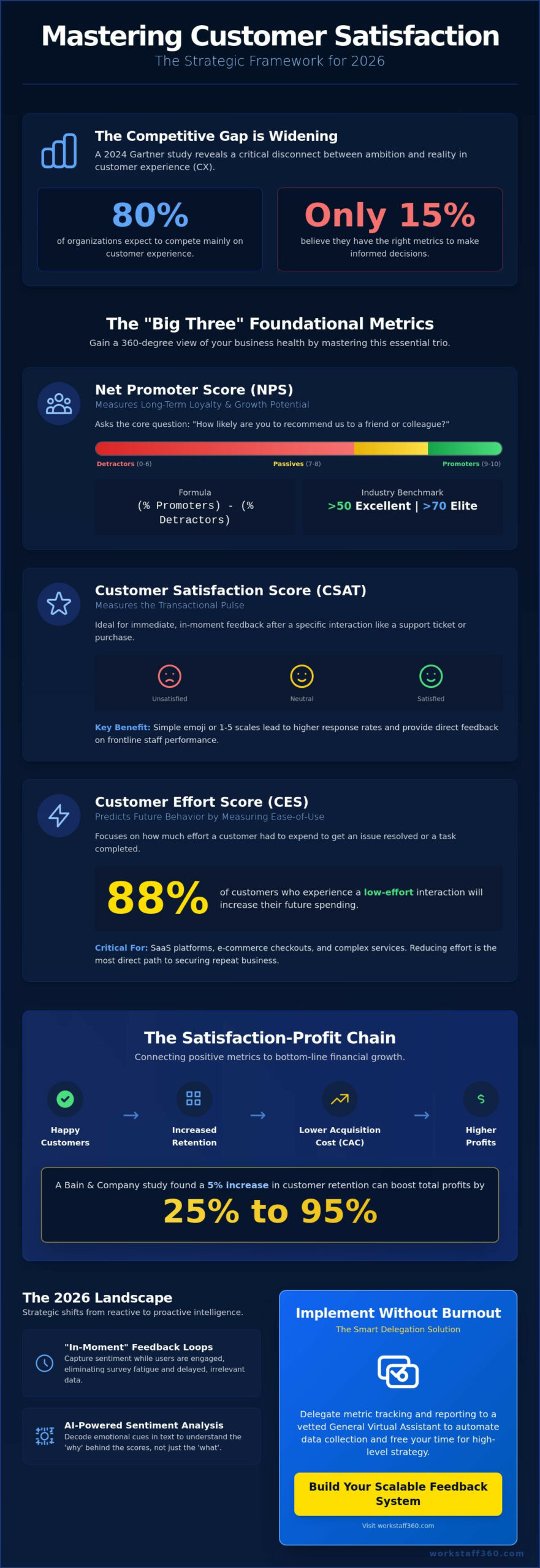
A 2024 study by Gartner reveals that while 80% of organizations expect to compete mainly on customer experience, only 15% believe they have the right customer satisfaction metrics to make informed decisions. You already understand that a high churn rate is a silent growth killer that drains your acquisition budget faster than you can refill it. It’s exhausting to collect mountains of data only to have it sit in silos while your customers suffer from survey fatigue and inconsistent service across different departments.
We’re here to transform that friction into a decisive competitive advantage. This guide provides the strategic roadmap to mastering the data points that drive long term retention and calculate the exact ROI of your service efforts. You’ll gain a streamlined framework to automate data collection, giving you the freedom to focus on high level leadership rather than manual reporting. We’ll break down the essential metrics for 2026 and provide a 360 degree view of how to build a scalable feedback system that fuels your business expansion.
Key Takeaways
- Master the “Big Three” framework—NPS, CSAT, and CES—to establish a clear, quantifiable baseline for how your services meet evolving market expectations.
- Connect your performance scores to the bottom line by leveraging the “Satisfaction-Profit Chain” to reduce churn and lower your customer acquisition costs.
- Eliminate survey fatigue and increase engagement by designing strategic feedback loops that capture high-quality data without interrupting the user journey.
- Utilize AI-powered sentiment analysis to decode emotional cues in customer communications, allowing you to move beyond basic scores to understand the true drivers of loyalty.
- Scale your reporting systems and prevent burnout by delegating the tracking of customer satisfaction metrics to a vetted General Virtual Assistant who can own the entire data process.
The Foundation: Core Customer Satisfaction Metrics for Every Business
Customer satisfaction metrics represent the quantifiable measurement of how your products, services, and brand interactions meet or exceed buyer expectations. In the high-stakes environment of 2026, these data points are no longer just “nice-to-have” statistics; they’re the strategic fuel for scaling operations. Most businesses only need to master the “Big Three” framework—NPS, CSAT, and CES—to gain a 360-degree view of their health. This foundational trio provides the clarity required to eliminate friction and empower your team to deliver excellence at every touchpoint.
The strategic shift in 2026 focuses on speed and context. Organizations have moved away from reactive, post-purchase surveys that arrive days later. Instead, the industry standard now prioritizes proactive, “in-moment” feedback loops that capture sentiment while the user is still engaged. Understanding the historical development and academic rigor behind customer satisfaction helps modern leaders appreciate why these benchmarks correlate so strongly with long-term revenue growth. When you measure accurately, you stop guessing and start growing.
Net Promoter Score (NPS): Measuring Long-Term Loyalty
Measuring long-term loyalty starts with the “Million Dollar Question”: How likely are you to recommend us to a friend or colleague? This single inquiry cuts through the noise to identify your true brand advocates. Respondents provide a score from 0 to 10, allowing you to categorize your audience into three distinct groups. Promoters (9-10) are your growth engines, Passives (7-8) are vulnerable to competitors, and Detractors (0-6) represent a high churn risk. To calculate your score, subtract the percentage of Detractors from the percentage of Promoters. A score above 50 is considered excellent in most service-based industries, while elite performers often break the 70-point barrier.
Customer Satisfaction Score (CSAT): The Transactional Pulse
Customer Satisfaction (CSAT) serves as the most immediate measure of a specific interaction. It’s the ideal tool to deploy immediately following a support ticket resolution or a successful purchase. By using simple 1-5 scales or intuitive emojis, you can significantly increase response rates compared to lengthy forms. CSAT is the best metric for evaluating the performance of customer support representatives because it isolates the quality of a single human interaction. High CSAT scores indicate that your frontline staff is effectively solving problems and maintaining the professional standards your brand requires.
Customer Effort Score (CES): Predicting Future Friction
Predicting future friction requires the Customer Effort Score, which focuses on “Ease of Use” rather than just “Happiness.” This metric asks customers to rate how much effort they had to put in to get their issue resolved or their task completed. Data from 2025 indicates that 88% of customers who experience low-effort interactions will increase their spending. It’s a critical KPI for SaaS platforms, e-commerce checkout flows, and complex service delivery models. If a process feels like a chore, your customers will find a simpler alternative. Reducing effort is the most direct path to securing repeat purchases and building a resilient business ecosystem.
The Financial Connection: Linking Satisfaction to Revenue
High customer satisfaction metrics don’t guarantee growth if your back door is wide open. You might see glowing survey results while your revenue leaks through a rising churn rate. Real growth happens when you align sentiment with financial performance. This alignment creates the Satisfaction-Profit Chain, where happy customers act as organic brand ambassadors, effectively slashing your Customer Acquisition Cost (CAC). A seminal study by Bain & Company demonstrates the direct link between loyalty and the bottom line, showing that a 5% increase in customer retention can lead to a 25% to 95% increase in total profits.
Successful leaders use these metrics to spot “At-Risk” accounts long before a cancellation request hits the inbox. By monitoring engagement levels and support ticket frequency, you can intervene with surgical precision. This proactive approach transforms support from a reactive cost center into a strategic engine for revenue protection. When you prioritize the financial weight of every “satisfied” checkmark, you move beyond vanity metrics and into true business optimization.
Customer Churn Rate: The Ultimate Reality Check
Calculating your churn rate provides an immediate snapshot of your business health. Use this formula: (Customers lost during period / Total customers at start of period) x 100. You must distinguish between voluntary churn, where a client chooses to leave for a competitor, and involuntary churn, which often stems from expired credit cards or administrative lapses. Monitoring 17 Key Metrics allows you to identify the specific friction points causing these exits. Many high-growth firms now leverage specialized virtual assistants to handle the delicate process of outreach for at-risk accounts. These professionals provide the human touch necessary to resolve grievances and secure renewals before the relationship dissolves.
Customer Lifetime Value (LTV): The ROI of Happiness
Customer Lifetime Value measures the total revenue you expect from a single account over the entire relationship. High NPS scores lead to higher LTV because happy clients are significantly more likely to accept upsells and provide high-quality referrals. You can use LTV data to justify the cost of premium customer support staffing. Investing in elite talent ensures that every interaction reinforces the client’s decision to stay. This creates a cycle of profitability where the cost of retention is dwarfed by the long-term revenue generated. If you are looking to stabilize your revenue streams, finding a dedicated staffing partner can provide the scalable support needed to keep your LTV climbing consistently.
Designing a Feedback Loop That Customers Don’t Hate
A high-performing feedback loop operates as a rigorous four-stage process: Ask, Categorize, Act, and Follow-up. Implementing this structure ensures that data collection serves a strategic purpose rather than becoming a digital nuisance. Optimizing your customer satisfaction metrics requires more than just sending surveys; it demands a commitment to systemic change based on the responses you receive.
Survey fatigue represents a significant threat to data integrity in 2026. When businesses over-measure every micro-interaction, response rates plummet below 15 percent and the quality of the remaining data suffers. Avoid interrupting the user experience by selecting strategic touchpoints. Instead of triggering a popup the moment a user logs in, wait until they successfully complete a core task. Research published in the Harvard Business Review, Stop Trying to Delight Your Customers, demonstrates that long-term loyalty stems from reducing customer effort rather than pursuing grand, delightful gestures. Use your feedback loop to identify and eliminate these high-effort friction points.
Closing the loop remains the most neglected step in the cycle. Data from 2025 indicates that 52 percent of consumers feel their feedback goes into a black hole. Change this perception by directly informing customers about the specific improvements made because of their input. This validation transforms a transactional survey into a collaborative relationship, encouraging future participation and driving higher engagement scores.
Choosing the Right Channel for Feedback
Select your communication channel based on the depth of insight required. Email surveys work best for holistic, post-purchase reflections, while in-app prompts capture immediate reactions to new features. SMS feedback delivers high open rates for quick service ratings but lacks space for nuance. Leverage live chat to gather qualitative, real-time data during the moments of highest intent. Use one-click sentiment buttons for high-volume interactions and reserve long-form surveys for quarterly strategic reviews where deep dives are necessary.
Common Pitfalls in Metric Collection
Eliminate biased questions that lead customers toward a positive response. Phrases like “How much did you enjoy our service?” presuppose a positive experience and skew your results. Address the silent majority by proactively reaching out to users who haven’t interacted with your support team in over 90 days. These customers often churn without a word. Finally, break down data silos. Analyzing these customer satisfaction metrics alongside sales and marketing data ensures your entire organization operates from a single version of the truth, preventing fragmented strategies that confuse the end user.
The 2026 Landscape: AI and Sentiment Analysis
Static scores like CSAT and NPS tell you what happened; they don’t explain why. By 2026, AI-driven analysis has bridged this gap. Modern systems now process thousands of unstructured data points from emails and chat logs to identify emotional cues. This shift moves customer satisfaction metrics from reactive reporting to proactive strategy. You’re no longer waiting for a survey response to understand your client’s frustration. Instead, AI decodes the intent and urgency behind every interaction.
Predictive satisfaction models use machine learning to anticipate a customer’s mood before they even type a word. A 2024 Gartner study projected that 60% of customer service interactions would involve AI-led sentiment detection by 2026. This technology flags accounts showing “churn signals,” such as increased support ticket frequency or subtle changes in linguistic tone. It allows your team to intervene before a minor annoyance turns into a lost contract.
Technology alone isn’t a silver bullet. Data provides the map, but you need a dedicated professional to navigate the nuance. AI identifies the friction; a skilled human applies the empathy required to fix it. This hybrid model ensures that while the data collection is automated, the resolution remains personal and high-touch.
Social Media Sentiment Tracking
Monitoring brand mentions on LinkedIn, X, and Reddit is no longer optional for growth-minded firms. Tools now aggregate public conversations to prevent viral PR crises. Success in this arena requires a work ethic built on extreme ownership. When a complaint goes public, your team must move from public defense to private resolution in under 15 minutes. This speed transforms potential critics into brand advocates by demonstrating visible, rapid accountability.
Real-Time Dashboarding for Small Businesses
Small businesses in 2026 have access to enterprise-grade tools that aggregate customer satisfaction metrics into a single “Health Score.” Monthly reports are dead. Instead, automated alerts trigger when a VIP customer’s score drops by more than 10%. This real-time visibility allows you to pivot resources instantly to protect your highest-value accounts. It removes the guesswork from retention, providing a clear, data-backed path to scalability.
Implementation: How to Track Metrics Without Founder Burnout
Most business owners fall into the “Tracking Trap” within the first 90 days of launching a new initiative. They start with high hopes for their customer satisfaction metrics, but manual data entry eventually kills the momentum. Statistics show that 65% of entrepreneurs stop updating their internal tracking spreadsheets by the third month because the administrative friction outweighs the perceived value. You cannot scale what you cannot measure; yet, you cannot measure everything yourself without hitting a functional ceiling.
Shift the burden by building a “Satisfaction Scorecard” for your weekly leadership meetings. This one-page document should filter the noise and focus on three core numbers: your current Net Promoter Score (NPS), the average response time for the week, and the total number of unresolved detractor tickets. Presenting these figures every Monday ensures your team stays aligned with the customer’s voice without requiring you to spend hours in the weeds of raw data.
The VA’s Role in Customer Satisfaction
A General Virtual Assistant (VA) acts as the engine behind your customer satisfaction metrics. They take ownership of the repetitive tasks that usually lead to founder burnout. Their responsibilities include:
- Setting up and automating survey tools: Your VA configures platforms like Typeform or SurveyMonkey to trigger automatically after a purchase or support interaction, ensuring data flows in without manual intervention.
- Compiling weekly sentiment reports: They aggregate responses into a digestible format, highlighting specific detractor comments that need immediate executive attention so you only see what matters.
- Executing “Surprise and Delight” campaigns: When a customer provides a 10/10 rating, your VA can immediately send a personalized thank-you note or a loyalty discount. This transforms passive promoters into active brand advocates.
Scaling Your Support with Dedicated Staff
Managing global growth requires moving past the “Solo-Owner Support” phase. Relying on your own limited bandwidth restricts your company’s reach and response quality. By hiring a virtual assistant in the Philippines, you secure professionalized talent that provides 24/7 coverage for global satisfaction tracking. This ensures your data collection never pauses, regardless of your time zone.
WorkStaff360 provides the vetted manpower needed to manage, track, and act on these critical insights. We match you with high-performing growth catalysts who integrate seamlessly into your existing ecosystem. This strategic delegation unlocks your creative potential and allows you to lead while we handle the operational precision.
Ready to scale your customer experience? Book a consultation with WorkStaff360 today.
Future-Proof Your Growth Strategy
Mastering customer satisfaction metrics isn’t just about data collection; it’s about securing your bottom line. Research from Bain & Company shows that increasing customer retention by 5% can boost profits by 25% to 95%. By 2026, AI-driven sentiment analysis will transform how we interpret feedback, moving beyond static scores to real-time emotional intelligence. You can’t manage this evolution alone without risking founder burnout or operational friction.
Stop juggling spreadsheets and start scaling with precision. WorkStaff360 provides a holistic 360-degree staffing approach that connects you with vetted talent from top global markets. We offer specialized support for e-commerce, healthcare, and real estate to deliver the human capital required to turn metrics into momentum. Our rigorous vetting process ensures your brand’s reputation remains in expert hands while you reclaim your time for high-level strategy.
Scale your customer support with a dedicated professional from WorkStaff360 and build a resilient foundation for the years ahead. You’ve got the vision; let’s provide the team to make it a reality.
Frequently Asked Questions
What is the most important customer satisfaction metric for a startup?
Customer Effort Score (CES) stands as the most critical metric for early-stage companies. Gartner research indicates that CES is 1.8x more predictive of customer loyalty than standard satisfaction scores. Startups must prioritize removing friction to ensure users reach their goals quickly. Focusing on ease of use prevents early churn and builds a stable foundation for scaling operations.
How often should I send out NPS surveys to my customers?
Distribute NPS surveys every 90 days to maintain an accurate pulse on your brand health. Data from Bain & Company shows that quarterly cycles maintain a 70% higher relevance rate compared to annual surveys. This frequency allows you to track shifts in sentiment following product updates or service changes. You’ll catch potential detractors early enough to intervene before they exit your ecosystem.
What is a ‘good’ Net Promoter Score in 2026?
Target a score of 50 or higher to rank among industry leaders. The 2026 Retently benchmark report highlights that elite SaaS organizations now maintain an average NPS of 62. Consistently monitoring customer satisfaction metrics helps you benchmark your performance against these high-performing peers. If your score falls below 30, it’s a clear signal to audit your service delivery immediately.
Can customer satisfaction metrics help reduce my churn rate?
Yes, these metrics serve as an early warning system for account cancellation. Organizations that implement predictive satisfaction modeling see a 15% reduction in churn within the first 12 months. By identifying customers with declining engagement scores, your team can proactively offer dedicated support. This strategic intervention transforms potential losses into long-term loyalty and recurring revenue.
What is the difference between CSAT and CES?
CSAT measures immediate happiness with a specific interaction, while CES measures how hard a customer had to work to get a result. A 2025 Harvard Business Review study found that 96% of customers who experience high-effort interactions become disloyal. Use CSAT for transactional feedback and CES to evaluate the overall efficiency of your business processes. Both tools provide a 360-degree view of the user experience.
How do I measure customer satisfaction without being annoying?
Deploy micro-surveys that require less than 10 seconds of the user’s time. SurveyMonkey data reveals that completion rates drop by 20% for every question added after the third one. Trigger these surveys at the precise moment of value, such as immediately after a successful ticket resolution. This approach respects your client’s time while providing the high-quality data you need to grow.
Do I need expensive software to track these metrics?
No, you can effectively track customer satisfaction metrics using your existing CRM or affordable integrated tools. Statistics show that 45% of mid-market firms successfully manage their feedback loops without investing in specialized enterprise platforms. Start with the tools you already own to maintain a lean operation. You can scale your tech stack once your data volume justifies the additional investment.
How can a virtual assistant help me with customer satisfaction?
A virtual assistant takes over the manual labor of survey distribution and data entry. Delegating these repetitive tasks saves business owners 10 hours per week on average. Your assistant can flag low scores for immediate attention and categorize qualitative feedback into actionable reports. This partnership gives you the freedom to focus on high-level strategy while ensuring no customer concern goes unnoticed.