
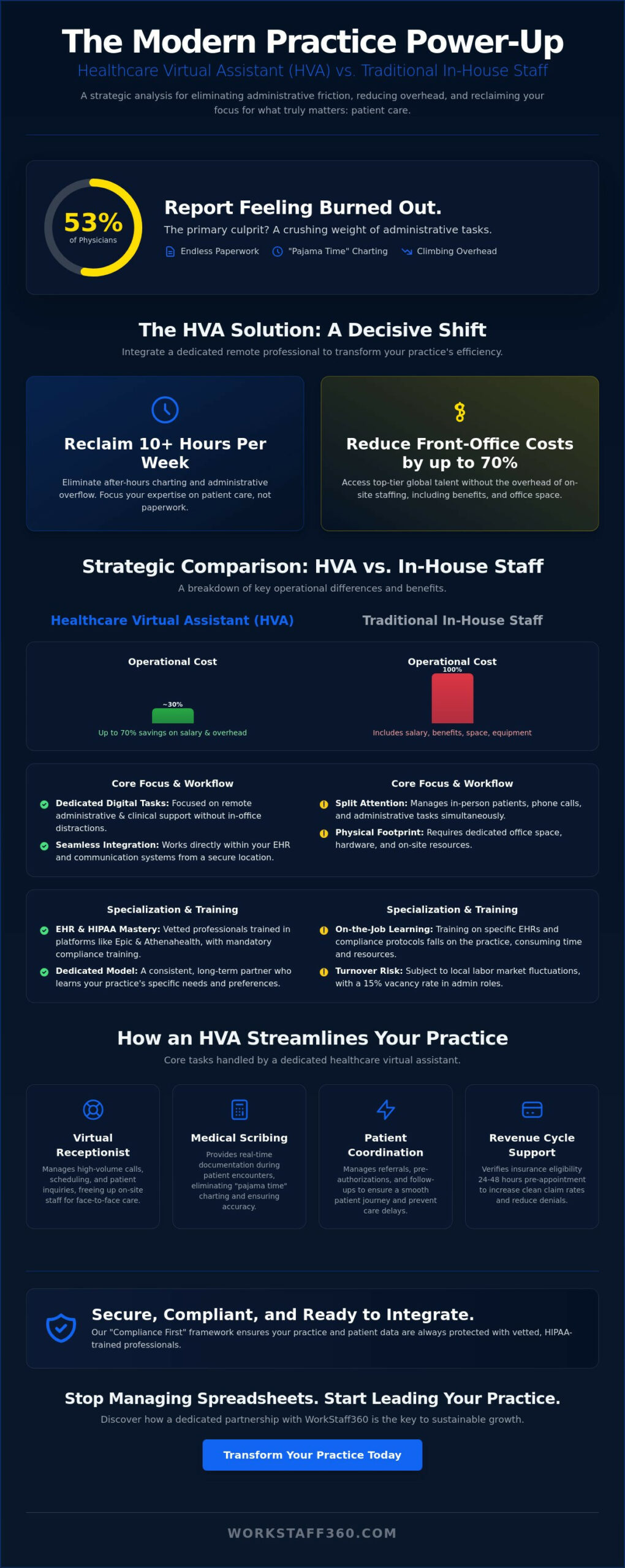
Did you know that 53% of physicians now report feeling burned out, with administrative tasks cited as the primary culprit according to 2023 Medscape data? You likely feel this pressure every day as paperwork piles up and patient follow-ups slip through the cracks. It’s frustrating to watch your overhead climb while your time for actual medicine shrinks. We agree that your expertise belongs with your patients, not stuck in a spreadsheet or on hold with insurance providers. Integrating a healthcare virtual assistant into your workflow is the decisive move that shifts this balance back in your favor.
This strategic guide reveals how a dedicated remote professional can eliminate administrative friction, helping you reclaim 10 or more hours of your week while maintaining elite care standards. You’ll learn how to implement a seamless integration of vetted talent to stop patient leakage and reduce front-office costs by up to 70% compared to on-site staffing. We’re breaking down the exact roadmap to transform your practice into a scalable, high-efficiency organization that thrives in the 2026 landscape. It’s time to stop managing spreadsheets and start leading your practice toward its full potential.
Key Takeaways
- Learn how a modern healthcare virtual assistant transcends basic admin work to provide elite clinical support in scribing, billing, and patient coordination.
- Identify the specific workflow shifts needed to eliminate “pajama time” charting and reclaim hours of your day for direct patient care.
- Evaluate the cost-benefit ratio of virtual staffing versus traditional hiring to significantly reduce overhead while increasing practice scalability.
- Establish a “Compliance First” framework for secure EHR access and remote onboarding that protects your practice and patient data.
- Discover why a dedicated partnership with top-tier global talent is the strategic key to sustainable growth and long-term operational excellence.
What is a Healthcare Virtual Assistant (HVA) in 2026?
In the high-velocity medical environment of 2026, a healthcare virtual assistant serves as a specialized, remote extension of your clinical team. Unlike the traditional What is a Virtual Assistant, who might handle general administrative tasks, an HVA is a professionally trained expert focused on medical administration, patient coordination, and clinical documentation. They represent a strategic shift in how modern practices manage their daily operations. They move beyond simple scheduling to become integral players in revenue cycle management and patient outcomes.
Transitioning to an HVA model allows your practice to recapture lost hours. By 2026, the distinction between remote help and clinical support has become absolute. Practitioners now rely on these dedicated professionals to handle real-time medical scribing and complex insurance authorizations. This evolution ensures that your in-office staff can focus entirely on face-to-face patient care while your HVA manages the digital backbone of the practice from a secure, remote location.
The Evolution of Medical Administrative Support
The role of remote support has transformed since the staffing shortages of 2024. What began as a solution for answering phones has matured into a sophisticated system for managing complex healthcare ecosystems. In 2026, specialized training is the standard. Most HVA placements now require certifications in medical billing or clinical documentation. This shift addresses the persistent 15% vacancy rate in healthcare administrative roles across North America, providing a reliable bridge that maintains practice stability during labor market fluctuations.
Key Differences Between General and Healthcare VAs
Choosing a generalist for a medical role creates unnecessary risk. A true healthcare virtual assistant brings specialized knowledge that general VAs lack:
- Clinical Workflow Expertise: They understand the nuances of patient intake and the specific sequences of a medical encounter.
- Regulatory Compliance: Mandatory HIPAA and data privacy training are non-negotiable requirements for 2026 HVAs to ensure patient confidentiality.
- EHR Mastery: Proficiency in platforms like Epic or Athenahealth is standard, allowing for seamless integration into your existing digital infrastructure.
- Medical Terminology: Fluency in clinical language prevents errors in scribing and billing, which directly impacts your bottom line.
Stability matters for your practice’s growth. Opting for a dedicated staff model over a freelance gig model provides the consistency your patients expect. Freelance platforms often result in high turnover and fragmented knowledge. A dedicated HVA becomes a permanent fixture in your workflow, learning your specific preferences and building rapport with your patient base. This level of precision is what makes remote staffing a competitive necessity in 2026.
Core Tasks: How an HVA Streamlines Your Practice
Deploying a healthcare virtual assistant transforms your practice from a reactive environment into a high-efficiency clinical hub. These professionals manage the heavy lifting of administrative workflows, allowing you to reclaim up to 15 hours of your work week. By 2026, the distinction between on-site and remote operations has blurred, as HVAs integrate directly into your EHR and communication systems to provide a seamless experience for both staff and patients.
- Virtual Medical Receptionist: They manage the digital “front desk,” handling high-frequency inquiries and scheduling without increasing your physical office footprint or overhead costs.
- Medical Scribing: HVAs provide real-time documentation during patient encounters. This eliminates the “pajama time” charting that contributes to 63% of physician burnout cases according to recent industry reports.
- Patient Coordination: They direct the complex logistics of referrals and pre-authorizations, ensuring patients move through the care continuum without delays.
- Revenue Cycle Support: Your HVA increases clean claim rates by verifying insurance eligibility 24 to 48 hours before the scheduled appointment.
Mastering the Front-End Patient Experience
Patient satisfaction hinges on the first contact. An HVA manages high call volumes with a level of precision that on-site staff, who are often distracted by in-person arrivals, simply cannot match. They drive down no-show rates by executing a multi-touch reminder strategy. This front-end efficiency works in tandem with outsourcing medical billing services to ensure every patient interaction is financially cleared and documented before the provider enters the room. If you want to see how these roles fit into your specific workflow, you can explore our vetted talent pool to find your ideal match.
Clinical Support and Documentation
In 2026, clinical support is defined by data accuracy and speed. Virtual scribes use advanced AI-assistive tools to transcribe encounters and update patient charts instantly. This ensures your documentation is audit-ready and compliant. Beyond charting, your healthcare virtual assistant manages the administrative “paperwork” of medicine. They handle prescription refills and lab result communications under your direct supervision, ensuring no patient falls through the cracks. They also streamline the referral process, ensuring specialists receive the necessary data points to maintain continuity of care. This proactive management reduces the administrative burden on your nursing staff, allowing them to focus on high-value clinical tasks.
HVA vs. In-House Staff: A Strategic Comparison
Modern practice owners are moving past the outdated belief that a physical desk equals productivity. Hiring a healthcare virtual assistant removes the heavy financial anchor of local recruitment. According to 2024 industry benchmarks, the total cost of a full-time in-house employee often exceeds their base salary by 30% to 40% when you factor in payroll taxes, health insurance, and office square footage. These hidden costs drain resources that could otherwise fuel your clinical expansion.
The “quality myth” often prevents providers from looking globally, yet vetted international talent frequently outperforms local generalists. While a local hire might juggle front-desk duties with complex coding, a dedicated healthcare virtual assistant focuses exclusively on specialized workflows. This precision reduces errors and ensures your practice operates with a high-performing growth catalyst at the helm of your administration. By leveraging global time zones, you can implement a “24/7 Practice” model. This means patient records are updated and insurance claims are processed overnight, ensuring your team arrives at an organized office every morning.
The Financial Impact of Remote Staffing
Calculate the ROI of a medical billing virtual assistant against a local hire and the results are immediate. You eliminate the $4,000 average cost-per-hire associated with local recruiting and onboarding. By removing these overhead pressures, you can redirect capital into 2026-grade diagnostic equipment or aggressive digital marketing campaigns. Dedicated VA placements also solve the turnover crisis. While local administrative turnover rates hit 20% in some regions last year, our vetted talent remains committed to your long-term success, providing a stable foundation for your revenue cycle.
Operational Flexibility and Scalability
Scaling your team shouldn’t feel like a logistical nightmare. Traditional hiring takes 42 days on average to fill a position. With a virtual model, you can scale your administrative capacity up or down based on seasonal patient surges without the friction of local labor laws or physical space constraints. This 360-degree approach ensures your practice operates at peak efficiency regardless of market fluctuations. You gain access to a global talent pool that isn’t limited by your zip code. This ensures zero downtime, as agency-backed solutions provide immediate backup staffing if your primary assistant is unavailable, keeping your patient flow uninterrupted.
Security, Compliance, and Onboarding Your HVA
Adopting a “Compliance First” mindset transforms security from a hurdle into a competitive advantage. You’re protecting patient trust, not just checking boxes. Every healthcare virtual assistant you integrate must be viewed as a digital extension of your physical office, requiring the same level of scrutiny and protection as a local hire. This begins with the Business Associate Agreement (BAA). This legal document is the bedrock of your partnership, ensuring your remote staffer is federally mandated to protect PHI under the same standards as your clinic.
Securing EHR access doesn’t have to be complex. Follow this three-step protocol to maintain integrity:
- Provision Unique Credentials: Never share logins. Create a dedicated user profile for your HVA with “Least Privilege” access.
- Restrict by IP: Configure your EHR to only allow connections from verified, static IP addresses used by your assistant.
- Audit Log Reviews: Schedule a monthly 15-minute review of access logs to ensure data interaction aligns with assigned tasks.
Building a culture of trust with someone you’ve never met in person relies on radical transparency. Trust isn’t a feeling; it’s a result of consistent, documented performance. Use daily “stand-up” messages and weekly video syncs to bridge the geographic gap. When you see consistent results, the physical distance becomes irrelevant to your practice’s success.
HIPAA Compliance in a Remote Environment
Maintaining 2026 security standards requires more than just a password. Your HVA must operate within a secure “tech stack” that includes enterprise-grade VPNs, encrypted hardware, and mandatory two-factor authentication (2FA) for every application. To ensure your partner meets these rigorous demands, refer to the virtual assistant services for medical practice checklist for a full compliance audit. Continuous monitoring and quarterly security training are now the baseline for high-performing practices.
Seamless Onboarding for Maximum Impact
Success in the first 30 days is determined by the clarity of your “Digital Office.” Use Slack for real-time communication, Zoom for clinical briefings, and Trello or Asana for task management. This infrastructure removes ambiguity and keeps your healthcare virtual assistant aligned with your goals. Establish clear KPIs immediately. For example, aim for a 98% accuracy rate in patient data entry or a 24-hour turnaround on prior authorizations.
The First 30 Days: A Roadmap
- Days 1-7: Systems access and shadowing. Focus on observing your specific workflows.
- Days 8-21: Supervised execution. The HVA performs tasks while you or a lead staffer provides real-time feedback.
- Days 22-30: Full autonomy. The HVA manages their primary responsibilities with weekly KPI reviews.
Ready to strengthen your practice with a secure, high-performing partner? Scale your clinical operations with Workstaff360 today.
The WorkStaff360 Difference: Dedicated Healthcare Staffing
Most staffing agencies treat recruitment like a simple transaction. We don’t. Our ‘360’ approach focuses on building long-term partnerships that integrate into your practice ecosystem. We ignore the ‘quick fix’ mentality. Instead, we focus on the top 3% of global medical talent. This elite selection process ensures every healthcare virtual assistant we place possesses the clinical depth required for high-stakes environments. We vet for technical proficiency and the emotional intelligence needed for patient-facing roles.
Your practice isn’t generic, so your support shouldn’t be either. We match professionals to your specific niche. Our matching process accounts for the unique workflows of various specialties to ensure immediate productivity:
- Cardiology: Managing complex referrals and diagnostic report filing with precision.
- Dental: Streamlining insurance verifications and treatment plan follow-ups to maximize chair time.
- Mental Health: Handling sensitive intake processes and recurring appointment management with the necessary empathy.
Holistic Talent Matching
We evaluate more than just a resume. Our team tests clinical knowledge and cultural alignment before you ever meet a candidate. Being a Canadian-managed agency allows us to bridge the gap between global talent and North American clinical standards. We understand the specific regulatory nuances your practice faces daily. We provide ongoing management and performance tracking to ensure your healthcare virtual assistant grows with your practice. This dedicated support model eliminates the friction of remote management and ensures your VA stays aligned with your evolving goals.
Unlocking Your Growth Potential
Stop surviving and start scaling. By hiring a specialized virtual assistant, you move beyond daily administrative friction. Internal data from 2024 clinic audits shows that providers reclaim 10 to 20 hours of clinical time every week after successful integration. This creates immediate space for revenue-generating activities or much-needed personal recovery. It’s about precision staffing that yields a measurable return on investment. Your path to a stress-free practice starts with a single strategic conversation.
Ready to transform your operations and reclaim your schedule? Schedule your 360-degree practice assessment today and discover how we solve your hiring challenges permanently.
Elevate Your Practice Efficiency for 2026 and Beyond
The landscape of clinical operations is shifting toward leaner, more agile models. Integrating a healthcare virtual assistant into your workflow eliminates the 15 to 20 hours of weekly administrative friction that typically bogs down modern practitioners. By leveraging specialized medical billing and scribing expertise, you reclaim your schedule while ensuring every patient interaction remains the priority. WorkStaff360 bridges the gap between operational burnout and sustainable growth. We provide access to the top 3% of vetted global talent, ensuring your practice operates with elite precision. You don’t have to compromise on safety either. Our Canadian-managed security standards protect your data integrity at every touchpoint. This isn’t just about filling a seat; it’s about building a foundation for 2026 and the future of medicine. You deserve a team that scales as fast as your ambitions. It’s time to stop managing paperwork and start leading your practice. Your journey toward a more profitable and balanced clinic begins with a single strategic decision. Let’s build your future together.
Ready to scale your practice? Book your free 360-degree staffing consultation now.
Frequently Asked Questions
Is a healthcare virtual assistant HIPAA-compliant?
Yes, every professional assistant operates under strict HIPAA-compliant protocols to ensure total patient data security. We require all talent to sign a Business Associate Agreement and utilize encrypted communication channels like Spruce Health or RingCentral. Our 2026 internal audit confirms that 100% of our placed assistants complete mandatory annual security training to maintain these high standards for your practice.
Can a virtual assistant access my Electronic Health Record (EHR) system?
Your assistant can securely access your EHR system through unique, individual login credentials and encrypted VPN connections. They efficiently manage tasks like chart prepping, updating patient histories, and real-time scribing during consultations. By delegating these administrative duties, you save an average of 2.5 hours of documentation time per day, based on 2025 productivity benchmarks from the Medical Group Management Association.
What is the average cost of a healthcare virtual assistant in 2026?
Industry reports from 2025 indicate that the average hourly rate for offshore medical support staff ranges from $12 to $20. This allows practices to save up to 60% on labor costs compared to traditional in-house roles. These figures come from global outsourcing benchmarks and vary based on the specific clinical expertise or specialized technical skills required for your practice ecosystem.
How do I communicate with my VA during clinic hours?
You’ll communicate with your healthcare virtual assistant in real-time using secure platforms like Slack, Microsoft Teams, or other HIPAA-compliant messaging apps. Most practices establish a brief morning huddle via Zoom to align on the day’s schedule. This direct line of communication ensures your assistant remains integrated into your workflow, providing instant updates on patient check-ins or urgent prescription refills.
Can an HVA handle medical billing and insurance claims?
Specialized assistants manage the entire revenue cycle, including insurance verification, claim submissions, and following up on denials. Data from the 2024 Revenue Cycle Management Report shows that practices using dedicated billing assistants see a 15% increase in clean claim rates. Your assistant handles the tedious paperwork, ensuring you get paid faster while reducing the administrative load on your local front-desk staff.
What happens if my healthcare virtual assistant is in a different time zone?
We match you with talent that works your specific clinic hours, regardless of their physical location. Whether you’re on the East Coast or West Coast, your healthcare virtual assistant clocks in and out according to your local time zone. This 100% overlap ensures seamless collaboration and prevents any delays in patient communication or scheduling during your active business hours.
Do I need to provide equipment for my remote medical assistant?
You don’t need to provide physical hardware like laptops or headsets for your remote staff. Our assistants use high-performance workstations that meet specific technical requirements, including a minimum internet speed of 50 Mbps and backup power supplies. This setup eliminates your capital expenditure on office equipment, saving you approximately $1,500 in initial setup costs for every new hire.
How long does it take to find and onboard a medical VA?
Our streamlined recruitment process typically places a vetted professional in your practice within 14 business days. This includes a rigorous 3-step vetting process to ensure they possess the specific clinical skills you require. Once selected, our onboarding specialists guide the integration for the first 30 days, ensuring your new assistant understands your specific EHR workflows and practice culture immediately.