
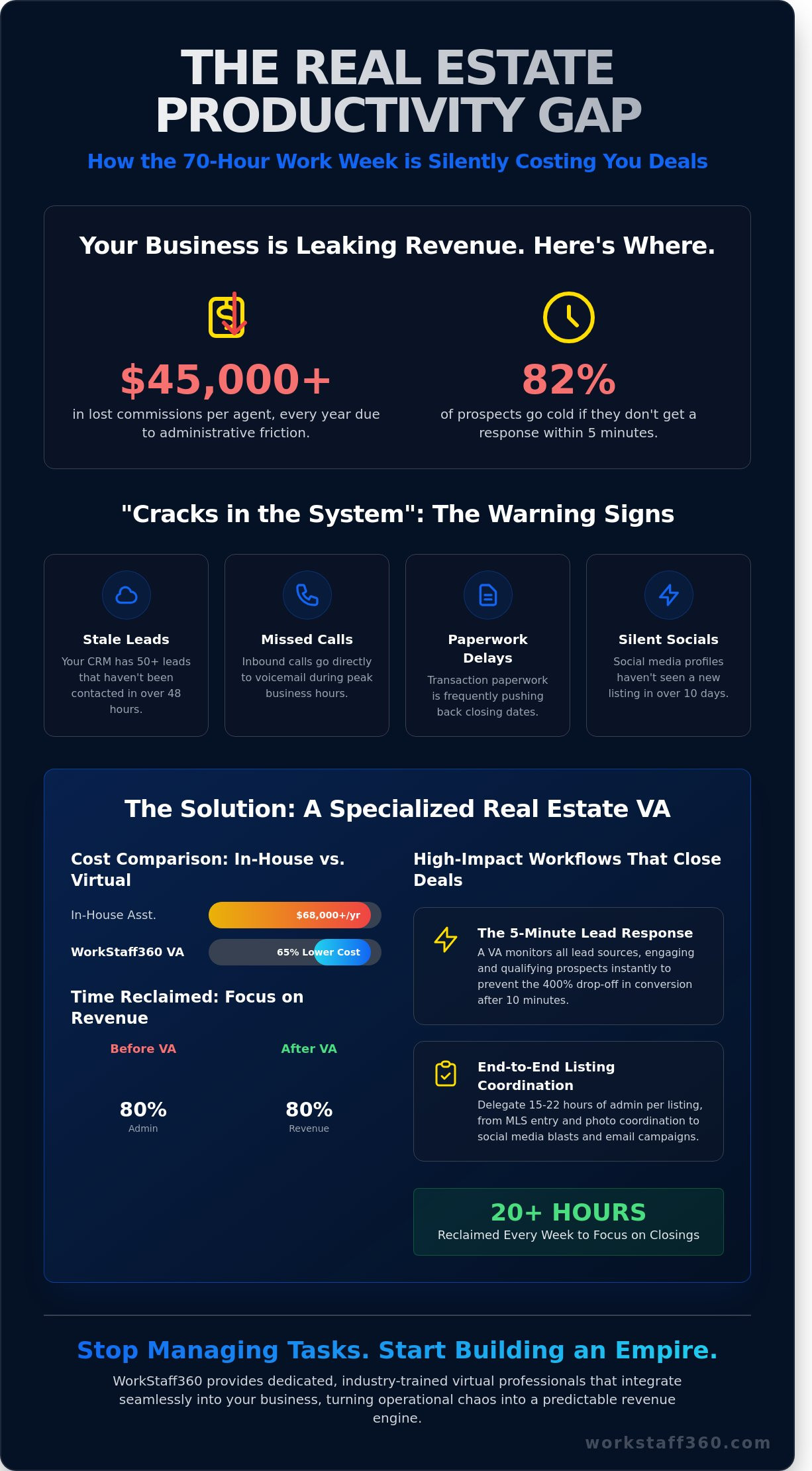
The 70-hour work week isn’t a badge of honor in real estate; it’s a structural failure that costs the average agent over $45,000 in lost commissions every year. You’ve likely felt the sting of a high-value lead going cold because 82% of prospects won’t wait more than five minutes for a response. It’s a common friction point where administrative burdens stifle your actual earning potential. Integrating a specialized virtual assistant for real estate agents is no longer a luxury for the top 1% of producers. It’s a fundamental requirement for any professional aiming to scale their GCI in 2026 without hitting a burnout ceiling.
You deserve a business that operates with 360-degree efficiency, even when you’re at the closing table. This article reveals how to leverage vetted talent to reclaim 20+ hours of your week while maintaining a relentless marketing presence. We’ll explore the exact systems used to build a seamless lead-to-close pipeline that turns your database into a predictable revenue engine. You’re about to discover a clear, actionable strategy to replace manual labor with scalable growth and total operational freedom.
Key Takeaways
- Learn why the modern virtual assistant for real estate agents has evolved from a simple admin into a specialized growth catalyst designed to scale your GCI.
- Implement high-impact workflows that prioritize speed-to-lead and consistent client nurturing to ensure no opportunity falls through the cracks.
- Discover why dedicated agency partnerships outperform short-term freelancers by providing the long-term consistency and data security essential for high-volume teams.
- Master the seamless integration of remote talent into your existing tech stack, focusing on optimized CRM management for platforms like Follow Up Boss and LionDesk.
- Unlock a holistic “360-degree” staffing strategy that matches you with vetted, industry-specific professionals ready to drive immediate results for your business.
Why Top-Producing Agents are Pivoting to Virtual Staffing in 2026
The modern Real Estate Virtual Assistant (REVA) is no longer a peripheral helper; they’re a specialized industry professional trained in high-level transaction coordination and digital marketing. By 2026, the shift from general administrative support to “growth catalyst” roles has become the standard for agents clearing $500k+ in GCI. This transition allows you to move beyond basic task completion into a model of scalable business intelligence. You aren’t just hiring a remote worker; you’re installing a dedicated engine for your business.
Hiring an in-house assistant in high-cost hubs like Toronto or New York requires a base salary often exceeding $68,000 per year, excluding benefits, payroll taxes, and office overhead. A specialized virtual assistant for real estate agents through WorkStaff360 delivers the same operational excellence at a 65% lower cost. Our philosophy focuses on dedicated support that integrates seamlessly into your existing ecosystem. We ensure your new hire isn’t just an outsider, but a core component of your daily workflow that understands your specific market nuances.
The “Cracks in the System” Test
You’ll know it’s time to scale when small errors begin impacting your bottom line. Look for these specific indicators in your current operations:
- Your CRM contains 50+ leads that haven’t been touched in over 48 hours.
- Inbound calls go to voicemail during peak showing hours.
- Transaction paperwork delays are frequently pushing back closing dates.
- Social media profiles haven’t seen a fresh listing update in 10 days.
Waiting until you’re completely overwhelmed costs more in lost commissions than the actual salary of a staff member. If your lead conversion rate drops by even 3% due to slow response times, you’re losing thousands. Get ahead of the curve by reviewing our ultimate guide to real estate virtual assistants to see how to patch these leaks before they sink your quarter.
Administrative Freedom vs. Strategic Growth
High-performing agents distinguish between “busy work” like data entry and “revenue work” such as showing houses and listing presentations. A virtual assistant for real estate agents bridges this gap by managing the 80% of tasks that don’t require a professional license. This delegation frees you to focus on high-leverage activities that directly impact your GCI. In 2026, a realtor’s success is measured by their ability to delegate everything that isn’t a closing negotiation. By offloading everything from social media scheduling to listing coordination, you reclaim roughly 22 hours per week. That’s time you can reinvest into high-value networking and closing deals.
5 Real-World Examples of REVA Workflows That Close Deals
Scaling your GCI requires moving beyond the solopreneur bottleneck. By integrating a virtual assistant for real estate agents, you transform your business into a systematic machine where no lead dies in an inbox. These five plug-and-play workflows demonstrate how WorkStaff360 professionals handle the heavy lifting; allowing you to focus on the 20% of activities that generate 80% of your revenue.
Example 1: The 5-Minute Lead Response Machine
Speed is the ultimate currency in the 2026 market. Research from LeadResponseManagement.org indicates that the odds of qualifying a lead drop by 400% after just ten minutes of silence. A WorkStaff360 VA monitors your Zillow, Realtor.com, and social media feeds 24/7. They immediately engage prospects via text or phone to qualify their budget and timeline. Once a lead is vetted, the VA executes a warm hand-off directly to your mobile. This ensures you only speak with high-intent buyers while your response time stays under the critical five-minute mark.
Example 2: End-to-End Listing Coordination
A single listing involves approximately 15 to 22 hours of administrative labor. Your VA manages the entire lifecycle; they input MLS data, coordinate with professional photographers, and upload virtual tours to your site. While you’re at a listing presentation, your VA launches “Just Listed” social media blasts and triggers multi-step email drips to your local database. This workflow ensures every property receives 100% of the marketing attention it deserves without consuming your personal time.
Example 3: Transaction Management and Closing Support
The period between an accepted offer and a closed deal is where most agents lose their momentum. A specialized VA acts as the central hub; chasing signatures via DocuSign and organizing escrow documents with surgical precision. They serve as the primary liaison between the title company, the lender, and the client to ensure every deadline is met. For a deeper look at high-level support, explore our specialized virtual assistant guide to see how these roles manage complex legal compliance and documentation.
Example 4: The CRM “Ghostwriter” and Nurture System
Most CRMs are data graveyards where leads go to be forgotten. Your VA cleanses this data daily; tagging prospects by intent and neighborhood. They ghostwrite personalized follow-up sequences that keep you top-of-mind. This consistent touchpoint strategy can increase your referral rates by as much as 25% within the first 12 months of implementation.
Example 5: Proactive Geographic Farming
Dominating a specific zip code requires consistent outreach. Your virtual assistant for real estate agents pulls tax records, identifies “likely to sell” properties through predictive analytics, and manages your digital ad campaigns. They turn cold data into a warm pipeline of seller leads, preparing you for a successful listing presentation. If you’re ready to stop juggling tasks and start closing, you can partner with WorkStaff360 to build these systems into your business today.
Comparing Dedicated Agency VAs vs. Short-Term Freelancers
Scaling your GCI in 2026 requires a stable foundation. You cannot build a high-volume real estate machine on the shifting sands of project-based freelancers. While a cheap gig worker might handle a single graphic or a data entry task, a professional virtual assistant for real estate agents manages your entire lead ecosystem. The difference lies in the commitment to your long-term outcomes versus a “task-complete” mindset. Before making your decision, reviewing a comprehensive comparison of the top real estate virtual assistant companies of 2026 can help you identify which provider offers the dedicated, long-term support your business truly needs.
The DIY hiring route on global bidding sites often leads to a cycle of constant replacement. Agents who hire independently spend an average of 25 hours sourcing, interviewing, and testing a single candidate. If that worker leaves after three months, you’ve wasted thousands of dollars in billable hours. WorkStaff360 eliminates this onboarding friction by providing a seamless integration process that places pre-vetted talent directly into your workflow.
- Agency VAs: Dedicated partners who learn your specific brand voice and local market nuances.
- Freelancers: Multiple clients often distract them, leading to delayed responses and missed follow-ups.
- Agency VAs: Backed by a Canadian management team that handles payroll, compliance, and performance.
- Freelancers: Zero accountability if they disappear with your login credentials or sensitive data.
The Hidden Cost of High Turnover
Losing a team member every 90 days destroys your business momentum. Data suggests that replacing a staff member costs roughly 33% of their annual salary in lost productivity and recruitment time. WorkStaff360’s long-term placement model ensures institutional knowledge stays inside your business. Our talent arrives already familiar with North American real estate terminology. They understand the difference between a “contingent offer” and “pending status” on day one, saving you weeks of basic training.
Security and Data Protection in 2026
Your CRM is your most valuable asset. Handing access to an unvetted freelancer exposes you to massive liability. Cyber threats in the real estate sector increased by 24% over the last calendar year, making security a non-negotiable priority. WorkStaff360 operates as a Canadian-managed entity, providing a layer of legal and professional accountability that offshore platforms lack. We implement 7 specific security protocols, including encrypted password management and restricted IP access, to keep your client files locked down. You gain the efficiency of a global workforce with the peace of mind that comes from elite domestic standards.
How to Integrate a Virtual Assistant into Your Real Estate Tech Stack
Integrating a virtual assistant for real estate agents into your business isn’t just about offloading work; it’s about building a high-speed digital engine. Success depends on a structured remote workflow that bridges the gap between your tools and your talent. You need a centralized communication hub using Slack for real-time updates and Zoom for deep-dive strategy sessions. Agents who automate 65% of their administrative intake by 2026 will see a direct boost in GCI because they’re finally free to focus on high-value closings. Start by documenting your Standard Operating Procedures (SOPs) in a shared Google Drive or Notion workspace. Use screen recording tools like Loom to capture your exact process for listing entries or contract coordination. This visual library allows your VA to reference your preferences without needing to ask the same question twice, saving you hours of repetitive training.
Mastering the CRM Lead Flow
Your CRM serves as the central nervous system of your operations. When you bring a VA on board, set up specific permissions in platforms like Follow Up Boss, LionDesk, or Chime. This protects your core database while giving your assistant the power to tag, categorize, and nurture cold leads. Task your VA with managing automated drip campaigns to ensure no prospect is ignored. A 2025 lead response study showed that agents who respond within 5 minutes are 21 times more likely to qualify a lead. Your VA makes this possible by monitoring incoming traffic around the clock. Implement a 10-minute “Daily Huddle” at 8:30 AM to align on the day’s top priorities. This quick sync ensures your team hits the ground running and stays focused on the hottest opportunities in the pipeline.
Leveraging AI for Content and Marketing
Modern marketing requires a volume of content that most agents can’t produce alone. Your VA should use AI tools to brainstorm five distinct social media hooks for every new listing. While AI handles the initial drafting, your VA takes on the vital role of proofreading and humanizing the text. They ensure every newsletter and property description reflects your unique brand voice rather than sounding like a generic template. Adopting this strategy cuts content production time by 75%, allowing you to dominate local search results while maintaining a polished, professional image across all digital platforms. This holistic approach ensures your 360-degree brand presence stays active without sacrificing your personal time. By 2026, the most successful agents will be those who use a virtual assistant for real estate agents to bridge the gap between AI speed and human connection.
Choosing WorkStaff360: Your Strategic Partner for Growth
Scaling a real estate business in 2026 requires a fundamental shift in how you value your time. WorkStaff360 facilitates this transition through a holistic, 360-degree approach that covers recruitment, onboarding, and long-term support. We don’t just fill a seat; we integrate a high-performing professional into your specific workflow. This partnership allows you to stop “working in” the business and finally start “working on” your growth strategy. Our process removes the typical headaches of global hiring. You won’t spend weeks sorting through resumes or managing payroll across borders. We handle the operational complexity so you can enjoy the scalability. By delegating the 80% of tasks that only generate 20% of your revenue, you reclaim the freedom to focus on closing deals and building relationships.
The WorkStaff360 Vetting Process
Our recruitment standards are notoriously high. We accept fewer than 3% of all applicants, ensuring you only meet the elite tier of talent. Our 5-stage screening process includes comprehensive background checks, technical skill testing, and personality profiling. We focus heavily on work ethic as a core competency. This ensures your virtual assistant for real estate agents possesses the grit and reliability needed to handle high-pressure market shifts. We handle the heavy lifting of sourcing and interviewing so you can skip the hiring friction and go straight to results. Every candidate is vetted for their ability to integrate into professional environments, ensuring they hit the ground running from day one.
Ready to Scale? Your Next Steps
The divide between top producers and struggling agents is widening. Recent 2025 industry data shows that 74% of agents earning over $250,000 in GCI now utilize remote support to manage their pipelines. Your competitors are already leveraging these global talent pools to lower their overhead and increase their output. Don’t let your business plateau because you’re busy with data entry or lead scrubbing. It’s time to build your remote empire. For a comprehensive guide on making the right hiring decision, check out our detailed resource on how to hire a real estate virtual assistant for maximum GCI growth. Book your free strategy call to see how we can customize a staffing solution for your specific goals. Hire a Real Estate Virtual Assistant today and start leading your business instead of just running it. Success in the modern market isn’t about working more hours; it’s about building better systems.
Elevate Your 2026 GCI with Strategic Human Capital
Winning in the 2026 real estate market requires a decisive shift from being a solo operator to becoming a true business owner. You’ve learned that a virtual assistant for real estate agents isn’t just a remote helper; it’s the engine behind your most profitable workflows. By leveraging our industry-specific vetting process, you bypass the 40-plus hours usually spent on recruitment to access the top 3% of global talent immediately. Our model prioritizes dedicated long-term placements over the high turnover of freelance platforms, giving you a stable foundation for growth. We protect your operations with Canadian-managed security standards, so your client data stays safe while you focus on high-value negotiations. It’s time to stop drowning in administrative tasks and start leading your market. Your path to a streamlined, high-output business starts with a partner who understands the high stakes of real estate. You’ve built the momentum; now let’s build the team that sustains it.
Ready to reclaim your time? Book your free WorkStaff360 consultation now!
Frequently Asked Questions
What tasks can a virtual assistant for real estate agents handle?
A virtual assistant for real estate agents handles everything from CRM management and cold calling to social media scheduling and transaction coordination. You can delegate up to 15 hours of weekly administrative work, including listing entry and appointment setting. This shift allows you to focus strictly on high-value activities like closing deals. By offloading these 25 specific recurring tasks, agents typically reclaim 40% of their productive hours for client-facing meetings. For a comprehensive breakdown of all delegatable tasks, check out our ultimate checklist for real estate virtual assistant services to ensure you’re maximizing your VA’s potential.
Do I need to be a licensed broker to hire a real estate VA?
You don’t need to be a licensed broker to hire a real estate assistant for administrative support. While specific states require licenses for negotiating prices or signing contracts, 92% of daily operations like lead scraping and email management are non-licensed activities. We ensure your assistant focuses on these high-impact support roles. This structure keeps your business compliant with local 2026 real estate regulations while maximizing your operational efficiency.
How much does a real estate virtual assistant cost in 2026?
In 2026, a high-quality real estate virtual assistant costs between $12 and $22 per hour depending on their specialized skill set. This rate represents a 65% reduction in overhead costs compared to hiring a full-time, in-house administrative coordinator in the United States. You eliminate expenses related to office space, equipment, and payroll taxes. Most WorkStaff360 clients see a full return on their investment within the first 90 days of placement.
Can a VA work in my specific time zone?
Your virtual assistant works exactly when you do by aligning 100% with your specific North American time zone. Whether you operate in EST or PST, our talent matches your business hours to ensure real-time communication and instant lead responses. This synchronization eliminates the 12-hour delay common with traditional outsourcing. You get a seamless extension of your team that’s available during your most critical 8 to 5 peak performance windows.
How do I handle training for a remote real estate assistant?
You handle training through our structured 14-day onboarding framework that utilizes screen-share recordings and standardized operating procedures. We provide the initial vetting and baseline training, so you only need to demonstrate your specific CRM workflows or local market nuances. Agents who use our documented “360-degree” training method reduce their ramp-up time by 50%. This approach ensures your new hire becomes a productive asset within their first two weeks.
What is the difference between an ISA and a general real estate VA?
An Inside Sales Agent (ISA) focuses exclusively on outbound prospecting and lead conversion, while a general virtual assistant for real estate agents manages your broader operations. ISAs are trained to handle the 50 to 100 daily cold calls required to fill your pipeline. General VAs manage your calendar, marketing, and transaction files. Teams that combine both roles often see a 30% increase in Gross Commission Income through better lead retention.
Is my client data safe with a virtual assistant from WorkStaff360?
Your client data remains secure through our rigorous 3-tier security protocol and mandatory non-disclosure agreements. We implement 256-bit encryption for all data transfers and use secure password management tools to limit direct access. Every WorkStaff360 professional undergoes a 5-point background check before joining our network. These 2026 security standards ensure your proprietary lead lists and sensitive contract details stay protected against unauthorized access at all times.