
Your refusal to let go is the single biggest bottleneck in your company’s revenue growth. You likely believe that maintaining total control is the only way to guarantee quality, yet data shows this mindset costs the average founder over 800 hours of strategic time in a single year. If you don’t master how to delegate tasks effectively, your business will remain capped by your personal bandwidth. You’ve built a solid foundation, but you’re currently the one holding up the ceiling.
It’s exhausting to feel that every minor decision must pass through your desk before it can move forward. You’ve worked hard to establish your brand, and the fear of a quality dip is a valid concern for any scaling executive. This guide promises to hand you a repeatable system to offload 70% of your operational workload while actually increasing output precision. We’ll explore the specific 2026 framework for vetting elite talent and building autonomous workflows that allow you to focus exclusively on high-level strategy and long-term expansion.
Key Takeaways
- Escape the “Indispensability Trap” and shift your focus from daily operations to high-level strategic growth.
- Master how to delegate tasks effectively using a 360-degree audit that identifies low-value, high-frequency tasks for immediate removal.
- Implement a results-driven 5-step framework designed to ensure seamless execution without the need for micromanagement.
- Calculate the true break-even point of delegation to overcome the fallacy that doing it yourself is the fastest route to success.
- Scale your organizational impact by integrating vetted virtual professionals who provide the dedicated support necessary for long-term scalability.
Understanding Delegation as a Strategic Growth Catalyst
Delegation isn’t just about clearing your plate. It’s the intentional transfer of authority and responsibility for specific outcomes to a qualified professional. To master how to delegate tasks effectively, you must first refine your understanding of delegation as a tool for leverage rather than just a way to dump work. Many leaders fall into the “Indispensability Trap.” They believe they’re the only ones capable of executing high-level tasks. This mindset turns the CEO into a liability. If the business stops when you step away, you haven’t built a company; you’ve built a high-pressure job.
The numbers support a shift toward distributed responsibility. According to Gallup research, CEOs who demonstrate high delegation talent achieve a 33% higher revenue growth rate than those who don’t. These high-growth leaders don’t just assign chores. They empower their teams to own results. In 2026, this process is faster and more cost-effective than ever. Global remote staffing platforms have removed the friction of local hiring, allowing you to source vetted talent in hours instead of months. This speed allows you to respond to market shifts with immediate precision.
Operator vs. Visionary: The Delegation Divide
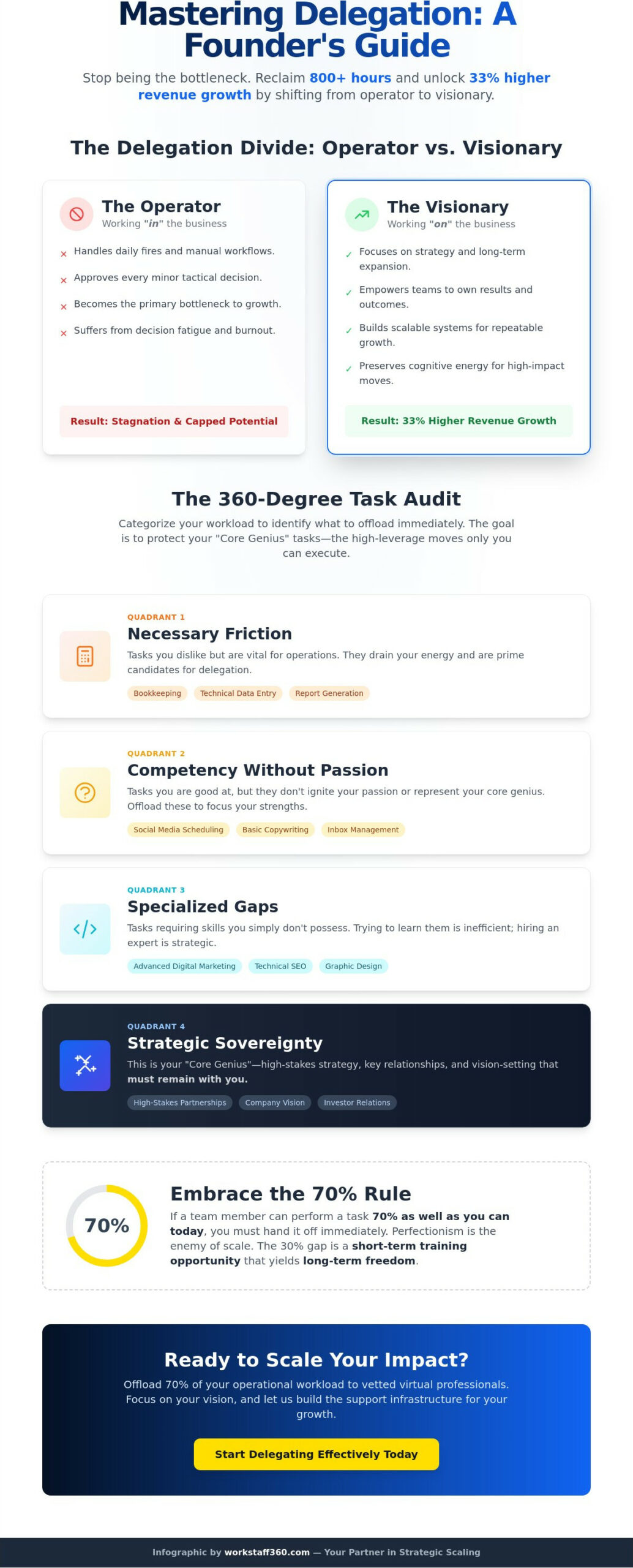
Scale requires a shift from tactical “operator” mode to strategic “visionary” leadership. Operators work “in” the business, handling daily fires and manual workflows. Visionaries work “on” the business, focusing on partnerships and long-term expansion. Your personal bandwidth eventually becomes the primary bottleneck for organizational scaling. The Visionary Gap is the distance between your current operational capacity and your future revenue goals.
The Psychological ROI of Letting Go
Letting go offers a massive return on your mental energy. Decision fatigue kills productivity when a leader must approve every minor tactical choice. Delegating these decisions to a dedicated assistant preserves your cognitive resources for high-impact moves. This shift also accelerates professional development for your team, building a resilient organization that thrives independently. Learning how to delegate tasks effectively creates a culture of accountability that attracts top-tier talent. For more on this, explore our strategic growth guide for small business.
Effective delegation provides three core benefits for the 2026 leader:
- Increased Agility: Teams move faster when they don’t wait for a single point of approval.
- Reduced Burnout: Strategic leaders focus on what they love, while specialists handle the rest.
- Scalable Systems: Documented delegation creates a repeatable blueprint for company growth.
The 360-Degree Task Audit: Identifying What to Delegate
Scaling a business requires a ruthless assessment of where your time goes. Most leaders treat their to-do list as a badge of honor, but an overflowing schedule often signals a failure to prioritize. To reclaim your focus, apply the “Ditch, Delegate, Do” framework. First, ditch tasks that offer zero ROI or no longer align with your 2026 goals. Next, identify the “Support Infrastructure” tasks that keep the lights on but don’t require your specific signature. Finally, protect your “Core Genius” tasks; these are the high-leverage moves that only you can execute to drive revenue.
The biggest barrier to growth is the perfectionism trap. You must embrace the 70% Rule: if a team member can perform a task 70% as well as you can today, you need to hand it off immediately. This gap represents a training opportunity, not a reason to hold onto the work. When you learn delegate effectively, you stop paying for your own time and start investing in your team’s capacity. Closing that 30% proficiency gap is a short-term effort that yields long-term freedom.
The Four Quadrants of Delegation
Categorize your current workload into these four specific buckets to gain clarity on your next hire:
- Quadrant 1: Necessary Friction. These are tasks you hate but are vital for operations, such as bookkeeping or technical data entry.
- Quadrant 2: Competency Without Passion. These are tasks you are good at, like social media scheduling or basic copywriting, but they aren’t your core genius.
- Quadrant 3: Specialized Gaps. These require skills you simply don’t have, such as advanced digital marketing or technical SEO.
- Quadrant 4: Strategic Sovereignty. This is high-stakes strategy and relationship building that must remain with you.
Auditing Your Week: A Practical Exercise
Commit to a 48-hour time audit to uncover hidden administrative leaks. For two days, log every activity in 15-minute increments. You will likely discover that “Low-Value, High-Frequency” tasks, such as email management and calendar coordination, consume up to 40% of your productive hours. These are prime candidates for a general virtual assistant who can streamline your workflow before you reach burnout.
Review your log for these common “15-minute” time-wasters that aggregate into hours of lost strategic momentum:
- Invoicing and following up on late payments.
- Formatting slide decks for internal meetings.
- Researching travel options or booking appointments.
- Filtering non-urgent inquiries from your inbox.
If your audit reveals more than five hours a week spent on these activities, it’s time to build a scalable team that handles the details while you handle the vision. Knowing how to delegate tasks effectively starts with acknowledging that your time is the company’s most expensive resource.
The 5-Step Framework for Effective Delegation in 2026
Delegation isn’t a one-time hand-off; it’s a strategic system. High-performing leaders who master how to delegate tasks effectively in 2026 prioritize the “Why” and the “Result” over the “How.” Micromanagement kills momentum and stifles the creative potential of your team. Success requires a structured five-step framework that transforms delegation into a repeatable engine for organizational growth. By following this process, you move from being a bottleneck to becoming a true architect of your business.
Step 1 & 2: Defining Outcomes and Matching Talent
Start by defining exactly what “done” looks like. Use SMART goals to eliminate any room for ambiguity. A 2024 report by the Project Management Institute revealed that 47% of project failures stem from poor requirements. Once the goal is clear, match the task to the right talent. Don’t settle for a generalist when you need precision. Hire a specialized virtual assistant with vetted skills in your specific industry. A Real Estate assistant understands the nuances of MLS listings, while a Healthcare assistant is already trained in HIPAA compliance. This specialized alignment can reduce onboarding time by 60% and ensures your staff hits the ground running.
Step 3 & 4: Resourcing and Communication
Empower your team with the necessary tools and authority. Provide clear SOPs, software passwords, and the power to make decisions within their domain. You must delegate the authority to solve problems, not just follow instructions. Establish communication rhythms that respect deep work and avoid meeting bloat. Use asynchronous tools like Loom or Slack to share updates and clarify how to delegate tasks effectively without clogging calendars. Research from Harvard Business School Online suggests that how to delegate effectively involves providing enough autonomy so that your team doesn’t hit a bottleneck every time a minor hurdle appears. Clear documentation prevents 85% of common execution errors in remote environments.
Step 5: Review and Refine
The final step is to build a feedback loop that improves quality over time. Establish a “No-Blame” culture where mistakes are treated as gaps in the process rather than personal failings. If a deliverable misses the mark, update the SOP to prevent a recurrence. Provide constructive feedback that empowers your assistant to take more off your plate with every project. Use a simple rule: give public credit for every win and offer private coaching for improvements. This approach builds a culture of ownership where your team feels invested in the company’s long-term success. Regular reviews ensure that your scaling efforts remain precise and sustainable as your workload grows.
Overcoming the “Faster to Do It Myself” Fallacy
Stop telling yourself you’ll save time by doing it yourself. This is the single biggest barrier to growth in 2026. Every time you reclaim a task, you’re trading long-term scalability for a few minutes of immediate comfort. Learning how to delegate tasks effectively requires you to view training not as an expense, but as a capital investment in your own freedom. If you’re still doing the $25-an-hour work, you aren’t leading; you’re just an expensive employee in your own company.
The Math of Modern Delegation
The logic is simple and undeniable. If a recurring task takes you 1 hour every week, and training a team member takes 5 hours upfront, you begin profiting in week 6. By the end of the first year, you’ve reclaimed 47 hours of high-level strategic time. If you refuse to delegate, the cost is infinite. You’ll perform that task every week until you retire or burn out. Shift your focus from the time lost today to the compounding hours gained tomorrow. Practical leadership is about identifying these time-leaks and plugging them with trained talent.
Most leaders fail because they focus on simple delegation, which handles one-off tasks. To scale, you must master systemic delegation. This means creating repeatable processes that run without your input. Use screen recording tools to clone your expertise. Record yourself doing the task once, narrate your thought process, and you’ve created a digital asset. You don’t need 50-page manuals; you need a searchable video library that allows your team to execute with 100% accuracy every time.
Building a Library of SOPs
Your first hire shouldn’t just do the work; they should document the work. Assigning the creation of Standard Operating Procedures (SOPs) to your staff turns tribal knowledge into a permanent company asset. This removes the risk of a single point of failure where only one person knows how a system works. A professional virtual assistant agency provides talent that is already trained in these documentation systems. This ensures your business operations stay organized and scalable from day one, regardless of who is in the seat.
Scaling Your Impact with WorkStaff360 Virtual Professionals
Scaling a business requires more than a simple list of to-dos. It demands a reliable infrastructure that supports your vision. WorkStaff360 acts as your strategic partner, handling the heavy lifting of recruitment so you can focus on high-level execution. While short-term freelancers often provide temporary fixes that lead to project churn, our dedicated remote professionals offer the continuity your business needs to thrive. This long-term alignment is essential when mastering how to delegate tasks effectively, as it builds institutional knowledge that stays within your organization rather than walking out the door after a single project.
Our 360-degree approach ensures that your virtual professional isn’t just a remote worker, but a seamless extension of your team. We manage the sourcing, interviewing, and initial onboarding, which removes the administrative friction that typically stops leaders from expanding. By providing a holistic ecosystem of support, we allow you to move from the day-to-day grind into a role of true strategic oversight.
Why Vetted Talent is the Key to Trust
Trust is the primary currency of successful delegation. Many leaders hesitate to let go because they fear a drop in quality or a lack of accountability. WorkStaff360 eliminates this friction through a rigorous vetting process that filters for the top 3% of global talent. We evaluate technical proficiency and cultural alignment to ensure every placement hits the ground running. For example, our Real Estate VA guide illustrates how specialized support manages complex property workflows, allowing you to step back with total confidence. Whether you require expertise in healthcare billing or digital marketing strategy, our specialized professionals provide the precision your specific industry demands.
- Long-term Stability: Dedicated staff members grow with your company, reducing the time you spend retraining new hires every few months.
- Specialized Expertise: Access VAs who already understand the nuances of your niche, from HIPAA compliance to advanced CRM automation.
- Reduced Overhead: Scale your team without the logistical headaches of traditional hiring, benefits, and physical office space.
Your Next 360-Degree Move
The journey from an overwhelmed operator to a visionary leader is a deliberate transition. You’ve explored the frameworks for how to delegate tasks effectively, and now you have the tools to execute. Don’t wait for the “perfect” moment to start. Offload one recurring administrative task today to begin building your delegation muscle. This simple act creates the mental breathing room necessary for strategic growth and innovation. Reclaim your calendar and lead your business to its full 2026 potential. Book a consultation with WorkStaff360 to find your perfect delegation partner.
Master Your Focus and Accelerate Your Scale
Scaling in 2026 requires a tactical shift from doing to leading. You’ve learned to identify high-impact tasks through the 360-degree audit and apply a 5-step framework for seamless handovers. Mastering how to delegate tasks effectively isn’t just about clearing your desk. It’s about reclaiming the 15 to 20 hours per week that executives often lose to administrative friction. According to Grand View Research, the global outsourcing market will expand to $525 billion by 2030 as businesses pivot toward specialized talent. WorkStaff360 connects you with vetted professionals from global markets who specialize in Real Estate, Healthcare, and Marketing. These aren’t temporary fixes. They’re long-term, dedicated placements designed to integrate into your business ecosystem. Stop letting the “faster to do it myself” fallacy stall your momentum. Start building your high-performing team today and shift your energy back to the visionary work that drives your revenue.
Ready to scale? Find your dedicated Virtual Assistant with WorkStaff360 today.
Your next level of organizational growth is within reach.
Frequently Asked Questions
What is the first thing I should delegate to a virtual assistant?
Start with high-frequency, low-complexity administrative duties like inbox management or calendar scheduling to learn how to delegate tasks effectively without risking core operations. Administrative tasks consume 20% of the average CEO’s workweek according to Harvard Business Review data. Shifting these 8 to 10 hours of repetitive work to a vetted assistant creates immediate room for high-level strategic planning and revenue-generating activities.
How do I know if I am micromanaging or just being thorough?
You’re micromanaging if you dictate the specific steps of a process instead of defining the desired outcome and key performance indicators. Gallup reports that 75% of employees who quit do so because of restrictive management styles. Focus on setting clear 360-degree expectations during the initial briefing. If you’re checking in more than twice per day on a routine task, you’re likely stifling your team’s productivity.
What happens if the person I delegate to makes a major mistake?
Conduct a root-cause analysis immediately to determine if the error stemmed from a broken process or a specific skill gap. Research indicates that 60% of workplace errors result from poor initial communication or vague instructions. Use the mistake as a diagnostic tool to refine your standard operating procedures. This proactive approach turns a single failure into a permanent system upgrade for your entire business ecosystem.
How much time should I expect to spend on training a new assistant?
Plan for 10 to 15 hours of direct training and feedback sessions during the first 30 days of the engagement. Following the 70-20-10 learning model ensures a seamless integration into your workflow. Investing this time upfront typically yields a 3x return on your personal capacity by the end of the first quarter. Dedicated support in the early stages prevents long-term friction and builds lasting professional trust.
Can I delegate tasks that require sensitive client data or passwords?
Yes, you can safely delegate sensitive tasks by using encrypted password management tools like LastPass or Dashlane to grant access without revealing credentials. Data shows that 80% of security breaches involve weak or compromised passwords; these tools mitigate that risk entirely. Vetted talent from Workstaff360 follows strict ISO-standard security protocols. This allows you to scale your operations while maintaining a rigorous defense of your intellectual property.
Is it better to delegate to a freelancer or a dedicated virtual assistant?
A dedicated virtual assistant is the superior choice for long-term scaling because they provide consistent availability and deep institutional knowledge. Freelancer turnover rates often exceed 50% annually, which forces business owners into a constant cycle of rehiring. A dedicated partner integrates into your company culture and focuses 100% of their professional energy on your specific growth targets. This stability is the key to sustainable expansion.
How do I maintain my brand voice when delegating communication tasks?
Provide a documented style guide and a library of 10 to 20 past email templates to serve as a concrete reference for your assistant. Forbes reports that consistent brand presentation across all platforms can increase revenue by 23%. Review the first 50 outbound messages to ensure the tone aligns with your professional identity. This precision ensures your brand remains recognizable while you step back from the daily keyboard grind.
What tools are best for managing delegated tasks in a remote team?
Utilize centralized project management platforms like Asana, ClickUp, or Monday.com to monitor how to delegate tasks effectively across a global team. Organizations using these tools report a 30% increase in overall team productivity and a significant reduction in missed deadlines. These platforms provide a 360-degree view of every project milestone. They remove the need for constant status update meetings and keep your momentum high.