
What if the missing link to your next 20% revenue jump isn’t a new marketing strategy, but a person who knows your next move before you do? Most leaders view an executive assistant as a luxury for managing calendars or filtering emails. In reality, the modern role has evolved into a high-level strategic partner. You likely feel the weight of decision fatigue every Tuesday afternoon when your inbox hits 200 unread messages and your deep work window vanishes. It’s a common friction point that turns high-performing CEOs into organizational bottlenecks.
You know that your time is the most expensive resource in your company. We agree that staying buried in low-level administrative friction is a poor return on investment for any visionary. This 2026 guide shows you how to leverage an executive assistant to reclaim 10 to 15 hours of deep work every single week. We’ll explore the transition from tactical support to strategic force multiplication, providing a blueprint for a seamless partnership that fuels scalable growth without the risk of burnout.
Key Takeaways
- Transform your leadership style by shifting from administrative oversight to a strategic partnership that acts as a force multiplier for your business.
- Optimize your daily workflow by leveraging an executive assistant to handle sophisticated inbox triage and complex calendar management.
- Distinguish between task-based support and high-level strategy to select the right tier of professional assistance for your current growth stage.
- Quantify the financial impact of your time by calculating your Effective Hourly Rate and reclaiming up to 10 hours of deep work every week.
- Streamline your onboarding process with a proven framework for vetting elite remote talent for intuition, communication, and technical proficiency.
Defining the Executive Assistant: More Than Just Administrative Support
An executive assistant serves as the primary engine behind a leader’s productivity. By 2026, the traditional image of a secretary has vanished. Modern leaders require a high-level partner who understands the business’s strategic vision and can execute on it independently. Wikipedia’s definition of an Executive Assistant emphasizes this distinction, noting that they often possess the authority to make decisions on behalf of their executives. This role has transformed from a gatekeeper who filters calls into a strategic partner who anticipates needs before they surface.
Think of an EA as a force multiplier. This term describes a factor that dramatically increases the effectiveness of a leader. For a CEO, an EA doubles their output without doubling their hours. You gain immediate psychological relief when you realize a trusted partner manages your professional ecosystem. This allows you to stop worrying about the “how” and focus entirely on the “why” of your growth strategy. When you aren’t bogged down by logistics, your creative capacity expands and your decision-making sharpens.
The Core Evolution of the EA Role
The role shifted significantly following the 2020 global transition to remote work. EAs now oversee complex projects and manage cross-functional teams rather than just filing documents. This evolution means they often act as a “Chief of Staff Lite,” handling vendor relationships and internal communications. Access to global talent means you can find a high-performing partner regardless of your physical location. An executive assistant is a strategic asset that generates a return on investment by reclaiming a leader’s most valuable resource: time.
Why Business Owners Often Confuse EAs with Admin Assistants
Confusion often arises because both roles handle scheduling and email. However, an administrative assistant performs specific tasks assigned to them. An EA manages outcomes. They take full ownership of your focus, ensuring you only attend meetings that require your unique expertise. This level of support falls under the umbrella of specialized virtual assistants, where the focus is on high-impact results rather than basic clerical support. By hiring for outcomes rather than hours, you secure a partner who actively drives your business forward. They don’t just clear your inbox; they ensure the right people are in the room to hit your Q4 targets.
Key Responsibilities: What Does an Executive Assistant Actually Do?
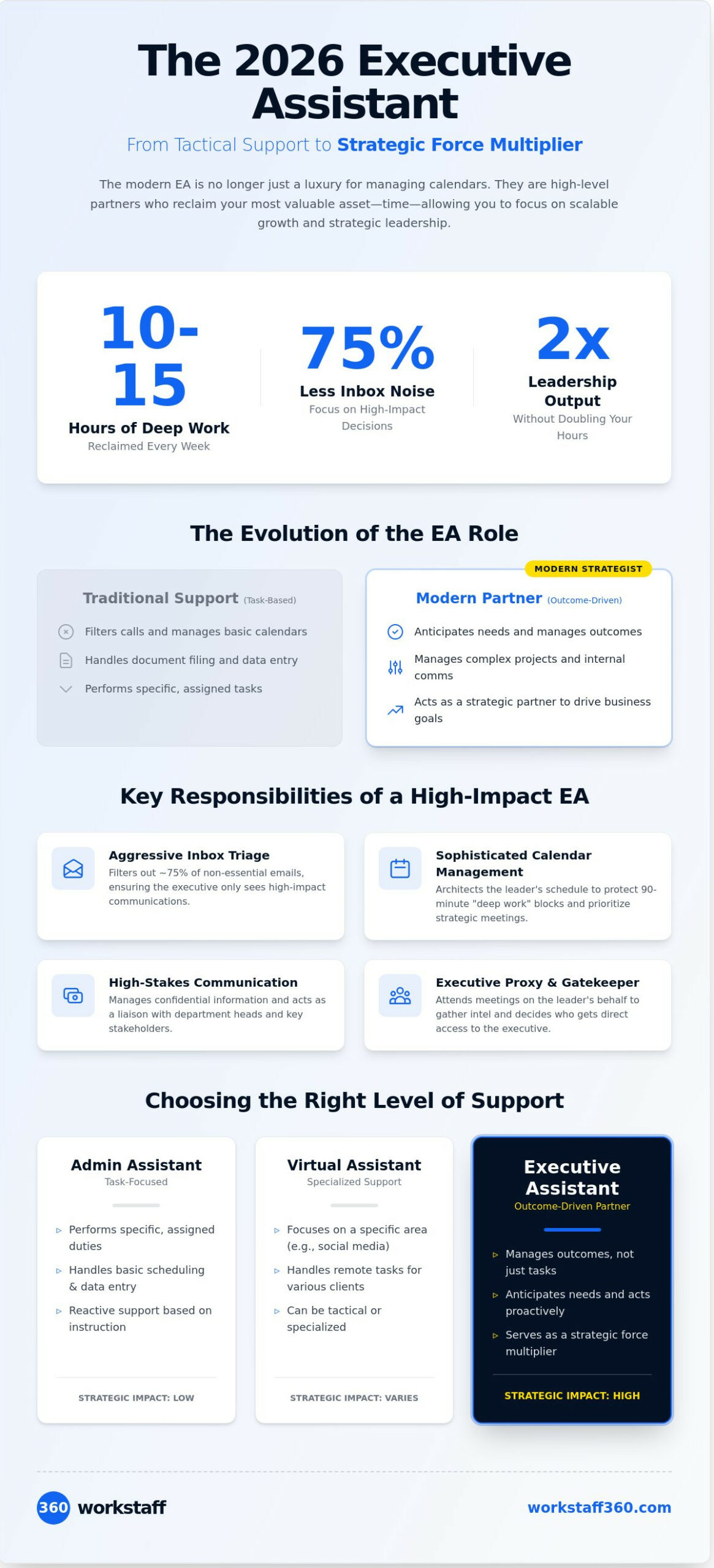
In 2026, the role of an executive assistant has evolved into a high-level strategic partnership. They don’t just fill gaps in a calendar; they architect a schedule that prioritizes 90-minute deep work blocks alongside critical stakeholder sessions. According to Forbes on Executive Assistant Responsibilities, these professionals manage complex logistics that go far beyond basic admin. They perform aggressive inbox triage, filtering out approximately 75% of non-essential noise so the leader focuses only on high-impact decisions that move the needle.
Managing the Executive’s Presence
Top-tier assistants function as a force multiplier for a leader’s influence. They often attend internal meetings as a proxy to gather intelligence and report back with actionable summaries, saving the executive up to 10 hours of meeting time per week. By drafting high-level communications that mirror the executive’s unique voice, they maintain a consistent presence across all digital channels. This ensures that stakeholder relationships remain strong; they act as the gatekeeper, deciding who gets access to the executive and when it’s appropriate to bridge that gap.
Operational and Project Support
Beyond administrative tasks, an executive assistant frequently operates as a project manager virtual assistant on internal initiatives. They track KPIs with precision, holding direct reports accountable to 30-60-90 day goals. Whether it’s organizing a high-stakes board retreat for 15 stakeholders or managing a confidential product launch, they provide the operational backbone that prevents project drift. They ensure that every directive is followed through to completion without the executive needing to micro-manage. If you’re ready to reclaim 20 hours of your week, consider how a vetted professional can transform your daily workflow and accelerate your organizational growth.
EA vs. Virtual Assistant vs. Admin Assistant: Choosing the Right Level
Distinguishing between support levels prevents operational bottlenecks and wasted capital. Many founders mistake a task-taker for a partner, which leads to frustration when strategic gaps remain. You must match the role to your business complexity and your specific leadership needs. While technical skills are teachable, the high-level intuition required of a top-tier executive assistant is a specialized professional trait.
The Hierarchy of Support
- Administrative Assistant: This role is primarily reactive. They focus on clerical support, such as filing digital documents or processing basic data entry. They handle the “what happened” in your business.
- Virtual Assistant: A virtual assistant manages active workflows and repeatable processes. They are often specialized; for example, you might hire a bookkeeping assistant to maintain ledger accuracy and financial reporting. They focus on “what is happening” right now.
- Executive Assistant: This is your strategic partner. An executive assistant anticipates needs before they arise and aligns their daily actions with your long-term goals. They focus on “what will happen,” ensuring your schedule reflects your highest priorities.
Decision-making authority marks the clearest boundary between these roles. An Admin Assistant asks what to do next. A VA asks for the process manual. An EA tells you they have already solved the problem. This shift from technical execution to emotional intelligence allows you to move away from micro-management. If your business generates over $1 million in annual revenue or you manage a team of 10 or more, a general VA will likely struggle with the complexity of your calendar and stakeholder relationships.
Transitioning from a VA to an EA
Identify the signs that your current support has outgrown their role. If your assistant suggests process improvements without being prompted or manages your inbox with 95% accuracy, they are moving toward strategic partnership. Elevating a task-taker requires a high level of trust and transparent communication regarding your business objectives. You must share your vision, not just your to-do list.
Researching the ROI of a Virtual Executive Assistant confirms that the financial return comes from time recovery. While a VA saves you money on labor, an EA earns you money by freeing your capacity for high-value revenue generation. Hiring an experienced EA from the start is often 40% faster for scaling because it removes the “training tax” associated with junior staff. Choose the level of support that matches where you want your business to be in 12 months, not just where it sits today.
The ROI of an Executive Assistant: Calculating Your Time Freedom
Hiring an executive assistant isn’t a luxury expense; it’s a high-yield investment in your company’s most valuable asset: your time. To see the impact, you must calculate your Effective Hourly Rate (EHR). Divide your annual revenue target by 2,000 working hours. If your EHR is $250 and you spend five hours a week on scheduling or basic inbox management, you’re losing $1,250 in value every single week. Over a year, that’s $65,000 of your time wasted on clerical work that doesn’t move the needle. You’re effectively paying yourself a premium to do $20 tasks.
The “10-Hour Rule” proves that a skilled assistant returns at least two full workdays to your week. By offloading 10 hours of logistical friction, you regain 400% more time for revenue-generating activities. This goes beyond clearing a calendar. It’s about eliminating the decision fatigue that drains your brain through 35,000 micro-decisions every day. A 2024 report by the American Psychological Association highlighted that chronic decision fatigue reduces executive performance by 22%. When you stop worrying about meeting links or travel logistics, you preserve your cognitive energy for high-stakes leadership.
Reclaiming Your Strategic Focus
Scaling requires moving from working “in” the business to “on” the business. A 2025 study of high-growth firms showed that founders who delegated administrative tasks saw a 30% increase in strategic output within six months. Consider the case of a fintech founder who scaled from $2 million to $12 million in revenue. By hiring an executive assistant, they shifted 25 hours per month from reactive inbox management to proactive partnership development. This change didn’t just grow the bottom line; it prevented the burnout that often collapses 7-figure businesses before they reach the 8-figure mark. With this reclaimed capacity, leaders can focus on high-impact learning or new ventures, such as the digital strategies taught by Victoria OHare for those looking to expand their reach without technical stress.
The Cost of Not Hiring an EA
The most common objection is “I can’t afford it.” In reality, you’re already paying for it through lost growth and missed opportunities. Administrative friction acts as a hidden tax on your momentum. Every minute you spend on a low-value task is a minute you aren’t closing a high-value deal. For many leaders, outsourcing for small business begins with this pivotal hire. Without it, you remain the bottleneck of your own organization, trapped in a cycle of reactive fire-fighting rather than proactive expansion. The cost of delay is far higher than the cost of the salary. If you run an online store, pairing executive-level delegation with a dedicated e-commerce assistant can eliminate the operational complexity that caps your revenue growth before it starts.
Ready to reclaim your schedule and accelerate your growth? Book a consultation with Workstaff360 and find the strategic support you need to scale.
How to Hire and Onboard a High-Performing Remote EA
Hiring a remote executive assistant requires a shift from viewing support as a commodity to seeing it as a strategic partnership. Your first step involves a ruthless audit of your calendar to separate un-delegate-able tasks from those an EA can own immediately. You must retain your core vision, final signatures, and high-stakes relationship building. Everything else, from complex travel logistics to initial inbox triage, belongs on your assistant’s plate from day one.
The Vetting Essentials
Finding the right fit means looking beyond a resume. Use these five interview questions to reveal strategic thinking and problem-solving capabilities:
- “Walk me through a time you anticipated a conflict in my schedule and resolved it before I noticed.”
- “How do you use AI tools to summarize long-form reports or automate repetitive data entry?”
- “What’s your strategy for learning my communication style to draft emails in my voice?”
- “If two high-priority projects land on your desk simultaneously, how do you determine which one to tackle first?”
- “Describe your ideal feedback loop for ensuring our working relationship stays aligned.”
Verify technical proficiency in modern tools like Notion, Slack, and advanced LLMs. A high-performing candidate should demonstrate how they use these platforms to create 20 percent more efficiency in your daily workflow. Cultural alignment is equally vital. If your pace is “move fast and break things,” a methodical, slow-paced assistant will create friction rather than flow.
Onboarding for Long-Term Success
The first 30 days dictate the trajectory of your partnership. Establish a daily 15 minute sync to align on priorities and clear blockers. Focus on “Quick Wins” during the first week, such as cleaning up a messy calendar or organizing a project folder, to build immediate momentum. This builds the trust necessary for a true mind-meld.
Document your preferences in a living “Executive Manual.” This resource should track everything from your preferred flight seats to how you like your meeting briefs formatted. A well-maintained manual reduces repetitive questions and allows your executive assistant to operate autonomously. A trial period of 90 days provides the necessary window to test chemistry and ensure they can handle the nuances of your business ecosystem.
Searching for this level of talent independently is often a 40 plus hour commitment that many founders can’t afford. Dedicated agencies like WorkStaff360 simplify this search by providing pre-vetted, elite talent that matches your specific industry needs. They handle the heavy lifting of recruitment, so you can focus on scaling your vision.
Ready to reclaim your time? Schedule a consultation with WorkStaff360 to find your dedicated Executive Assistant today.
Master Your Time and Scale Your Impact
Transitioning from tactical management to strategic leadership requires more than just a clear schedule. It demands a partnership. An executive assistant functions as a high-performing growth catalyst, managing complex workflows so you can focus on the 20% of tasks that drive 80% of your company’s revenue. Industry data indicates that delegating to a strategic partner can reclaim over 500 hours of executive time annually. This shift toward remote, high-level support is the standard for 2026. You need a partner who understands your business ecosystem from day one.
Stop settling for basic administrative help that adds more to your plate. WorkStaff360 connects you with the top 3% of vetted global remote talent, ensuring your placement is built for long-term strategic success. Our full-service agency model provides dedicated support and a replacement guarantee to keep your momentum steady. Scale your leadership with a dedicated Executive Assistant from WorkStaff360. You’ve built the vision. Now, it’s time to build the support structure that allows your potential to flourish.
Frequently Asked Questions
What is the difference between a virtual assistant and an executive assistant?
An executive assistant functions as a strategic partner who manages your business ecosystem, whereas a virtual assistant typically handles discrete, repetitive tasks. Data from a 2024 industry report shows that 75% of EAs contribute to high-level decision-making and project management. They don’t just clear your inbox; they anticipate needs and optimize your entire workflow for maximum ROI.
How many hours a week does an executive assistant usually work?
Most executive assistants work a standard 40-hour week, but the role often scales during critical business cycles. Statistics from the 2023 Bureau of Labor Statistics indicate that full-time administrative leaders average 38.5 to 42 hours per week. This schedule provides the consistent coverage you need to maintain momentum and ensure no strategic opportunities slip through the cracks.
Can an executive assistant work remotely effectively?
Remote executive assistant support is highly effective when backed by robust digital systems and clear communication protocols. A 2023 Stanford University study proved that remote employees are 13% more productive than office-based staff. By using cloud-based tools, your EA integrates seamlessly into your operations regardless of their physical location, giving you global access to top-tier talent.
What skills should I look for when hiring an executive assistant?
Prioritize a blend of technical proficiency and soft skills like proactive problem-solving and emotional intelligence. The 2025 Future of Jobs report by the World Economic Forum ranks analytical thinking as a top priority for modern support roles. You need a partner who masters tools like G-Suite or Slack while demonstrating the discretion required to handle sensitive board-level communications.
Is an executive assistant worth the cost for a small business owner?
Investing in an executive assistant is a primary growth lever that typically frees up 10 to 15 hours of your time every week. Research from Harvard Business Review highlights that CEOs who master delegation grow their companies 33% faster than those who don’t. This reclaimed time allows you to focus on high-revenue activities that far outweigh the initial staffing investment.
How do I trust an executive assistant with my passwords and private data?
Protect your sensitive information by using SOC 2 compliant password managers like 1Password or Dashlane to share access securely. These tools allow your EA to log in to accounts without ever seeing your actual plain-text passwords. Since 80% of security breaches stem from poor password hygiene, these professional protocols safeguard your business while enabling your assistant to work efficiently.
What tasks should I never delegate to an executive assistant?
Never delegate final disciplinary actions, the articulation of your core company vision, or the signing of documents with personal fiduciary liability. U.S. legal standards require the business owner’s direct involvement in specific tax filings and high-stakes contract approvals. Keep these high-impact responsibilities on your plate to maintain legal compliance and ensure your brand’s unique identity remains intact.
How do I manage a remote executive assistant across different time zones?
Synchronize your schedules by creating a 3 to 4 hour overlap for live meetings while utilizing asynchronous tools for everything else. Data shows that remote teams across multiple time zones increase efficiency by 25% when they rely on documented SOPs. Use Loom for video briefings and Slack for status updates to keep projects moving forward 24/7 without requiring constant real-time interaction. If you’re looking to extend your support team further, pairing your EA with a digital marketing assistant can help ensure your brand presence scales alongside your operational capacity.