
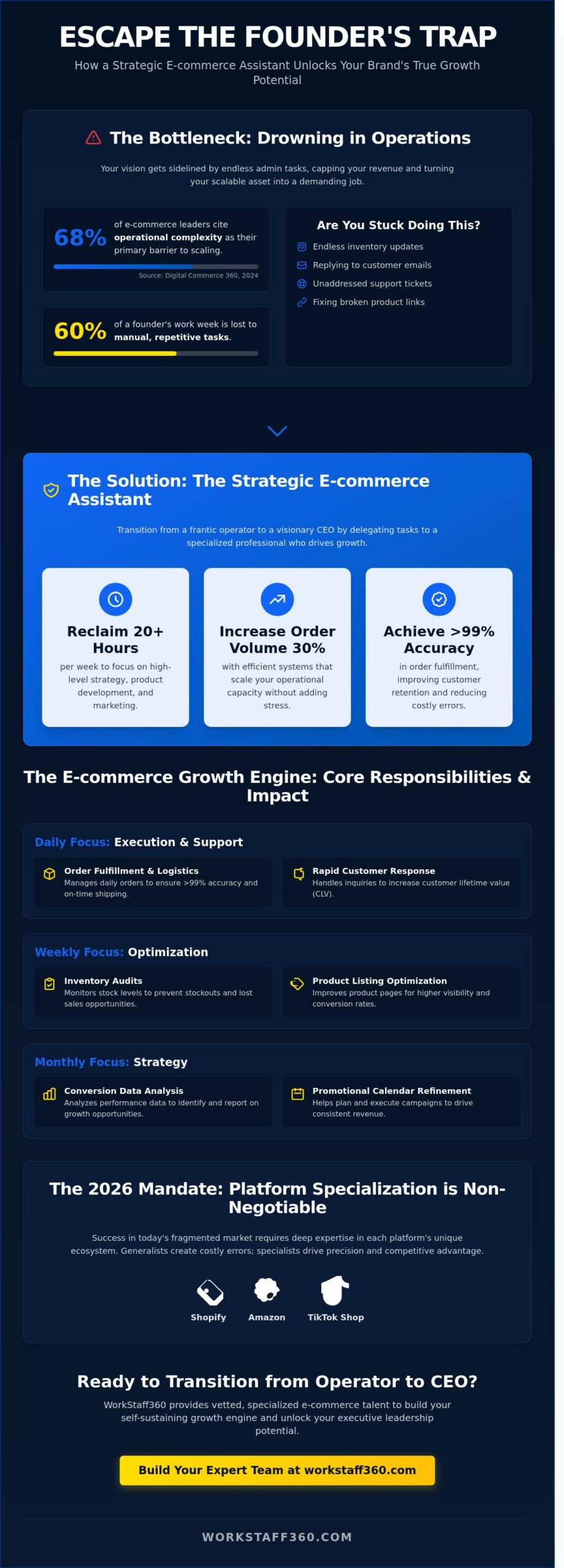
By 2026, the difference between a high-growth brand and a struggling storefront won’t be your ad spend, it’ll be your operational infrastructure. You’ve likely spent the last 12 months buried in Shopify admin tasks or losing sleep over unaddressed Amazon support tickets. It’s frustrating to watch your strategic vision get sidelined by endless inventory updates and customer emails. A 2024 industry report by Digital Commerce 360 confirms this struggle, noting that 68% of e-commerce leaders cite operational complexity as their primary barrier to scaling. You aren’t alone in feeling that your store has become a demanding job rather than a scalable asset.
Hiring a dedicated e-commerce assistant is the single most effective lever to reclaim 20 hours of your week and eliminate the bottlenecks that cap your revenue. This strategic move allows you to transition from a frantic operator to a visionary CEO. In this guide, you’ll discover how to source and integrate vetted talent that handles everything from product listings to rapid customer response. We’ll provide the exact 2026 framework to build a seamless, self-sustaining growth engine that improves retention and scales your store with expert efficiency.
Key Takeaways
- Escape the “Founder’s Trap” by identifying the specific operational bottlenecks currently stalling your store’s revenue growth and scalability.
- Maximize store efficiency through specialized workflows and AI-assisted management tools tailored for the 2026 digital marketplace.
- Evaluate the true cost of ownership between agency-vetted talent and freelancers to ensure your e-commerce assistant provides long-term stability.
- Master a structured 30-day onboarding roadmap and establish clear KPIs to transform your new hire into a high-performing growth catalyst.
- Discover how a holistic, 360-degree approach to staffing eliminates recruitment friction and unlocks your potential for executive leadership.
The Operational Bottleneck: Why E-commerce Scaling Requires Specialized Support
Scaling a digital brand demands more than just a high-quality product. By 2026, global retail e-commerce sales are projected to surpass $8.1 trillion, making understanding the e-commerce landscape a prerequisite for any founder aiming for market leadership. A modern e-commerce assistant acts as the operational engine that powers this growth. They aren’t merely remote workers; they’re specialized partners who resolve the friction of daily logistics so you can focus on high-level strategy.
Many founders fall into the “Founder’s Trap,” a cycle where manual administrative tasks consume 60% or more of their work week. When you’re stuck updating inventory levels, responding to basic shipping queries, or fixing broken product links, you aren’t growing your business. You’re simply maintaining it. This manual overhead stunts revenue growth by diverting energy away from product development and marketing. If your brand is processing more than 45 orders daily or managing multiple storefronts, you’ve reached the tipping point where DIY operations become a liability.
High-growth brands in 2026 are moving away from general administrative help. They’re investing in dedicated staffing that brings immediate technical value. This shift ensures that every operational touchpoint, from the warehouse to the customer’s inbox, remains seamless and professional.
The 2026 E-commerce Landscape: Complexity vs. Opportunity
The current market is defined by extreme fragmentation. Success now requires a presence on Shopify, Amazon, and TikTok Shop simultaneously. Generalists often struggle because they lack the platform-specific expertise needed to navigate these unique ecosystems. In 2026, specialized knowledge is the baseline for efficiency. You need support that understands the nuances of TikTok’s creator marketplace or the intricacies of Amazon’s A9 algorithm. This technical precision prevents costly errors and ensures your brand remains competitive across all channels.
From Data Entry to Growth Catalyst
A strategic e-commerce assistant provides much more than basic clerical support. While a clerk might just enter data, a professional assistant optimizes your operations to drive revenue. They improve customer lifetime value (CLV) by managing sophisticated retention campaigns and ensuring order accuracy exceeds 99%. This transition from reactive tasks to proactive growth is essential for long-term success. To unlock this level of performance, your brand requires a specialized virtual assistant who understands the rigorous demands of modern digital retail.
- Eliminate bottlenecks: Delegate 15+ hours of weekly admin to free up leadership focus.
- Drive precision: Use platform-specific experts to manage Shopify and Amazon backends.
- Scale faster: Implement systems that allow for a 30% increase in order volume without adding stress.
Professional support doesn’t just fill a seat. It creates the infrastructure necessary for your brand to dominate an increasingly crowded marketplace. By identifying the tipping point early, you position your business for sustainable, rapid expansion.
Maximizing Store Efficiency: Core Responsibilities of an E-commerce Assistant
A top-tier e-commerce assistant transforms your backend operations from a chaotic checklist into a streamlined revenue engine. They don’t just react to problems; they anticipate them. Their daily workflow centers on order fulfillment and immediate customer inquiries, while their weekly focus shifts to inventory audits and listing optimization. Monthly, they analyze conversion data to refine the promotional calendar. This structured approach ensures no detail slips through the cracks as you scale. By delegating these repetitive yet vital tasks, you reclaim the mental bandwidth needed for high-level vision.
Modern store management relies heavily on technological integration. Recent data from a 2024 report on AI in e-commerce reveals that 84% of retail leaders are prioritizing AI to enhance customer experiences. Your assistant leverages these tools to automate repetitive tasks, such as generating initial product descriptions or sentiment analysis on reviews. This proactive stance separates average stores from market leaders who use data to drive every decision.
Platform and Inventory Management
Your assistant owns the digital shelf. They manage product listings by writing SEO-rich descriptions and organizing high-quality image assets that capture attention. Accuracy is critical, especially when tracking inventory across multiple FBA centers or third-party warehouses. They execute price adjustments in real-time and ensure your promotional calendar runs without a hitch. If a SKU runs low, they trigger reorder alerts before you lose a single sale. This precision prevents the 15% revenue loss many stores face due to out-of-stock items.
Customer Experience and Retention
Every support ticket is a sales opportunity in disguise. By managing live chat and social media inquiries with speed, your assistant builds the trust necessary for conversion. They handle returns and exchanges with a level of professionalism that protects your store ratings. They also utilize digital marketing assistant techniques to generate authentic reviews, which increases your social proof. If you want to see these results in your own store, it’s time to hire a vetted professional who understands the nuances of buyer psychology.
The Technical Stack: Tools They Must Master
Success in this role requires deep technical proficiency. Your assistant must navigate Shopify, BigCommerce, or Amazon Seller Central with total confidence. They drive retention through email marketing automation in Klaviyo or Omnisend, ensuring your brand stays top-of-mind. To keep the team aligned, they use Slack and Trello, often working alongside a project manager virtual assistant to hit aggressive growth milestones. This mastery of the stack ensures your business operates as a cohesive, efficient unit rather than a collection of disconnected apps.
Strategic Hiring: Agency-Vetted Professionals vs. Short-Term Freelancers
Choosing between a gig-worker and a dedicated partner determines the trajectory of your store. While many founders gravitate toward low-cost freelancers to save on immediate expenses, the total cost of ownership (TCO) often tells a different story. Short-term hires frequently lack the commitment needed for complex operations, leading to a “hiring loop” that consumes approximately 20% of a founder’s workweek in recruitment and retraining. According to data from the Society for Human Resource Management, the cost of replacing an employee can reach 33% of their annual salary when accounting for lost productivity and onboarding time. WorkStaff360 solves this by providing a dedicated e-commerce assistant through a model built for permanence rather than project-based tasks.
High turnover creates a vacuum of institutional knowledge that stalls growth. When a freelancer leaves after 90 days, they take their understanding of your customer base and internal workflows with them. Agency-vetted professionals offer a stable foundation, allowing you to focus on high-level strategy instead of micro-managing basic tasks. This shift from reactive hiring to proactive staffing is the primary differentiator for brands looking to scale efficiently.
The Vetting Advantage: Quality Control in Remote Staffing
Technical proficiency is the baseline for any successful hire. We implement rigorous testing protocols that evaluate a candidate’s mastery of platforms like Shopify, Amazon Seller Central, and various CRM tools. However, technical skill alone isn’t enough. Our recruitment process identifies elite talent in the Philippines and Pakistan by focusing on three critical soft skills:
- Proactive Communication: Ensuring updates happen before you have to ask for them.
- Time Management: Utilizing structured workflows to hit deadlines without constant oversight.
- Critical Thinking: Solving operational bottlenecks independently to keep the business moving.
WorkStaff360 filters thousands of applicants to find the top 3% of talent. This precise matchmaking ensures your e-commerce assistant possesses both the grit and the expertise required to handle the fast-paced demands of digital retail.
Stability and Scalability: The Case for Long-Term Partnerships
Scaling a brand from $1 million to $10 million requires a team that grows alongside the business. A dedicated assistant who stays for years becomes a repository of brand intelligence. They understand your voice, your customers, and your specific logistics hurdles. This continuity prevents the operational dips that occur during staffing transitions. Our 360-degree approach focuses on long-term integration, positioning your assistant as a strategic asset. You gain the freedom to innovate while your dedicated staff handles the daily execution, creating a seamless path toward market leadership.
The Success Roadmap: Vetting and Onboarding Your E-commerce Staff
Build a high-performance engine by following a structured 30-day integration plan. Your new e-commerce assistant needs a clear trajectory to move from a trainee to a strategic asset. Dedicate the first 7 days to tool mastery and brand voice alignment. By day 15, transition them to live tasks like inventory updates and active customer support. By day 30, your assistant should manage daily operations with 90% autonomy, allowing you to exit the weeds of daily execution.
Eliminate remote work friction through precise communication cadences. Implement a 15-minute daily sync via Slack or Teams to address immediate blockers. Supplement this with a 30-minute weekly performance review to analyze data and adjust strategies. This rhythm ensures your team stays synchronized without the burden of unnecessary meetings.
Security and Data Privacy Protocols
Protect your digital assets with rigorous access controls. Use encrypted tools like LastPass or Dashlane to share credentials without exposing raw passwords. Grant limited, staff-level permissions within Shopify or Amazon Seller Central to ensure your e-commerce assistant only accesses necessary modules. Industry data from 2023 indicates that 43% of cyberattacks target small businesses, making enterprise-grade data security protocols a non-negotiable standard for your remote operations.
Setting Measurable KPIs for E-commerce Roles
Drive accountability through hard data. Set a benchmark of a 2-hour maximum response time for customer tickets and maintain a 4.8/5 satisfaction score. Monitor listing accuracy religiously, aiming for a 99% error-free rate during inventory syncs. When you align your assistant’s performance with a 15% target increase in store conversion rates, you transform a standard role into a powerful revenue driver.
Integration with Your Financial Team
Scale faster by bridging the gap between operations and accounting. Your assistant must collaborate closely with a bookkeeping assistant to ensure every transaction is logged correctly. This partnership streamlines invoice processing for store supplies and optimizes expense tracking. Research shows that businesses with integrated back-office functions reduce operational friction by 25% to 30% annually.
Ready to reclaim your time and scale your store with precision-vetted talent? Hire a dedicated e-commerce assistant today and start your 30-day success roadmap.
Scaling with WorkStaff360: The 360-Degree Approach to E-commerce Support
WorkStaff360 operates as a high-performing growth catalyst rather than a simple recruitment agency. We believe your business deserves more than a temporary fix or a revolving door of freelancers. Our 360-degree approach ensures every e-commerce assistant we place becomes a long-term asset within your company’s ecosystem. You’ll work directly with a dedicated account manager who handles the heavy lifting of the staffing process. This partner oversees everything from initial screening to ongoing performance management, removing the friction of hiring and allowing you to scale with total confidence. We prioritize long-term placements because 90% of our talent stays with the same client for over 12 months, creating the stability your brand needs to thrive.
Our Rigorous Selection Process
We filter the top 1% of remote talent through a multi-stage vetting system that eliminates the guesswork for you. Out of every 1,000 applicants, only 10 meet our elite standards for professional rigor and technical expertise. Our process includes:
- Platform Proficiency Testing: Candidates undergo 40+ specific assessments for platforms like Shopify, Amazon Seller Central, and Magento to prove they can hit the ground running.
- Problem-Solving Simulations: We use real-world scenarios to test how talent handles logistics delays, inventory discrepancies, and complex customer inquiries.
- Cultural Alignment: We match staff based on your brand’s communication style and core values, ensuring a seamless integration into your existing team.
Your Strategic Partner in Global Staffing
Canadian entrepreneurs trust WorkStaff360 because we understand the unique pressure of maintaining global competitiveness while managing local overhead. The “360 Concept” provides holistic support that extends far beyond the initial hire. We manage the administrative complexities of global talent acquisition so you don’t have to. This partnership allows you to reclaim your time and focus on high-level strategy and creative expansion. While your e-commerce assistant handles the operational “how” of daily tasks, you’re free to focus on the “why” of your brand’s future.
Delegating the technical execution to a vetted professional unlocks your leadership potential. You’ll stop spending five hours a day on data entry and start spending those hours on product development or market expansion. This shift from worker to visionary is the primary driver of 300% year-over-year growth for many of our retail partners. We provide the infrastructure; you provide the vision.
Ready to build your elite remote team? Book your strategy consultation today and discover how a dedicated partner can transform your operations.
Take Command of Your Market Position
Scaling a digital storefront in 2026 requires more than just high-volume traffic; it demands total operational precision. You’ve seen how a specialized e-commerce assistant eliminates the 40% time-drain often spent on manual inventory updates and repetitive customer tickets. Transitioning from short-term freelancers to agency-vetted professionals ensures your foundation is built for long-term stability rather than temporary fixes. WorkStaff360 provides the 360-degree support you need to pivot from daily fires to high-level strategy. We grant you immediate access to the top 1% of global talent, ensuring every hire possesses specialized platform expertise across all major sales channels. With dedicated account management, your integration remains seamless and your growth stays on track. Stop managing repetitive tasks and start leading your industry with a team that’s as invested in your success as you are. Your next phase of growth is ready when you are.
Ready to scale your store? Schedule your free consultation with WorkStaff360 today.
Frequently Asked Questions
What is the difference between a general VA and an e-commerce assistant?
A dedicated e-commerce assistant specializes in retail-specific operations like listing optimization and inventory management, while a general VA handles broad administrative tasks like scheduling. Data from 2024 shows that specialized assistants increase operational efficiency by 35% compared to generalists. They understand the specific nuances of conversion rates and digital storefronts. This specialization ensures your business scales without the friction of teaching basic retail concepts to a general worker.
How much does it cost to hire a dedicated e-commerce assistant in 2026?
Hiring a dedicated e-commerce assistant in 2026 follows global outsourcing trends where specialized remote talent costs approximately 20% more than general administrative support. According to the 2024 Global Outsourcing Survey by Deloitte, cost savings remain a primary driver for 70% of businesses moving toward specialized remote roles. You’ll find that rates reflect the technical expertise required for specific platform management. Investing in vetted talent ensures you pay for performance rather than just hourly presence.
Can an e-commerce assistant manage my Amazon FBA account?
Yes, a specialized assistant can manage your Amazon FBA account by handling inventory replenishment and monitoring Seller Central health metrics. They track key data points like the Inventory Performance Index to avoid costly storage fees. By delegating these 24/7 monitoring tasks, you free up 15 hours of leadership time per week. This proactive management prevents stockouts and maintains your Buy Box eligibility through consistent account maintenance.
How do I ensure my store data is secure when hiring a remote assistant?
You secure your store data by implementing password management tools like LastPass and using platform-specific staff accounts with restricted permissions. WorkStaff360 recommends following the 2023 ISO/IEC 27001 standards for data management to minimize operational risks. Professional assistants sign non-disclosure agreements that protect your intellectual property. These layers of security ensure that 100% of your sensitive financial information remains restricted to authorized personnel only.
What platforms should an e-commerce assistant be familiar with?
A proficient e-commerce assistant must demonstrate mastery in platforms like Shopify, Amazon, and Walmart Marketplace. They should also navigate backend tools like Klaviyo for email marketing and Helium 10 for product research. Proficiency in these systems reduces onboarding time by 50% because the assistant understands your existing technical ecosystem. This technical fluency allows for seamless integration into your current business workflow from day one.
How long does it take to see a return on investment after hiring?
Most businesses see a positive return on investment within 90 days of hiring a dedicated assistant. This timeline accounts for the initial 30 day integration period followed by 60 days of optimized operations. Data from 2023 small business reports indicates that delegating routine tasks leads to a 25% increase in sales growth within the first two quarters. The speed of your ROI depends on how quickly you hand over high-impact tasks to your new hire.
Will I need to provide training for my new e-commerce assistant?
You’ll provide brand-specific training, but a vetted assistant arrives with foundational platform knowledge already intact. Focus your efforts on teaching your unique brand voice and specific SOPs rather than basic software navigation. This approach cuts training time by 40% and allows the assistant to contribute to growth initiatives immediately. Standardized documentation ensures the transition remains smooth and professional for everyone involved.
Can one assistant manage multiple sales channels like Shopify and TikTok Shop?
One assistant can effectively manage multiple channels like Shopify and TikTok Shop if they use centralized inventory management software. Cross-platform management is a standard requirement for 85% of modern retail roles. They synchronize product listings and respond to customer inquiries across all touchpoints to maintain brand consistency. This multi-channel approach maximizes your reach without requiring a separate hire for every new platform you join.