
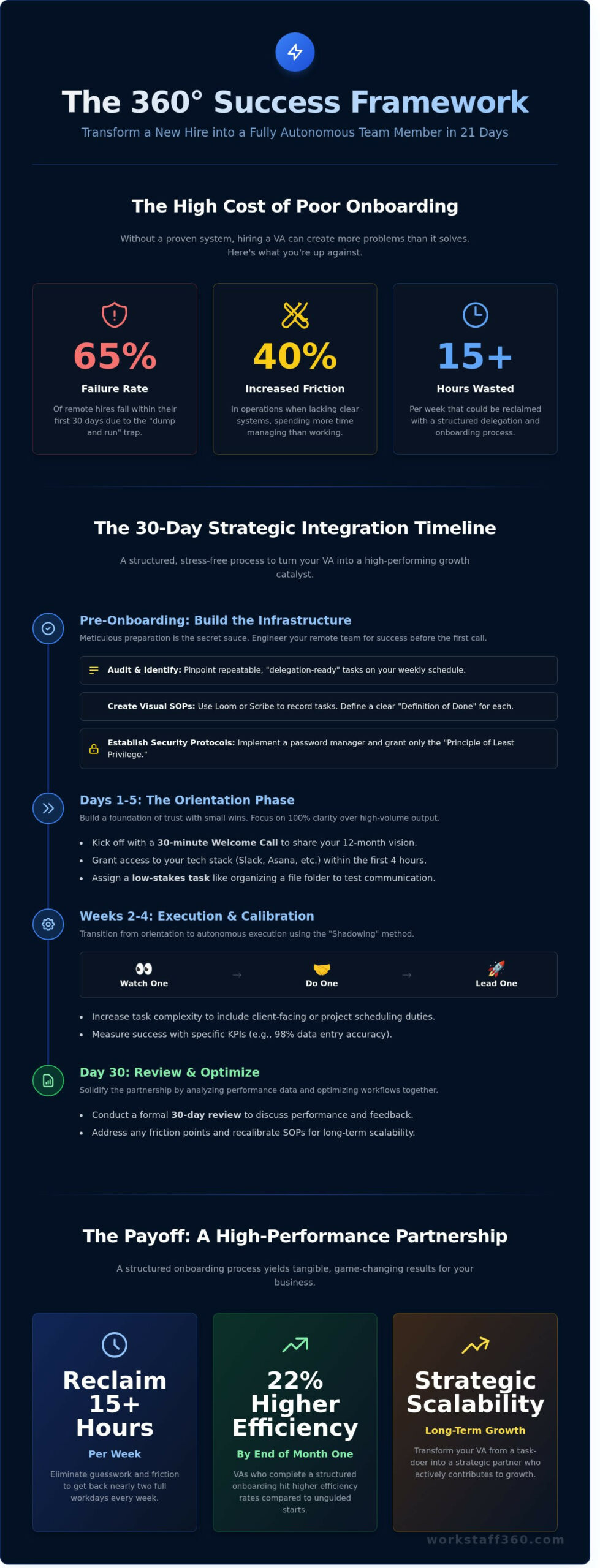
Hiring a virtual assistant isn’t the cure for your burnout; it’s often the catalyst for a 40% increase in operational friction if you lack a proven system. Most entrepreneurs fail to onboard a virtual assistant correctly, falling into the “dump and run” trap that sabotages 65% of remote hires within their first 30 days. You’ve likely felt the anxiety of handing over sensitive passwords or the frustration of waiting weeks for a new hire to produce quality work. It’s exhausting to spend more time managing a person than they actually save you.
You deserve a streamlined integration that respects your time and secures your business ecosystem. This 360-Degree Success Framework provides the exact blueprint to transform a new hire into a fully autonomous team member within 21 days. We’ll eliminate the guesswork by implementing clear SOPs and security protocols that reclaim 15 hours of your work week almost immediately. You’re about to master a structured, stress-free process that turns your VA into a high-performing growth catalyst and a strategic key to your long-term scalability.
Key Takeaways
- Prepare your digital infrastructure and audit current workflows to transform delegation from a bottleneck into a high-performance engine.
- Implement a tiered 30-day roadmap to onboard a virtual assistant effectively, prioritizing small wins to establish immediate momentum and trust.
- Elevate your operational efficiency by shifting from transactional messaging to strategic collaboration using a purpose-built communication stack.
- Safeguard your team’s productivity by avoiding the “dump and run” trap and replacing micromanagement with clear, results-oriented frameworks.
- Leverage the WorkStaff360 advantage to bypass onboarding friction through pre-vetted orientation and dedicated support managers who bridge the gap.
Pre-Onboarding: Building the Infrastructure for a Seamless Start
High-performing remote teams don’t happen by accident; they’re engineered through meticulous preparation. Most entrepreneurs treat hiring as a plug-and-play solution, yet data suggests that 46% of new hires fail within 18 months due to poor clarity or misaligned expectations. To successfully onboard virtual assistant talent, you must build the infrastructure before the first Zoom call. This preparation acts as the secret sauce that transforms a standard hire into a high-leverage asset from day one.
Start by auditing your current weekly schedule to identify “delegation-ready” tasks. If a process takes you 5 hours a week and follows a repeatable logic, it’s a prime candidate for outsourcing. You’re transitioning from the role of a doer to a leader, which requires documenting the internal logic behind your decisions. The Virtual assistant (occupation) involves a professional relationship where the contractor provides specialized support, but they can only execute as well as your instructions allow. Clear preparation eliminates the friction that typically stalls new partnerships.
Standard Operating Procedures (SOPs): Your Business Blueprint
Stop writing 50-page manuals that nobody reads. Use tools like Loom or Scribe to record your screen while performing a task, creating a visual guide in real-time. Every recurring task needs a clear “Definition of Done.” For example, if your VA manages lead generation, “done” means 15 verified emails entered into the CRM by 5:00 PM every Friday. Organize these videos in a centralized library like Notion or Google Drive to ensure your onboard virtual assistant process remains scalable as you grow.
The Security Protocol: Protecting Your Digital Assets
Security shouldn’t be an afterthought in a remote environment. Protect your business by implementing a password manager like LastPass or 1Password to share access without revealing raw credentials. Follow the “Principle of Least Privilege,” granting only the minimum level of access required for a specific role. A 2022 cybersecurity report noted that 82% of data breaches involved a human element, so establish a secure file-sharing environment using Google Workspace or Dropbox where you retain total ownership of all data.
The First 30 Days: A Strategic Timeline for VA Integration
The first 30 days determine whether your partnership thrives or stalls. Success hinges on a psychological shift; you aren’t just filling a seat, you’re building a foundation of trust. Start with small wins. These micro-successes boost confidence and validate your choice to onboard virtual assistant talent. A tiered rollout prevents the 40% drop in productivity often seen when new hires face information overload. Balance technical checklists with relationship building to ensure your VA feels like a strategic partner rather than a remote tool. Establish KPIs that focus on process adherence and communication speed rather than just final output during this initial window.
Day 1 to Day 5: The Orientation Phase
Kick off the partnership with a 30-minute Welcome Call to share your 12-month vision. This aligns their daily tasks with your high-level goals. Grant access to your tech stack, including Slack, Asana, and company email, within the first 4 hours of their start time. Assign a low-stakes task, like organizing a 50-file Google Drive folder or formatting a weekly report, to test the communication flow. This phase focuses on achieving 100% clarity over high-volume output.
Week 2 to Week 4: The Execution and Calibration Phase
Transition from orientation to execution using the “Shadowing” method. Your VA should watch one process, do one with supervision, and finally lead one independently. By day 20, increase task complexity to include client-facing emails or project scheduling. Measure success through specific KPIs like a 98% accuracy rate on data entry or a sub-2-hour response time during business hours.
A formal 30-day review allows you to optimize your staffing strategy based on real-world performance data. This structured approach ensures your VA hits a 22% higher efficiency rate by the end of month one compared to unguided starts. Use this time to address friction points immediately. If a process takes 30% longer than expected, recalibrate your SOPs together to ensure long-term scalability and precision.
Establishing Communication Rhythms and Collaborative Workflows
Transitioning from transactional messaging to strategic collaboration is the bridge between a temporary fix and a scalable business asset. When you onboard virtual assistant talent, you aren’t just hiring a pair of hands; you’re integrating a new engine into your business ecosystem. Move away from fragmented emails and adopt a high-performance tech stack. Use Slack for rapid, real-time updates; Asana for structural task management; and Zoom for high-depth strategy sessions. This multi-layered approach ensures that 95% of communication is categorized by urgency and complexity, preventing critical information from being buried in an inbox.
Establish a 360-degree feedback loop from day one. Encourage your VA to suggest at least two process improvements every month. This empowers them to act as a growth partner rather than a passive observer. To manage global time zones, set firm “Office Hours” with a mandatory 4-hour overlap window. This overlap provides the necessary window for real-time collaboration while respecting the autonomy of remote work schedules. Clear expectations around response times, such as a 2-hour window for Slack and 24 hours for email, eliminate guesswork and maintain professional momentum.
The Daily Stand-up: 10 Minutes to Alignment
Consistency creates clarity. A 10-minute daily stand-up keeps your VA focused on your highest-leverage goals without requiring constant supervision. Whether you host this synchronously via video or asynchronously through a dedicated Slack channel, your VA should answer three specific questions every morning:
- What did you achieve in the last 24 hours?
- What are your top three priorities for today?
- What specific bottlenecks are currently blocking your progress?
If a bottleneck is technical, don’t waste time typing long explanations. Use screen-sharing tools to record a 90-second walkthrough. This visual troubleshooting method saves roughly 15 minutes of back-and-forth communication per task and builds a reusable training library for your business.
Project Management: Keeping the Vision on Track
Centralize every deliverable in ClickUp or Trello to ensure nothing falls through the cracks. High-growth firms that use centralized project management see a 27% increase in task completion rates within the first 90 days. Use “Tags” to categorize work by department and “Priority Levels” to signal which items impact your bottom line immediately. A task is a single actionable step with a clear deadline, while a project is a cohesive collection of tasks designed to achieve a specific strategic outcome. By maintaining this distinction, you help your VA understand how their daily output contributes to your 360-degree business vision.
Avoiding the “Dump and Run” and Other Common Onboarding Pitfalls
Successful business scaling requires more than just hiring; it demands strategic integration. Many entrepreneurs fall into the “dump and run” trap, where they hand over a chaotic inbox and vanish. This approach is the primary reason why 45% of remote collaborations struggle in the first 90 days. When you onboard virtual assistant talent, you’re building a partnership, not just buying hours. You must bridge the gap between your expectations and their initial understanding of your unique business ecosystem.
Avoid assuming that “common sense” is universal. Cultural nuances often dictate how a professional approaches a task. For example, in some high-context cultures, workers may hesitate to ask questions because they don’t want to seem intrusive. You must explicitly state that questions are a sign of engagement, not weakness. Micromanagement is another productivity killer. If you spend 4 hours reviewing 8 hours of their work, you’ve destroyed your ROI. Trust the vetting process and focus on results rather than every keystroke.
Treat the first 14 days as a calibration period. Mistakes will happen. Instead of seeing them as deal-breakers, use them as data points to refine your Standard Operating Procedures (SOPs). A single error is a training opportunity; a repeated error is a process flaw that needs your leadership. Patience during this ramp-up phase pays dividends in long-term loyalty.
The Information Overload Trap
Giving a new hire access to 20 different software tools on day one is a recipe for paralysis. It’s much better to onboard virtual assistant professionals using a phased approach. Symptoms of an overwhelmed VA include total silence or uncharacteristic delays on simple tasks. Implement the “One Task at a Time” rule for the first 48 hours to build their confidence. Provide a centralized Resource Hub where they can find login credentials and brand guidelines. This empowers them to solve problems without interrupting your workflow.
Cultural Integration: Beyond the Work
Isolation leads to low retention. Introduce your VA to the wider team during a 10 minute video call to foster a sense of belonging. Share your “Company Why” to turn a task-taker into a mission-driven partner. According to 2023 industry data, remote staff who understand the company’s long-term goals are 82% more likely to stay past the one-year mark. Recognize small wins early to boost morale and solidify their commitment to your success.
Why a Managed Agency Partnership Makes Onboarding Effortless
Hiring on your own often leads to a 50% turnover rate within the first six months. WorkStaff360 eliminates this volatility by acting as your strategic partner from day one. We don’t just hand you a resume; we manage the initial orientation and technical setup. Our dedicated support managers facilitate the first 90 days of the relationship, ensuring your communication protocols are met and expectations stay aligned. This bridge reduces the friction most entrepreneurs feel when they try to onboard virtual assistant talent without a structured framework.
Choosing a managed agency secures your return on investment. Freelance platforms often result in inconsistent quality or sudden “ghosting,” which costs businesses approximately $4,129 per hire in lost productivity and recruitment fees according to SHRM data. Before committing to any hiring model, understanding the key differences in a freelance vs virtual assistant comparison helps you make a more informed decision that protects your bottom line. Our 360-degree approach focuses on long-term placements. Once your first VA is integrated, scaling becomes a repeatable process. You’ll use the same established workflows to add a second or third team member, doubling your output without doubling your management hours. Understanding the virtual assistant cost breakdown for 2026 helps you budget for sustainable growth rather than chasing the cheapest hourly rates that often lead to expensive turnover.
Vetted Talent: Reducing the Training Burden
Standard recruitment takes an average of 42 days to fill a professional position. We shorten this timeline to under 10 days by maintaining a pool of pre-screened professionals. Our rigorous selection process filters out 97% of applicants, focusing on specialized skills for Real Estate and Healthcare sectors. When you hire a pre-trained professional, you cut your internal training time by 50%. Before finalizing your hiring decision, using a comprehensive virtual assistant services checklist ensures you evaluate every critical factor — from security protocols to specialized skill sets — so you select a partner who delivers measurable ROI from day one. You can learn more about our General Virtual Assistant services to see how we match specific skill sets to your operational needs. This precision ensures your new hire is productive by day three, not month three.
Ready to Scale? Your Next Steps
Your business deserves a foundation built on elite talent and reliable systems. We provide the infrastructure so you can focus on high-level strategy. Our support system evolves with you, providing performance reviews and proactive adjustments as your workload increases. It’s time to reclaim your schedule and unlock your leadership potential. Schedule your free growth strategy session today to find your perfect match and start your journey toward seamless expansion. We make it easy to onboard virtual assistant professionals who are ready to hit the ground running.
Take Command of Your Growth with a 360-Degree Integration
You’ll transform a simple hire into a long-term growth engine by mastering the first 30 days of your partnership. Establishing clear communication rhythms and avoiding the common “dump and run” mistake helps you secure the high-level ROI that modern firms demand in 2026. Successful leaders don’t just hire; they onboard virtual assistant talent using a structured framework that prioritizes infrastructure before the first task begins.
WorkStaff360 simplifies this transition through our Canadian-owned and operated model. We provide specialized professionals for the Real Estate and Healthcare sectors, focusing on dedicated, long-term placements instead of the inconsistent results found with freelancers. You’ll gain a partner committed to your specific business ecosystem, ensuring your workflows remain precise and your time remains your own. It’s time to stop managing tasks and start leading your organization.
Ready to scale? Book your free WorkStaff360 consultation and meet your vetted VA today.
The path to a leaner, more efficient operation starts with this strategic shift. Your future top performer is ready to help you reclaim your focus and drive your vision forward today.
Frequently Asked Questions
How long does it typically take to onboard a virtual assistant?
Expect a comprehensive onboarding process to span 14 to 30 days for total integration into your business ecosystem. During the first 7 days, you should focus on technical setup and cultural alignment. By day 14, a high-performing VA typically handles 60% of their core responsibilities independently. This structured timeline prevents burnout and establishes clear milestones, ensuring your business maintains its growth momentum without any operational friction.
What tools are absolutely essential for VA onboarding in 2026?
Equip your team with AI-driven project management platforms like ClickUp or Asana and secure communication hubs like Slack to onboard virtual assistant talent effectively. In 2026, automated workflow tools save an average of 12 hours per week on administrative overhead. Use Loom for recording video-based SOPs and LastPass for encrypted access management. These tools create a 360-degree view of your operations, ensuring every task remains visible and on track.
How do I safely share my passwords and sensitive data with a remote VA?
Protect your digital assets by using enterprise-grade password managers like 1Password or Dashlane instead of sharing raw credentials. These platforms allow you to grant encrypted access without ever revealing the actual password to the user. Setting up a dedicated folder for your VA ensures they have the 10 to 15 logins required for daily operations. This method maintains 100% security while giving your staff the tools they need to succeed.
What should I do if my VA makes a mistake during the first week?
Address errors immediately by conducting a 15-minute feedback loop to clarify your standard operating procedures. Data shows that 85% of early mistakes stem from unclear instructions rather than a lack of skill or effort. Use this as a coaching opportunity to refine your documentation and prevent future issues. Correcting a minor error on day 3 prevents it from becoming a systemic problem that could cost you 20 hours of rework later.
Is it better to onboard a VA through an agency or hire directly?
Partnering with a professional agency is 40% faster than direct hiring because the vetting and initial training are already complete. Agencies provide a 360-degree support system that includes backup talent and payroll management for your peace of mind. While direct hiring might seem cheaper at first, the hidden costs of recruitment and turnover often exceed the 25% premium paid for the security and rigor of a managed service. Understanding the complete virtual assistant cost structure for 2026 reveals why quality partnerships deliver better long-term value than bargain-hunting approaches.
How do I manage a virtual assistant in a different time zone?
Establish a 2-hour daily overlap for synchronous meetings and urgent status updates to ensure seamless communication. Use a “follow-the-sun” model where you assign tasks at the end of your workday for completion by the time you wake up. This strategy effectively doubles your company’s productive hours. Tools like World Time Buddy help schedule these touchpoints, ensuring your remote team stays aligned with your specific business goals regardless of their geographic location.
What are the first 5 tasks I should delegate to my new VA?
Delegate these 5 high-impact tasks to onboard virtual assistant professionals for an immediate return on investment: email inbox filtering, calendar management, LinkedIn lead research, CRM data entry, and basic social media scheduling. Handing off these repetitive workflows clears 10 to 15 hours from your weekly schedule. This shift allows you to move from working in your business to working on your business, fueling long-term scalability and leadership focus.
How do I know if the onboarding process was successful?
Measure success by tracking three specific KPIs: task completion rate, accuracy of deliverables, and the reduction in your own administrative hours. A successful integration results in a 90% task accuracy rate by the end of week 4. If you’ve reclaimed 10 hours of your time and your VA is proactively suggesting 1 or 2 workflow improvements, your onboarding process has hit the mark for professional excellence and operational efficiency.