
Stop treating your global talent search like a bargain hunt if you want to protect your bottom line in 2026. While a 2023 Deloitte report found that 50% of executives prioritize cost reduction through outsourcing, nearly 40% of those leaders struggle with the high turnover and management friction that comes from poor vetting. You’ve likely felt the sting of high local labor costs and the exhaustion of replacing “cheap” freelancers who simply can’t keep up with your pace. Understanding the true virtual assistant cost means looking past the hourly rate to the long-term value of seamless integration and vetted expertise.
We’re here to provide a definitive budget framework for the coming year, giving you the clarity needed to scale your business with precision. This guide breaks down the tiered pricing models between offshore talent and specialized agencies, helping you eliminate hidden management costs once and for all. You’ll gain the tactical confidence to choose a staffing model that acts as a growth catalyst rather than a budget drain. By the end of this article, you’ll know exactly how to align your investment with your specific operational goals to unlock your leadership potential.
Key Takeaways
- Master the shift from hiring simple task-takers to integrating strategic remote professionals who drive long-term business growth.
- Navigate the primary factors influencing virtual assistant cost, ranging from technical proficiency in specialized software to industry-specific expertise.
- Evaluate the critical differences between freelance marketplaces and managed agencies to minimize management overhead and complex legal risks.
- Quantify your potential ROI by comparing the high overhead of in-house employees against the streamlined efficiency of dedicated remote staff.
- Leverage a 360-degree vetting process to secure elite-level talent that scales your operations without the burden of hidden staffing costs.
Understanding Virtual Assistant Cost in 2026: Beyond the Hourly Rate
Scaling a business in 2026 requires more than just extra hands; it demands a shift in how you view remote talent. The outdated model of hiring simple task-takers has been replaced by a demand for strategic remote professionals who integrate deeply into your operations. When you evaluate the virtual assistant cost, you aren’t just paying for time. You’re investing in a system that frees your leadership team to focus on high-value revenue drivers. The Virtual assistant (occupation) has matured into a sophisticated role that requires a 360-degree view of your business ecosystem, balancing budget with the non-negotiable needs for data security and reliability.
Focusing solely on the price per hour often leads to hidden expenses that drain your momentum. Low-cost hires without vetted backgrounds frequently result in high turnover or security vulnerabilities. In 2026, savvy entrepreneurs prioritize technical proficiency and professional maturity over the lowest possible bid. A professional at $15 per hour who utilizes advanced automation tools often delivers 300% more value than a $5 per hour alternative who requires constant supervision. True growth comes from finding the sweet spot where cost meets high-level competence.
The Global Landscape: Offshore, Nearshore, and Onshore
The geography of your team significantly dictates your virtual assistant cost and operational speed. The Philippines and Pakistan remain the top-tier markets for English-speaking talent in 2026 due to their robust infrastructure and cultural alignment with Western business standards. While North American rates for specialized talent now sit between $30 and $60 per hour, high-quality global talent in these offshore hubs provides equivalent results for $10 to $25. Time zone alignment also plays a critical role in value. While 12-hour differences allow for “follow-the-sun” productivity, nearshore options offer real-time collaboration that can reduce friction for fast-paced projects.
The Evolution of the VA: From Admin to Growth Catalyst
Modern virtual assistants have moved far beyond basic data entry to occupy specialized roles in digital marketing, CRM architecture, and executive operations. The modern virtual assistant functions as a long-term strategic asset who manages complex systems to drive business scaling rather than just completing isolated tasks. This evolution is powered by the integration of AI tools. Instead of replacing humans, AI has augmented the VA’s output, allowing them to handle higher volumes of work with surgical precision. These increased productivity levels justify stable professional fees because the speed of execution has doubled compared to 2024 standards. You’re no longer paying for effort; you’re paying for the accelerated results that a tech-enabled professional delivers to your bottom line.
Pricing Factors: What Actually Drives Virtual Assistant Rates?
Understanding your virtual assistant cost requires looking past the simple hourly rate. It’s about the value delivered per hour and the strategic impact on your bottom line. Skill complexity dictates the market rate. While a general administrator handles basic scheduling, a specialist manages the technical infrastructure that keeps your business profitable. Recent Harvard Business School research on remote work highlights how productivity gains and persistence in distributed teams depend on structured management and clear skill alignment. This research underscores why paying for experience yields a higher return. An executive-level partner might cost 40% more than an entry-level assistant, but they operate with total autonomy and require zero hand-holding.
Technical proficiency also shifts the pricing needle. Knowledge of specialized tools like Salesforce CRM, Athenahealth EHR, or complex bookkeeping software like NetSuite demands a premium. These experts don’t just use the tools; they optimize them to save you time. Contract length plays a final, crucial role. Committing to a long-term partnership often secures more predictable and lower monthly costs. Providers value the stability of a 12-month agreement over a month-to-month arrangement, often passing those savings directly to the client.
General Admin vs. Specialized Virtual Assistant Cost
Industry-specific knowledge creates a significant price gap. Hiring specialized virtual assistants ensures your operations meet high regulatory standards. Real Estate VAs focus on transaction coordination and lead follow-up expertise, saving brokers approximately 15 hours per closing. Healthcare VAs manage the heavy lifting of HIPAA compliance and medical billing. These niche roles command higher rates because they protect your business from compliance risks and revenue leaks that a generalist might overlook.
The Value of Vetted Talent
Rigorous vetting processes separate high-performers from the unvetted masses on generic marketplaces. Vetted talent undergoes testing for soft skills, work ethic, and technical aptitude before they ever see your job description. While unvetted freelancers might offer lower upfront quotes, they often lead to expensive project failures or high turnover. Data from 2024 indicates that businesses using vetted talent see a 30% reduction in onboarding time. Investing in a professional staffing partner reduces long-term virtual assistant cost by ensuring a 95% retention rate over the first year. You gain the freedom to focus on high-level growth while we handle the precision of matching you with top-tier talent.
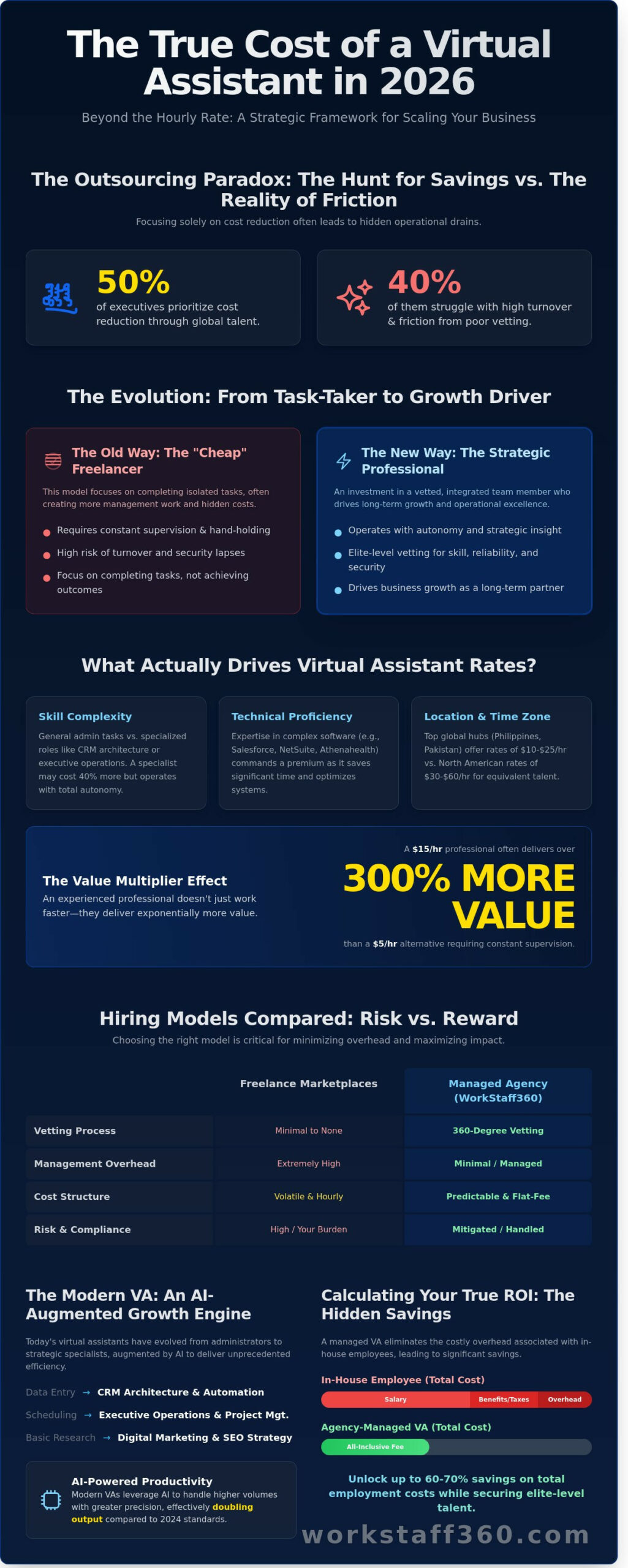
Comparison: Agency-Managed vs. Freelance Marketplaces vs. Direct Hiring
The staffing model you choose dictates your long-term virtual assistant cost and your business’s ability to scale. Freelance marketplaces offer the lowest initial price point, yet they often come with a heavy management tax. You spend your own hours acting as a recruiter, project manager, and technical support lead. Direct hiring offers more control over the culture, but it forces you to navigate the complexities of international labor laws, local tax compliance, and cross-border payroll systems. This model often requires legal counsel and specialized HR software, which adds thousands to your annual overhead.
WorkStaff360 provides a managed agency model designed for stability and professional rigor. We act as a strategic partner that absorbs the risks of global recruitment. Our “all-in” approach means you pay for a vetted professional who is ready to contribute from day one. You skip the trial-and-error phase that defines most remote hiring experiences. By analyzing the risk-to-reward ratio, it becomes clear that agencies offer the highest level of predictability for growing firms.
The Hidden Costs of “Cheap” Freelancing
Low hourly rates on marketplaces often mask expensive operational leaks. Calculating the cost of your time spent hiring a virtual assistant without an agency reveals a significant investment. Data suggests business owners spend 40 to 60 hours sourcing, interviewing, and testing candidates before finding a viable match. If you value your time at $100 per hour, you’ve invested $6,000 before your assistant even opens their laptop.
The price of “ghosting” is another critical factor. When an unmanaged freelancer disappears, your projects stall and your recruitment cycle restarts from zero. This churn can cost a business up to 33% of the worker’s annual salary in lost productivity. Security also presents a hidden liability. Unmanaged remote access lacks the rigorous data protection protocols that agencies provide, potentially exposing your company to data breaches that cost an average of $4.45 million globally according to recent industry reports. Understanding the full implications of the freelance vs virtual assistant decision is essential before committing to a staffing model that could either accelerate or hinder your growth.
Why Agencies Provide the Best ROI for Scaling Businesses
Agencies offer a 360-degree support system that protects your capital. You benefit from a replacement guarantee, which ensures you never pay for recruitment twice. If a placement fails to meet expectations, the agency handles the transition and provides a new professional at no extra cost. This stability keeps your virtual assistant cost predictable and your projects on schedule.
Managed support shifts the leadership burden away from your desk. Having a dedicated account manager means you don’t spend your mornings troubleshooting technical issues or chasing deadlines. Agencies also front-load the costs of professional readiness. They invest in the infrastructure, continuous training, and high-speed hardware required for elite performance. This holistic approach ensures your staff isn’t just a remote worker, but a high-performing catalyst for your organization’s growth.
Calculating ROI: How a VA Saves You More Than Just Salary
Hiring local talent in 2026 remains a high-stakes financial commitment. A standard administrative role in the US or UK carries a base salary between $60,000 and $80,000. However, the sticker price is just the beginning. Once you factor in the “burdened cost” of payroll taxes, health insurance, and 401k contributions, that figure often climbs 30% higher. Contrast this with a total virtual assistant cost of $20,000 to $30,000 for a dedicated professional. This shift represents a fundamental change in how modern firms manage human capital.
The In-House vs. Virtual Cost-Benefit Analysis
The financial advantage of a virtual model extends far beyond the monthly paycheck. You eliminate the massive overhead associated with physical workspace, including desks, high-end hardware procurement, and utility costs. Businesses leveraging global talent pools typically realize a 70% average savings on total labor costs when comparing the all-in expense of a virtual professional to the burdened salary of a local hire. Consider these specific areas where costs disappear:
- Zero Payroll Taxes: Agency-managed VAs handle their own tax compliance and social contributions.
- No Equipment Stipends: Remote professionals provide their own updated hardware and high-speed internet.
- Reduced HR Friction: You bypass the traditional 42-day hiring cycle and the administrative weight of local labor law compliance.
Productivity gains also drive ROI. Research from Stanford University indicates that remote workers often show a 13% increase in performance due to fewer office distractions and a quieter working environment. When your team delivers more output per hour at a lower price point, your margins expand immediately.
Maximizing Value Through Proper Onboarding
High ROI depends on how quickly your new hire becomes effective. Efficiently onboarding a virtual assistant shortens the “time to value” from several weeks to just a few days. Structured training protocols and clear Standard Operating Procedures (SOPs) remove the expensive learning curve that often plagues new hires. When you provide a roadmap, your VA begins contributing to your bottom line almost immediately.
Calculate the gap between your billable rate and the virtual assistant cost. If you charge $250 per hour but spend five hours a week on data entry, you’re losing $1,250 in weekly revenue. Delegating these tasks to a VA for a fraction of that cost unlocks your potential to focus on high-level strategy and client acquisition. This 360-degree approach ensures your investment pays dividends through increased precision and faster project completion.
Scaling with WorkStaff360: High-Impact Talent, Predictable Pricing
Success in 2026 relies on operational stability rather than the hit-or-miss nature of freelance marketplaces. WorkStaff360 eliminates the friction of global staffing by removing the hidden expenses that often inflate your total virtual assistant cost. These costs are rarely found on a price tag; they include the 42 days the average company spends filling a position and the productivity gaps caused by high turnover. We provide a managed solution that replaces marketplace volatility with dedicated, long-term professionals who act as a strategic extension of your brand.
Modern businesses now prioritize retention over low-cost bidding wars. Our model ensures you aren’t just hiring a temporary freelancer but a committed team member invested in your long-term vision. We manage the administrative overhead, payroll complexities, and performance monitoring. For organizations that require on-site support in addition to virtual help, LetME serves as an excellent example of how mobile platforms can connect employers with quality-assured personnel in the service and retail sectors. This structure allows you to focus on high-level strategy while we handle the operational heavy lifting. You receive predictable pricing and elite talent without the traditional headaches of international recruitment or the risks of unvetted hires.
Our Dedicated Vetting and Matching Process
We save you over 100 hours of manual labor by filtering the top 3% of global talent through a rigorous 360-degree assessment. Our process goes beyond technical proficiency. We match candidates based on cultural alignment and work-ethic compatibility to ensure a seamless integration into your business ecosystem. As a Canadian-managed agency, we offer the security of North American professional standards alongside a vast global reach. This combination provides the reliability your executive team requires to scale with confidence, ensuring every hire is both a technical and a cultural win.
Start Your Growth Journey Today
Every business has unique demands, which is why we provide custom quotes tailored to your specific industry needs. We don’t believe in one-size-fits-all solutions. Instead, we focus on optimizing your virtual assistant cost by matching you with talent that delivers immediate ROI. Before committing to any staffing partner, reviewing a comprehensive virtual assistant services checklist can help you audit security protocols, verify specialized skill sets, and ensure seamless workflow integration. The first 30 days of our partnership are dedicated to setting a solid foundation, ensuring your new assistant is fully aligned with your specific goals and workflows. This period transforms a simple hire into a high-performing growth catalyst for your organization.
Secure Your Competitive Edge for 2026
Success in the coming years demands a transition from simple outsourcing to strategic talent integration. You’ve learned that the true virtual assistant cost involves more than a base rate; it encompasses the long-term ROI of high-level expertise and operational security. By 2026, businesses that bypass the risks of unvetted marketplaces will capture more market share through sheer efficiency. WorkStaff360 streamlines this evolution by connecting you with the top 3% of vetted talent, backed by a dedicated account manager who handles the heavy lifting of recruitment.
Choosing a partner with Canadian-managed security standards means your intellectual property remains safe while your team scales. Don’t settle for the friction of direct hiring when you can leverage a scientific matching process designed for elite performance. It’s time to reclaim your focus and lead your industry with a team that operates at your pace. Get a custom virtual staffing quote for your business today and start building your high-impact workforce. Your vision deserves the support of world-class professionals who are ready to grow alongside you.
Frequently Asked Questions
What is the average hourly rate for a virtual assistant in 2026?
The average hourly rate for a virtual assistant in 2026 ranges from $15 to $35 depending on the professional’s region and specific expertise. Offshore talent in Southeast Asia typically starts at $12 per hour, while specialized US-based professionals often command $50 or more. This virtual assistant cost reflects a global 4% annual increase in labor rates tracked since 2023. You gain access to premium skills while maintaining a lean, scalable budget.
Why do agency-managed VAs cost more than freelancers on Upwork?
Agency-managed VAs cost 20% to 40% more than freelancers because the price includes vetting, management, and operational security. You pay for a dedicated infrastructure that ensures your assistant is reliable and productive from the first hour. While a freelancer might offer a lower sticker price, the hidden cost of turnover and training often exceeds the agency premium. We eliminate those risks by providing a 360-degree support system for your business.
Are there hidden fees when hiring a virtual assistant through an agency?
Most reputable agencies charge an upfront recruitment fee ranging from $500 to $1,500 to cover intensive sourcing and vetting processes. You won’t find surprise charges for payroll processing or basic administrative oversight in a transparent service agreement. Always review contracts for “buy-out” clauses, which can cost 15% of the VA’s annual salary if you choose to hire them directly. Clear terms protect your investment and ensure a seamless partnership.
How much can I save by hiring a VA in the Philippines or Pakistan vs. the US?
Hiring a virtual assistant in the Philippines or Pakistan saves businesses between 60% and 80% compared to hiring a US-based equivalent. A full-time administrative role in the US averages $45,000 annually, whereas the same talent abroad costs approximately $12,000 to $18,000. These savings allow you to scale your team 3x faster without increasing your overhead. It’s a strategic move that boosts your bottom line and expands your leadership potential.
Does the cost of a virtual assistant include their equipment and software?
Your virtual assistant cost generally covers the individual’s hardware and high-speed internet, but specialized software licenses remain your responsibility. VAs provide their own workstations and standard communication tools like Slack or Zoom. If your workflow requires premium tools like Salesforce or Adobe Creative Cloud, you’ll need to provide a seat on your corporate plan. This ensures you maintain total control over your data and proprietary systems.
Is it cheaper to hire a part-time or full-time virtual assistant?
Full-time virtual assistants are more cost-effective because they offer a lower hourly rate compared to part-time or project-based contracts. Agencies often provide a 10% discount for 40-hour weekly commitments to incentivize long-term stability. Part-time roles carry a premium because the VA must balance multiple clients to remain profitable. Choosing a full-time dedicated partner ensures your business remains their primary focus and accelerates your growth trajectory.
How do specialized VA costs (like Real Estate or Healthcare) compare to general admin?
Specialized VAs in fields like Real Estate or Healthcare cost 30% to 50% more than general administrative assistants. While a general VA handles basic emails for $15 per hour, a specialized professional with HIPAA training or MLS experience commands $25 or more. This investment pays off through reduced training time and higher accuracy in industry-specific tasks. You get expert-level execution that drives measurable results in competitive niche markets.
What happens if the VA I hire is not a good fit?
If a VA isn’t a good fit, a professional agency provides a replacement at no additional cost within the first 30 days. We manage the entire transition to ensure your operations don’t skip a beat during the handoff. This safety net removes the stress of hiring and protects your valuable time. You get a committed partner who prioritizes your long-term success over a quick placement, ensuring every hire is a growth catalyst.