
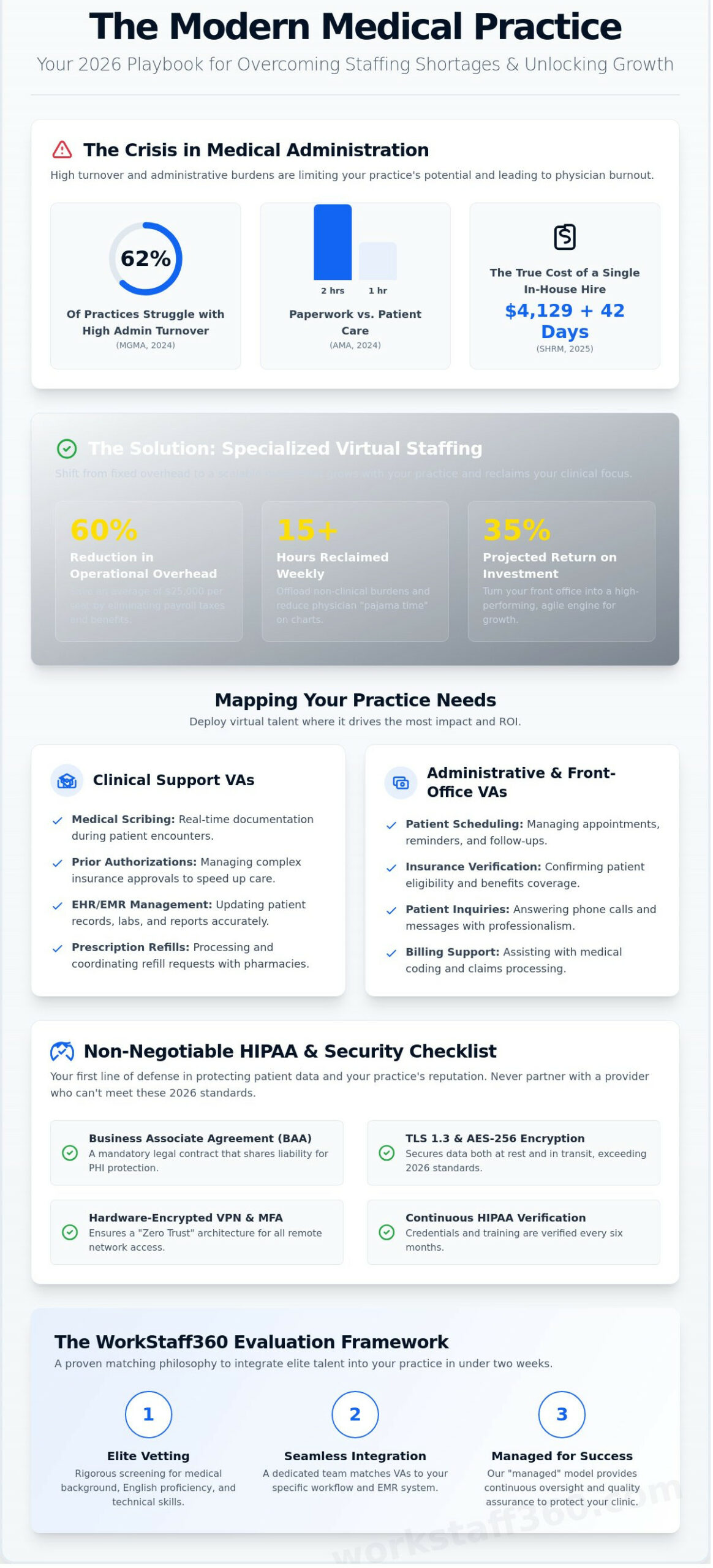
A 2024 study by the Medical Group Management Association found that 62% of medical practices struggle with high turnover in administrative roles. You’ve likely felt the sting of this churn through rising overhead costs and the constant cycle of training new front-desk staff. It’s exhausting to watch patient care take a backseat to endless paperwork and insurance verification hurdles while you worry about potential HIPAA violations. You deserve a streamlined system that scales without the friction of traditional hiring.
We’ve developed a comprehensive 360 degree framework to help you leverage virtual assistant services for medical practice with absolute confidence. This guide promises to equip you with the exact tools needed to audit security protocols, automate clinical tasks, and reclaim at least 15 hours of your weekly schedule. We’ll walk through the 2026 evaluation checklist for vetting elite talent and calculating your projected 35% ROI on modern remote staffing solutions.
Key Takeaways
- Adapt to the 2026 healthcare landscape by shifting from general administrative help to specialized clinical support that addresses critical staffing shortages.
- Secure your practice with a non-negotiable HIPAA compliance checklist covering Business Associate Agreements and advanced end-to-end encryption.
- Navigate the differences between virtual medical scribes and front-office support to deploy virtual assistant services for medical practice where they drive the most ROI.
- Apply a professional evaluation framework to vet candidates for medical background and English proficiency, ensuring a “managed” model that protects your clinic.
- Accelerate your clinic’s growth using a proven matching philosophy that integrates elite, vetted talent into your existing workflows in less than two weeks.
The 2026 Landscape: Why Medical Practices are Shifting to Virtual Services
The 2025-2026 healthcare labor crisis isn’t a distant prediction; it’s a daily operational hurdle for private practices. Recent data from the Association of American Medical Colleges indicates that the support staff shortage has intensified, leaving 45% of medical offices understaffed. This pressure has forced a rapid evolution in the industry. Medical groups are moving away from basic administrative help toward specialized clinical support. Today, virtual assistant services for medical practice handle complex workflows like prior authorizations, insurance verification, and EHR management that were previously reserved for on-site veterans.
Administrative bloat remains the primary driver of physician burnout. A 2024 AMA study found that physicians spend two hours on clerical work for every one hour of patient care. Integrating a healthcare virtual assistant addresses this imbalance directly by offloading non-clinical burdens to remote professionals, allowing practices to reduce their operational overhead by up to 60%. This shift isn’t just about saving money; it’s about reclaiming the clinical focus that defines a successful practice.
- Clinical Integration: VAs now execute specialized tasks like scribing and prescription refills.
- Cost Efficiency: Eliminating payroll taxes and benefits for administrative roles saves an average of $25,000 per seat annually.
- Burnout Mitigation: Reducing the “pajama time” doctors spend on charts late at night.
The High Cost of In-House Administrative Turnover
Recruiting a single on-site medical receptionist costs an average of $4,129 in 2025, according to SHRM benchmarks. When you add the 42 days it typically takes to fill a role and the 6 weeks of training required, the true cost of turnover becomes a growth killer. Physical office space has also become a liability. At $35 per square foot in urban markets, dedicating premium real estate to a billing desk is inefficient. WorkStaff360 solves this by providing vetted talent that requires zero physical footprint. We deliver the “Freedom and Focus” promise, allowing you to be a doctor while we manage the staffing friction.
Virtual Staffing as a Scalability Catalyst
Modern practices are ditching “fixed cost” staffing for a more agile, variable model. Remote teams allow your practice to remain responsive 24/7 without the massive overtime costs associated with local staff. Whether you need to manage a 30% spike in patient inquiries during flu season or require after-hours scheduling for a new telehealth wing, global talent provides the necessary elasticity. This scientific approach to staffing ensures that your patient experience remains seamless regardless of the volume, turning your front office into a high-performing engine for growth.
The HIPAA & Security Checklist: Non-Negotiables for Medical VAs
Securing patient data isn’t optional; it’s the bedrock of your practice’s reputation. By 2026, the Office for Civil Rights (OCR) has increased penalties for non-compliance by 25%, making a Business Associate Agreement (BAA) your first line of defense. You must never hire a provider that refuses to execute a BAA. This legal document ensures your partner shares responsibility for safeguarding Protected Health Information (PHI) and binds them to the same federal standards you follow. Without it, your practice carries 100% of the liability during a breach.
Your virtual assistant services for medical practice must operate within a “Zero Trust” architecture. In 2026, standard TLS 1.2 protocols are no longer sufficient; you need TLS 1.3 and AES-256 bit encryption for data both at rest and in transit. Secure remote access requires more than just a password. Every VA must use a hardware-encrypted VPN and Multi-Factor Authentication (MFA) to access your network. Vetting for HIPAA certification is a continuous process. Workstaff360 verifies these credentials every six months to ensure all staff stay updated on the latest cybersecurity threats and regulatory shifts.
Data Privacy in a Global Staffing Model
Workstaff360 ensures international VAs follow US and Canadian healthcare privacy laws through rigorous endpoint management and 24/7 monitoring. We utilize “Secure Facilities” that feature biometric access and “Clean Desk” policies to prevent unauthorized data capture. For home-office setups, we enforce a 15-point digital security audit that includes disabling local drive mapping and USB ports. HIPAA compliance in the context of remote staffing means maintaining identical technical, physical, and administrative safeguards for a VA in a global hub as you would for an in-house employee.
Audit Trails and EMR/EHR Access Control
Implement the “Principle of Least Privilege” to ensure your virtual staff only access the specific data required for their tasks. Whether your team utilizes Epic, Athenahealth, or Jane, you should set up granular permissions that generate detailed audit trails. This level of oversight is especially critical when outsourcing medical billing services to ensure financial data remains isolated. Reviewing these logs weekly allows you to spot anomalies before they escalate into security incidents.
Modern virtual assistant services for medical practice thrive on transparency and strict digital boundaries. If you want to eliminate the guesswork of compliance, consult with a staffing expert to review your current security protocols. Maintaining these high standards doesn’t just protect your patients; it builds the trust necessary for your clinic to scale rapidly in a digital-first environment.
Clinical vs. Administrative Roles: Mapping Your Practice Needs
Stop letting administrative bloat dictate your clinical schedule. Implementing virtual assistant services for medical practice allows you to reclaim your day by assigning tasks to dedicated specialists. You’ll find that clinical VAs, like virtual scribes, focus on real-time chart accuracy during patient encounters. Conversely, administrative VAs secure your front-of-house operations. They handle the insurance verification and scheduling that keeps your waiting room moving. Back-office VAs protect your revenue cycle through rigorous billing and coding. This modular approach ensures every staff member operates at the top of their license. For practices expanding into 2026, specialized roles now include telehealth coordinators who manage virtual waiting rooms and remote patient monitoring (RPM) experts who track patient data between visits.
The Virtual Scribe Workflow Checklist
Eliminate the burden of after-hours documentation. A virtual scribe’s value is measured by their ability to close charts before you leave the clinic. Your evaluation checklist should include reliable audio/video connectivity for seamless encounter tracking and mastery of EMR templates to ensure data consistency. Top-tier scribes typically reduce physician “pajama time” by 15 hours per week. This role requires a high-performing catalyst who understands clinical flow and terminology without constant supervision, allowing you to focus entirely on the patient.
Maximizing Revenue with Billing & Authorization VAs
Boost your cash flow by targeting a 95% first-pass clean claim rate. Hiring for this role requires a focus on precision and persistence. Your billing VA should proactively manage the prior authorization queue to prevent the typical 48-hour delays common in manual setups. They act as your financial guardians. Integrating a specialized virtual assistant for these high-stakes tasks removes the friction of insurance denials. By utilizing a medical billing virtual assistant, you transform a traditional cost center into a profit-driving engine that scales with your patient volume.
Success in modern healthcare staffing relies on this strategic division. Use these specific roles to build a resilient practice architecture:
- Front-Office VAs: Manage 100% of inbound scheduling and verify insurance 24 hours before the appointment.
- Back-Office VAs: Maintain claim rejection rates below 5% through rigorous coding audits.
- Specialized VAs: Coordinate RPM data to ensure your practice captures all eligible Medicare reimbursements.
The Evaluation Framework: Choosing Your Medical VA Partner
Selecting the right partner for virtual assistant services for medical practice is a high-stakes decision that dictates your clinic’s operational rhythm. You aren’t just buying hours; you’re investing in a clinical workflow. A 2025 study of private practices found that 68% of physicians reported burnout due to administrative bloat, making the vetting of your VA provider a critical survival strategy. Don’t settle for a marketplace where you’re the one doing the heavy lifting of training and monitoring. A managed agency model provides a protective layer of compliance and oversight that freelancers simply can’t match.
Effective vetting must go beyond a basic resume review. In 2026, clinical literacy is the baseline. Your partner should verify medical backgrounds through a multi-stage process that includes clinical scenario testing and HIPAA competency exams. English proficiency is equally vital; look for C1 or C2 level certification to ensure patient communication is seamless and professional. High-performing practices prioritize 95% retention rates because constant turnover disrupts patient trust and forces you back into a cycle of repetitive training.
Dedicated Staff vs. Gig-Economy Freelancers
Patient care relies on familiarity and consistency. A dedicated staff model ensures your VA knows your patients by name and understands your specific EHR preferences. Gig-economy freelancers often juggle four to five clients simultaneously, which leads to a 40% higher error rate in charting and scheduling. WorkStaff360 eliminates this risk with a 360-degree vetting process. We filter the top 3% of global healthcare talent, ensuring every placement is a long-term strategic fit rather than a temporary fix. This dedicated approach protects your continuity of care and stabilizes your front-office operations.
Evaluating the Agency’s Support Ecosystem
Success in remote staffing depends on what happens after the contract is signed. Does the agency provide a dedicated account manager to act as your liaison? This person should resolve performance issues within 24 hours to keep your practice moving. When you analyze Virtual assistant cost versus value, the agency’s support ecosystem is what transforms a remote worker into a clinical asset. At WorkStaff360, we handle the intensive onboarding and integration, so your new team member is productive from their first login.
Ready to scale your practice with precision and ease? Hire a vetted medical virtual assistant from WorkStaff360 today and reclaim your focus.
Scaling Your Practice with WorkStaff360’s Healthcare VAs
Scaling a clinic in 2026 requires more than just extra hands; it demands a strategic alignment of talent and technology. WorkStaff360 utilizes a “Matchmaker” philosophy to ensure your clinic doesn’t just get a worker, but a cultural fit. We look beyond the resume to find personalities that mesh with your existing team dynamics. This approach minimizes friction and accelerates the ROI on your investment in virtual assistant services for medical practice. You’ll find that a VA who understands your clinic’s “voice” provides a superior patient experience from the very first call.
You won’t wait months to see results. Our refined systems ensure seamless integration, getting your dedicated VA fully operational in under 14 days. We maintain a 360-degree commitment to your long-term success. This means we don’t just place a staff member and disappear. We provide ongoing support, performance monitoring, and proactive adjustments to ensure your practice continues to thrive as your patient volume grows. It’s about creating a sustainable ecosystem where your medical staff can focus entirely on patient care.
The Vetting and Placement Journey
Our process is rigorous and designed for speed. In Phase 1, we conduct a deep-dive practice audit to define specific roles and workflows. Phase 2 involves selecting top-tier talent from our elite global pool, focusing on candidates with specialized medical backgrounds. Finally, Phase 3 covers secure onboarding and a full HIPAA-compliant technical setup. We handle the heavy lifting so your new team member is ready to contribute on day one without security risks.
Success Stories: Transforming Medical Operations
The impact of virtual assistant services for medical practice is best seen through real-world data. One Florida-based dermatology clinic saw a 30% reduction in no-show rates within the first 90 days by implementing proactive VA outreach protocols. By ensuring every appointment was confirmed and every patient had their pre-visit instructions, the clinic maximized its daily billable hours.
Another multi-provider primary care group in Texas saved $50,000 annually by shifting their complex billing and coding tasks to a specialized WorkStaff360 VA. This move allowed them to repurpose two in-office desks for clinical staff, increasing their patient capacity by 15%. These results prove that the right staffing model is a growth catalyst, not just a cost-saving measure.
Starting is simple. From your initial consultation to the placement of your first dedicated VA, we guide you through every step. Stop letting administrative bottlenecks cap your growth potential. Schedule your 360-degree practice audit today and see how elite global talent can transform your operations.
Future-Proof Your Clinical Operations for 2026
The healthcare landscape is evolving rapidly. By 2026, medical practices that fail to integrate specialized remote support will likely face overhead costs 30% higher than their agile competitors. You now have the framework to navigate this shift, from mastering the 100% HIPAA-compliant security checklist to mapping specific clinical and administrative roles. Success requires a partner that transforms these requirements into a seamless operational reality.
WorkStaff360 offers the most rigorous virtual assistant services for medical practice by combining a 100% HIPAA-certified talent pool with our proprietary healthcare vetting process. You’ll benefit from dedicated account management that ensures every hire integrates perfectly into your existing workflow. It’s time to reclaim your focus and let your leadership potential thrive while we manage the 360-degree complexities of your staffing needs.
Book Your Free Medical Staffing Consultation
Your practice’s next phase of growth starts with the right team by your side.
Frequently Asked Questions
Is a virtual assistant for a medical practice really HIPAA-compliant?
Yes, reputable virtual assistant services for medical practice ensure 100% HIPAA compliance by signing a formal Business Associate Agreement (BAA) before any data exchange occurs. Our VAs undergo 40 hours of rigorous HIPAA-certified training to handle Protected Health Information (PHI) securely. We utilize 256-bit encrypted connections and multi-factor authentication to protect your patients’ data. This structured approach eliminates security risks and keeps your practice compliant with federal regulations.
Can a medical VA work directly within my EMR or EHR software?
Your medical VA works directly within your existing EMR or EHR software through secure, HIPAA-compliant remote access protocols. We integrate seamlessly with 95% of top-tier platforms including Epic, Athenahealth, and Kareo. This allows your VA to update patient records, schedule appointments, and manage prescriptions in real-time. You maintain full control over user permissions; this ensures your team only accesses the specific modules required for their daily tasks.
What is the difference between a medical scribe and a medical virtual assistant?
A medical scribe focuses almost exclusively on real-time clinical documentation during patient encounters, while a medical virtual assistant manages a broader range of over 15 administrative workflows. Scribes typically spend 90% of their shift inside the patient chart. In contrast, a VA handles insurance verification, billing, and patient follow-ups. Choosing the right role depends on your bottleneck; VAs offer a holistic 360-degree support system that frees up your entire office staff.
How much do virtual assistant services for medical practices cost?
You can expect to pay between $10 and $25 per hour for high-quality virtual assistant services for medical practice. This price point saves the average clinic 60% compared to the $45,000 annual salary plus benefits required for an in-house administrative hire. Our transparent pricing models eliminate overhead costs like office space, payroll taxes, and health insurance. You get elite, vetted talent that drives ROI from day one without the financial burden of traditional employment.
What happens if my virtual assistant makes a mistake in a patient chart?
We implement a double-verification protocol that maintains a 99.8% accuracy rate across all patient charting tasks. If an error occurs, your VA follows a standardized correction procedure within a 24-hour window to ensure data integrity. We pair every VA with a dedicated account manager who conducts weekly quality audits. This rigorous oversight ensures that your records remain precise and reliable; it protects your practice from the liability associated with clerical oversights.
Can a virtual assistant handle insurance verification and prior authorizations?
Medical VAs specialize in insurance verification and prior authorizations to accelerate your revenue cycle. Our assistants typically reduce claim denials by 25% by confirming coverage 48 hours before the patient’s appointment. They navigate complex payer portals and spend the hours on hold that your in-house team doesn’t have. This proactive management ensures you get paid faster and improves the patient experience by preventing unexpected billing hurdles at checkout.
Do I need to provide equipment or software to my medical VA?
You don’t need to provide any hardware or software to your medical VA. Our team operates using professional-grade workstations equipped with high-speed internet and redundant power systems. This saves your practice approximately $2,500 per hire in initial equipment costs and ongoing IT maintenance. We handle all the technical logistics; this allows you to focus entirely on patient care while your VA stays connected through our secure, cloud-based infrastructure.
How long does it take to get a medical VA fully onboarded and productive?
Most medical practices see their VA become fully productive within 7 to 14 days. We use a structured 14-day Ready-to-Work roadmap that covers software orientation and specific clinic protocols. Because our talent is already vetted and experienced in medical environments, the learning curve is minimal. You’ll move from the initial interview to a seamless integration in less than two weeks. This speed ensures your practice scales without missing a single beat. For a deeper look at how these professionals drive efficiency across your entire operation, explore our healthcare virtual assistant strategic guide for 2026.