
What if your constant search for specialized experts is the exact bottleneck preventing your company from hitting its 2026 revenue targets? You’ve likely experienced the fatigue of recruiting a new specialist for every minor task, only to face inconsistent quality or a sudden lack of continuity when that worker moves on. It’s a common friction point for the 73% of organizations that, according to the 2024 Deloitte Global Human Capital Trends report, struggle with effective workforce integration. You need a solution that protects your bottom line while providing the elite support required to scale. Understanding the nuances of freelance vs virtual assistant models is the first step toward reclaiming your time.
This strategic guide clarifies these two distinct paths to help you identify which model offers the most seamless integration for your specific workflow. We’ll show you how to move past the hire and hope phase into a structured system of vetted talent and dedicated support. You’ll discover the fundamental differences in these roles and learn how to implement a 360-degree staffing strategy that ensures your sensitive data remains secure while your leadership potential is finally unlocked. By the end of this article, you’ll have a clear roadmap for building a resilient, remote team that drives measurable growth.
Key Takeaways
- Distinguish between project-based specialists and ongoing support partners to align your hiring strategy with 2026 growth targets.
- Master a high-precision decision framework for the freelance vs virtual assistant model to optimize for task frequency and complexity.
- Protect your bottom line by identifying hidden recruitment costs and the long-term security benefits of a dedicated staffing structure.
- Eliminate operational bottlenecks and the “single point of failure” risk by leveraging a holistic, agency-backed support system.
- Reclaim your strategic focus by delegating dynamic day-to-day management to vetted talent designed for seamless business integration.
Freelancer vs. Virtual Assistant: Defining the Remote Landscape in 2026
Scale your business with precision by understanding the core differences in remote talent. In 2026, remote work accounts for approximately 32% of the global knowledge workforce, according to recent labor market projections. This shift has transformed outsourcing from a simple cost-saving measure into a sophisticated ecosystem of specialized contributors. Choosing between a freelance vs virtual assistant depends entirely on your specific objective: do you need a temporary architect or a permanent engine room?
A freelancer acts as a specialist hired for a specific deliverable or a finite, time-bound project. They arrive with a targeted set of skills to solve a singular problem. Conversely, a Virtual assistant provides ongoing administrative, technical, or creative support to maintain business momentum. While both operate as independent contractors, their engagement models differ drastically. One is a tactical strike; the other is a long-term alliance. Distinguishing between these two is vital for your 2026 growth strategy. Misallocating resources here creates friction, while the right choice ensures seamless integration and rapid scalability.
Your resource allocation strategy must prioritize the nature of the work over the job title. If you fail to distinguish between project-based needs and operational needs, you risk overpaying for routine tasks or under-skilling critical projects. Workstaff360 focuses on this distinction to provide vetted talent that aligns with your specific organizational goals, ensuring your staffing moves are both scientific and personalized.
The Freelance Specialist Model
Hiring a freelancer gives you access to high-level, niche skills without the overhead of a full-time executive. You might hire a freelancer for web development during a site relaunch or brand identity design for a new product line. This model is transactional. The relationship ends when the project is delivered. It’s the ideal choice for “one and done” tasks that don’t require deep institutional knowledge or daily participation in your company culture. You pay for the result, not the process. This allows for total flexibility, letting you pivot your strategy without the burden of long-term commitments.
The Virtual Assistant Partnership Model
Focus on business continuity and managing recurring workflows by choosing the partnership model. This approach is relational, meaning the VA becomes an extension of your internal team. They learn your preferences, master your specific software stacks, and anticipate needs before they become bottlenecks. A virtual assistant is a strategic partner in business growth. This 360-degree approach ensures your operations remain disciplined and efficient. By offloading the routine, you unlock your own leadership potential and gain the freedom to focus on high-impact decisions that drive revenue.
The Project vs. Partnership Paradigm: Core Operational Differences
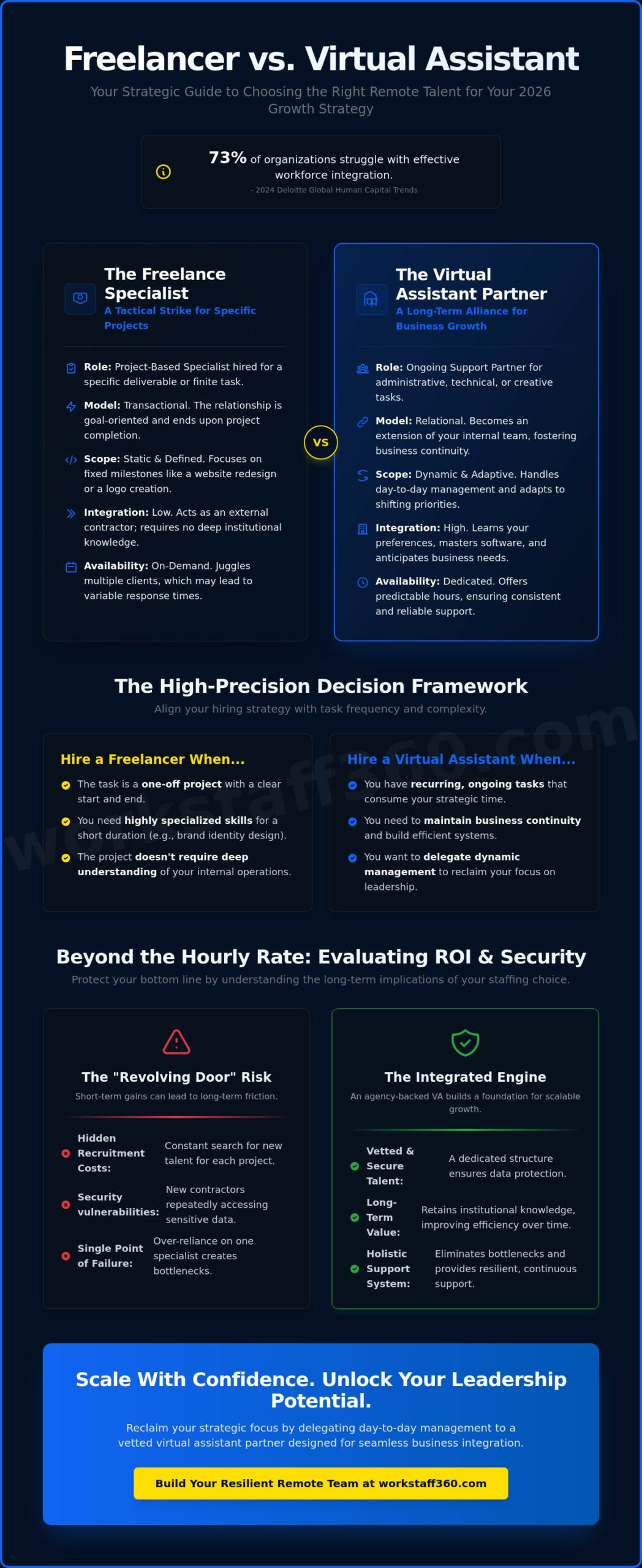
Choosing between a freelance vs virtual assistant model isn’t just a budget decision; it’s a strategic choice about how your business breathes. Freelancers are specialized “fixers” who arrive to solve a specific problem and depart once the milestone is met. In contrast, a Virtual Assistant (VA) acts as a growth partner, integrating into your daily operations to maintain momentum. This distinction dictates whether you’re managing tasks or building a scalable engine.
- Scope of Work: Freelancers focus on static project milestones, such as a website redesign or a single marketing campaign. VAs handle dynamic day-to-day management, adapting to your shifting priorities in real time.
- Training Requirements: You provide a freelancer with a brief. You provide a VA with an onboarding framework. The former expects you to have the answers; the latter helps you build the systems.
- Availability: Freelancers are often on-demand and juggle multiple clients, leading to potential delays during their peak periods. VAs offer dedicated, predictable hours, ensuring they’re available when your business needs them most.
- Role Evolution: Freelancers typically stay in their specific lane to maintain efficiency. VAs grow with your business, taking on more complex responsibilities as they understand your long-term vision.
Workflow Integration and Institutional Knowledge
VAs excel at absorbing the nuances of your business, from your specific CRM workflows to your unique brand voice. They don’t just execute tasks; they refine the process. This prevents the “Brain Drain” risk common in freelance relationships, where vital knowledge about your preferences disappears the moment a project ends. A dedicated VA contributes directly to building your company’s Standard Operating Procedures (SOPs). By documenting these processes, they ensure your business remains functional and resilient, regardless of individual personnel changes. Explore how Workstaff360 simplifies this integration by providing talent trained to prioritize your institutional growth.
Reliability and Long-Term Scalability
The “Freelance Merry-go-round” is a significant drain on executive energy. Research from the Society for Human Resource Management indicates that hiring a new team member can take up to 42 days on average, a cycle you don’t want to repeat every time a project ends. A dedicated VA model eliminates this friction through predictability in billing and scheduling. You gain a reliable asset who understands your long-term goals. To maximize this relationship, focus on onboarding your new VA using a structured success framework. This initial investment transforms a remote worker into a core pillar of your scaling strategy, allowing you to focus on high-level leadership rather than administrative minutiae.
The Decision Framework: When to Hire a Freelancer vs. a Virtual Assistant
Choosing between a freelance vs virtual assistant requires a cold, hard look at your operational friction. You don’t just need a body in a seat; you need a strategic asset that fits your 2026 growth trajectory. Our 360-degree approach to staffing ensures you don’t just fill a gap, but optimize your entire business ecosystem. This decision hinges on four critical pillars: frequency, complexity, management, and longevity.
Start by assessing task frequency. If you’re tackling a quarterly project, like a 50-page annual report or a brand refresh, you’re looking for a specialist. If you’re facing a daily pain point, like a flooded inbox that grows by 30 messages every hour, you need a partner. Next, evaluate complexity. Deep specialists solve specific technical hurdles. Versatile generalists manage the ecosystem around those hurdles. Ask yourself if you want to manage the person or the project. Hiring a freelancer means you’re buying an outcome; hiring a VA means you’re building a process. Finally, consider the future. A 2025 industry report showed that 62% of scaling firms regret hiring short-term contractors for roles that eventually became permanent needs. Don’t pay for the same onboarding twice.
Hire a Freelancer When…
- You need a specific technical outcome. This includes high-stakes, one-off tasks like a website migration, a custom API integration, or drafting a complex legal contract.
- The task is highly specialized and won’t recur for at least a year. If you only need a 3D product render once for a launch, a freelancer is the surgical, cost-effective choice.
- You have a clearly defined “Definition of Done.” When the project requires zero ongoing maintenance or iterative updates, the freelance model offers the cleanest exit strategy.
Hire a Virtual Assistant When…
You’re drowning in “admin debt.” This looks like missed meetings, unsorted data entry, and a calendar that looks like a Tetris game gone wrong. A VA doesn’t just clear the deck; they keep it clear. You should also look for a specialized virtual assistant for recurring industry roles. In real estate, for example, a VA can manage lead intake 24/7. This typically boosts conversion rates by 22% compared to solo management. Hire a VA when your goal is to delegate entire processes. You aren’t just handing off a task; you’re offloading the mental load of ensuring that process survives the week. This shift allows you to reclaim up to 15 hours of your peak creative time every single month.
Beyond the Hourly Rate: Evaluating Long-Term ROI and Business Security
Choosing between a freelance vs virtual assistant often starts with a simple price comparison, but the true impact on your bottom line lies in operational stability. Freelancers often operate on a project-to-project basis, which introduces a high risk of “ghosting.” According to a 2024 survey by the Freelancers Union, 30% of independent contractors juggle more than three clients simultaneously, often leading to divided focus or sudden departures. Every time a freelancer leaves your ecosystem, you lose approximately 33% of their annual salary in recruiting, interviewing, and re-training costs. These hidden expenses erode your margins and stall your momentum.
Eliminate the friction of the open market by opting for a dedicated partnership. A professional virtual assistant integrates into your business for the long haul, absorbing your brand voice and standard operating procedures. This continuity prevents the “knowledge drain” that occurs when a transient freelancer moves on to a higher-paying gig. By investing in a vetted professional, you secure a reliable teammate who is motivated by your growth rather than just the next invoice.
Data Security and Professional Vetting
Security is the silent killer of scaling businesses. While transient freelancers might use unsecured personal networks or shared devices, a dedicated VA sourced through an agency operates under strict security protocols. Agencies conduct rigorous background checks and ensure HIPAA or GDPR compliance, protecting your sensitive intellectual property from the start. Managing access becomes simpler when you have a long-term partner who uses encrypted password managers like LastPass or Dashlane to handle client information safely. This professional alignment reduces the 43% of cyberattacks that specifically target small businesses with weak internal controls. Dedicated professionals are far more likely to adhere to strict security protocols because their career longevity depends on their reputation for integrity and precision. Before committing to any provider, use a comprehensive virtual assistant services checklist to audit security protocols and verify that your chosen partner meets the compliance standards your business requires.
Calculating the True Cost of Hiring
Analyze the virtual assistant cost compared to the erratic rates of top-tier freelancers. Freelancers often charge a premium for their flexibility, but you pay a hidden tax in “Management Overhead.” This overhead represents the time you spend explaining tasks, chasing deadlines, and correcting errors. If you spend 5 hours a week managing a freelancer’s workflow, you’re losing 20 hours a month of high-level leadership time. For a founder whose time is worth $250 per hour, that’s $5,000 in lost revenue potential every single month.
ROI is the value of the time a leader regains for high-level strategy. When you delegate 10 hours of administrative or technical tasks to a VA, you aren’t just saving money on labor; you’re creating a $2,500 revenue window to close new deals or develop new products. Workstaff360 focuses on this holistic 360-degree view of your business, ensuring that your staffing choices act as a catalyst for expansion rather than a drain on your energy. This strategic shift transforms your remote staff from a line-item expense into a high-yield asset.
Stop wasting your peak creative hours on administrative friction. Scale your business with a vetted partner today and reclaim your focus.
Scaling with Confidence: Why a Dedicated VA Agency Outperforms the Freelance Market
Scaling isn’t just about adding more hands; it’s about building a resilient infrastructure. When evaluating the freelance vs virtual assistant landscape, many business owners realize that individual contractors often represent a single point of failure. If a freelancer falls ill or takes a vacation, your operations halt. A dedicated agency model eliminates this friction by providing a 360-degree support system. We handle the heavy lifting of recruitment, background checks, and payroll, ensuring your business maintains 100% uptime regardless of individual circumstances.
Choosing between the freelance vs virtual assistant route often comes down to how much risk you’re willing to manage alone. WorkStaff360 bridges the gap between the commitment of a full-time employee and the cost-effectiveness of a contractor. This hybrid approach offers the stability your brand needs to grow without the overhead of traditional hiring. You gain a partner who is deeply invested in your long-term success, not just someone looking for their next gig.
- Recruitment Redundancy: We maintain a bench of talent to ensure your business never skips a beat.
- Operational Oversight: Our team manages the administrative burden so you don’t have to.
- Quality Assurance: Continuous monitoring ensures that performance remains at an elite level.
The WorkStaff360 Advantage
Our recruitment process is scientific and rigorous. We source, test, and vet the top 1% of global remote talent to ensure every placement meets elite standards. Whether you need a specialized healthcare virtual assistant to manage patient scheduling or a real estate professional to handle lead generation, we match you with an expert who understands your industry’s specific nuances. We focus on long-term placements because we know that institutional knowledge is a competitive advantage.
Your Path to Strategic Growth
The first 30 days with your dedicated professional focus on integration and workflow optimization. You’ll move from being a “Task Master” who micromanages every detail to a “Visionary Leader” who focuses on high-level strategy. Research from the Harvard Business Review suggests that leaders who delegate effectively can generate 33% more revenue than those who don’t. By offloading administrative burdens, you reclaim the mental bandwidth required to innovate and scale.
Future-Proof Your Operations With Strategic Remote Partnerships
Choosing between a freelance vs virtual assistant setup defines how your business handles the complex demands of 2026. Freelancers are excellent for isolated, one-off tasks, but they don’t offer the deep operational integration required for sustainable growth. To scale effectively, you need a partnership built on reliability and specialized expertise rather than a revolving door of contractors. WorkStaff360 streamlines this transition by connecting you with vetted top 1% global talent. Whether you need specialized support in real estate or healthcare, our model focuses on dedicated long-term placements that go beyond simple task management. You’ll benefit from agency-backed support that maintains high performance standards and protects your business security. It’s time to stop managing individual projects and start building a cohesive team that grows with you.
Scale your business with a dedicated, vetted Virtual Assistant from WorkStaff360.
You’ve built a strong foundation; now let’s unlock your full leadership potential together.
Frequently Asked Questions
Is a virtual assistant cheaper than a freelancer?
A virtual assistant typically costs less than a freelancer for long term operational support. Freelancers often charge 20% to 50% more per hour because they must cover their own project based overhead and marketing costs. VAs provide a consistent monthly rate that can reduce your total cost of ownership by up to 70% compared to local hires. This makes the freelance vs virtual assistant choice a matter of budget efficiency versus project specificity.
Can a virtual assistant do specialized tasks like graphic design or SEO?
Modern virtual assistants frequently specialize in technical domains like SEO or graphic design. At WorkStaff360, 85% of our talent pool possesses niche certifications in tools like Adobe Creative Suite or Google Search Console. These specialists provide the same high quality output as a freelancer but operate within your internal team structure. You gain specialized skills without the high friction of managing multiple independent contractors for every individual project.
How do I know if I need a dedicated VA or just a one-off freelancer?
Choose a dedicated VA if your tasks repeat more than 3 times per week. One-off freelancers excel at defined projects with a clear end date, such as a 5 page website build or a single logo design. If you need 10 to 40 hours of ongoing support for administrative or marketing tasks, a VA is the strategic choice. This decision determines your ability to scale without hitting operational bottlenecks during peak growth periods.
What are the biggest risks of hiring a freelancer for ongoing work?
Availability and lack of continuity represent the primary risks when you rely on freelancers for daily operations. A 2023 industry survey found that 40% of freelancers juggle more than five clients simultaneously, which often leads to missed deadlines. When evaluating freelance vs virtual assistant options, remember that VAs provide a dedicated presence. They integrate into your culture, ensuring your institutional knowledge stays within your company rather than walking away.
Do virtual assistants work full-time or part-time?
Virtual assistants offer flexible scheduling ranging from 20 to 40 hours per week. Most high growth companies opt for full-time VAs to ensure total alignment with their business hours and goals. This consistency allows the assistant to master your specific processes and software quickly. You can scale their hours as your workload increases, providing a seamless transition from a part-time support role to a full-time operational lead.
How does WorkStaff360 ensure the quality of their virtual assistants?
We employ a rigorous 5 stage vetting process that only 3% of applicants successfully complete. This system includes comprehensive background checks, English proficiency exams, and technical skills assessments tailored to modern business needs. Our 360 degree approach ensures that every candidate isn’t just a worker but a vetted talent ready for seamless integration. We monitor performance metrics during the first 90 days to guarantee the highest level of professional rigor.
Can I hire a virtual assistant for a specific industry like Real Estate or Healthcare?
You can certainly find VAs who specialize in highly regulated industries like Real Estate and Healthcare. These professionals understand specific compliance requirements like HIPAA or local property listing regulations. We match you with talent that has at least 2 years of direct experience in your specific sector. This specialized knowledge reduces training time and ensures your remote partner hits the ground running from day one.
What happens if my virtual assistant is not a good fit for my business?
We offer a rapid replacement guarantee to ensure your operations never skip a beat. If the initial match doesn’t meet your expectations within the first 30 days, our team identifies a new candidate at no additional cost to you. This commitment to your long term success removes the risk typically associated with global staffing. Our goal is to find the perfect human element that unlocks your creative and leadership potential.